The scientific significance of the only hurricane ever to directly hit NYC

This is a guest post from Bruce Parker, Visiting Professor, Center for Maritime Systems, Stevens Institute of Technology, and author of the recent book The Power of the Sea – Tsunamis, Storm Surges, Rogue Waves, and Our Quest to Predict Disasters.

The only hurricane in recorded history whose eye passed over New York City arrived there on the evening of September 3, 1821.  Its storm surge produced a 13-foot rise in water level in only an hour.  This surge flooded the lower end of Manhattan up to Canal Street, the waters of the Hudson and the East rivers essentially joining to cover the sidewalks of New York.  Ships were carried up onto the shore in many locations and numerous wharves were damaged.  The Battery was completely destroyed.  A few miles north the storm surge demolished a bridge that spanned the Harlem River from (what is now) East 114th Street to the northwest end of Ward’s Island.  Although there was a great deal of damage, New Yorkers were actually lucky, because the hurricane struck at low tide.  Even greater flooding and destruction would have occurred if the hurricane’s storm surge had arrived at high tide (which would have added another 5 feet of water).  Also, the hurricane was only a Category 2.  Two days earlier while to the east of Florida it had been a Category 5, but after passing over land several times its power was greatly reduced by the time it hit New York City.

This hurricane is actually more significant for another reason, for it played an important role in the first scientific understanding of what exactly a hurricane is.  The pattern of its destruction as it passed through Connecticut and Massachusetts stimulated William Redfield to grasp for the first time the rotary nature of a hurricane.  Redfield was a saddle maker turned steamboat captain and a self-taught amateur scientist.  About a month after the hurricane he was traveling with his son from their home in Middletown, Connecticut, to Stockbridge, Massachusetts, the home of the family of his wife, who had just died giving birth.  In spite of his great sadness (or perhaps because of it), as Redfield moved through the countryside he stared intently at the destruction that had been caused by the winds of the storm.  He noticed that all the “fruit trees, corn, etc were uniformly prostrated to the north-west” in Connecticut, but when he reached Massachusetts, he noticed that the trees and corn “were uniformly prostrated towards the south-east.”

Ten years later Redfield published a scientific paper in which he used this information (plus wind data he acquired from all over those two states as well from states along the Atlantic Coast) to demonstrate that “this storm was exhibited in the form of a great whirlwind.”  That paper thrust him into the scientific limelight and also into what was later called the “American storm controversy.”  This “controversy” was an ongoing debate that began when James Espy, a scientist at the Franklin Institute in Philadelphia, put forth a different theory on hurricanes, one that said the air does not rotate around a quiet center (the eye) but  instead that the air just rushes in from all directions directly toward a low-pressure center.  Espy’s theory built upon Benjamin Franklin’s suggestion a century before that a storm was a moving system of winds and that it moved in a direction that was not necessarily the same as the direction of the winds themselves. [He had explained this with an analogy of a chimney over a fire. “Immediately the air in the chimney, being rarified by the fire, rises; the air next to the chimney flows in to supply its place, moving towards the chimney; and, in consequence, the rest of the air successively, quite back to the door [the source of cold air from the outside].”  Franklin envisioned warm air rising over the Gulf of Mexico and cooler air from the northeast flowing in to replace it, this airflow beginning first near the Gulf, then extending a little farther away (for example, to Philadelphia), and then still farther away (for example, to Boston).]  Now Espy added to Franklin’s analogy of heated air moving up a chimney the important idea that the updraft in the center of a hurricane is stronger if the air is moist.  He used the concept of latent heat, which is the heat required to turn a liquid into gas (or the heat released when a gas condenses into liquid).  Espy realized that water vapor is lighter than dry air and that, as moist air rises and expands, the latent heat released as the water vapor condenses helps the convection to continue longer.  Thus, warm moist air contributes more to convection in a hurricane than does dry air, which is one reason hurricanes form over warm oceans.  This was an important contribution to meteorology, but unfortunately Espy got the wind direction wrong because he did not include the effect of the Earth’s rotation.

The debate became national, with scientists in New York supporting Redfield and scientists in Philadelphia supporting Espy. Then it became an international debate when scientists in England supported Redfield, but scientists in France supported Espy.  The issue was finally cleared up in 1856 in a paper by William Ferrel, who recognized that Redfield and Espy each had part of the answer (as so often happens).  It is the Earth’s rotation that is responsible for hurricanes having circular wind patterns, counterclockwise in the Northern Hemisphere and clockwise in the Southern Hemisphere.  A hurricane has a low-pressure center area and it is surrounded by higher pressure air masses.  At the low-pressure center the air is rising because of heat and moisture from the ocean, and air moves toward the center of the storm to replace it.  The air currents coming from the north, south, east, and west are all pushed toward the right (in the Northern Hemisphere) by the Coriolis effect (due to the rotation of the Earth).  These multiple pushes, however, drive the rotation around the low-pressure center in a counterclockwise direction, almost like small gears around one large gear in the middle, the large gear rotating in a direction opposite to the rotation of the small gears.  

For historical references see: The Power of the Sea – Tsunamis, Storm Surges, Rogue Waves, and Our Quest to Predict Disasters.”  The book includes many other stories of how scientists learned to predict storms and storm surges, and of their destructive and deadly impact throughout history.

[Note:  Proof that the 1821 hurricane was the only one to ever hit New York City directly was provided by a paleotempestology study in 2001.  The study found three significant overwash deposits in the New York City area, each caused by a very large storm surge. The middle sediment layer was from the storm surge produced by the 1821 hurricane.  The study shows that another hurricane crossed the New York City location, but long before there was a New York City, sometime between 1278 and 1438.  A third sediment layer, the uppermost and smallest layer, was from the storm surge caused by a northeaster in 1962.]
Posted in water, weather | Tagged , , , , , | 3 Comments

Which way would airborne toxic gases blow during a terrorist release?

In the event of a terrorist release of a harmful chemical, biological or radiological (CBR) agent as a weapon in an urban area, the motion of the gas and particles is unpredictable.  Factors that contribute to the complexity of the prediction problem include the corrugated building landscape, local surface heating (e.g., asphalt and building sides) and evolving meteorological conditions.  Much can be done to reduce this predictability gap.

Computer simulation of midtown NYC with ~6 m resolution showing contaminant dispersion from an instantaneous release in Times Square, New York City as predicted by the Naval Research Laboratory FAST3D-CT model. The frames show concentrations at 3, 5, 7, and 15 minutes after release. The simulation illustrates how a gas moves alongside a tall building, drawing the gas into higher, swifter air where it can rapidly materialize at distances downwind and impact the population many blocks away. (Courtesy of Jay Boris)

Downtown Manhattan remains a significant terrorist target

Almost ten years after 9/11, continued progress on the new WTC site heralds the revitalization of the downtown commercial and residential sectors.  In addition, leisure, tourist and commuter traffic is projected to soar with the transportation hub (Calatrava-designed PATH and subway station), 9/11 memorial and urban park collocated at the WTC site.  The NYPD is increasing its presence in the area by establishing a WTC post at the 9/11 memorial.  Over 600 officers will staff the command post.  With the Goldman Sachs headquarters now located across the street from the WTC site and other major financial entities housed in the adjacent World Financial Center, the threat profile of this section of the NYC continues to be raised.

Significant security concerns exist for both the WTC downtown area and the Wall Street area a few blocks away that contains the Federal Reserve and New York Stock Exchange. A network of surveillance cameras has been deployed as part of the Lower Manhattan Security Initiative.  And at the WTC site itself, NYPD Commissioner Ray Kelly noted that as part of the June 2010 World Trade Center Strategic Security Plan:

“…the Port Authority has agreed to integrate all of the security technologies deployed throughout the site (including more than 3,000 closed-circuit TV cameras) into the NYPD’s state-of-the art Coordination Center, where they can be monitored 24/7 by police personnel.”

Through the Department of Homeland Security (DHS) Securing the Cities program radiation detectors on NYPD and fire department boats and helicopters, along with chem/bio detectors, bridge the technology gap and facilitate detection.  But what happens if the terrorist, despite cameras and sensors, manages to commit an attack with a chemical/biological/radiological weapon? Can we effectively warn and evacuate the most severely impacted parts of the city?

A pressing need for airflow studies of downtown Manhattan

I was a principal investigator and member of the management team of the DHS Urban Dispersion Program.  By releasing harmless gas in midtown Manhattan in 2005 and tracking where it went, we were able to discern much about the patterns of transport in a complicated urban environment.  What we learned is nicely summarized here.  The upshot is that there is so much that we do not know about how airflow around particular buildings, changing surface heating conditions, and evolving meteorology conspire to drive the movement of a potentially harmful gas.

Also, different locations can have very different weather regimes, and thus have different air transport patterns.  Downtown Manhattan has a different “microclimate” than midtown Manhattan.  So although there are some basic principles that will apply at both sites, there are many surprises waiting for us.  For instance, the concentration of very tall buildings is much denser in lower Manhattan compared with midtown.  This could have a channeling effect on the gas, causing it to flow more quickly down the narrow, tall urban canyons.  In addition, downtown Manhattan is much more exposed to the river and ocean environment that often generates strong and fluctuating winds, such as sea breezes.

By conducting a field experiment in downtown Manhattan to release tracer gas in multiple locations at different times of the day and night and under different weather conditions, we can build a database of information.  This information would consist of not just the concentration of the gas at different locations, but also the air temperature and winds throughout the city.  Fortunately, as a legacy of the Urban Dispersion Program, we have a network of meteorological sensors that can be employed for this task.

We can then use this information to improve airflow models configured for local city areas, such as the one shown above.  And we can continue to make these models more sophisticated, such as linking them with a weather forecasting model, in order to enhance the realism of the predictions.  We need to be prepared with the detailed knowledge of how a CBR contaminant would move through the unique urban environment of downtown Manhattan.  And we need to be prepared in advance so we can save lives in the event of a terrorist CBR attack on lower Manhattan.

Posted in air pollution, security, weather | Tagged , , , , , , , | Comments Off on Which way would airborne toxic gases blow during a terrorist release?

Urban Oceanographer: Scuba Diving in Newark Bay

My good friend and colleague, Professor Richard (Dick) Hires loves ocean field work. It doesn’t matter what the weather or ocean conditions are, and it doesn’t matter what we’re doing. It’s always good, and always interesting to Dick. Which means it’s always good and always interesting to those of us who’ve accompanied Dick. One such time, back in the mid 90’s, always comes to mind when I try to explain to people why there really is nothing like ocean fieldwork in NY Harbor.

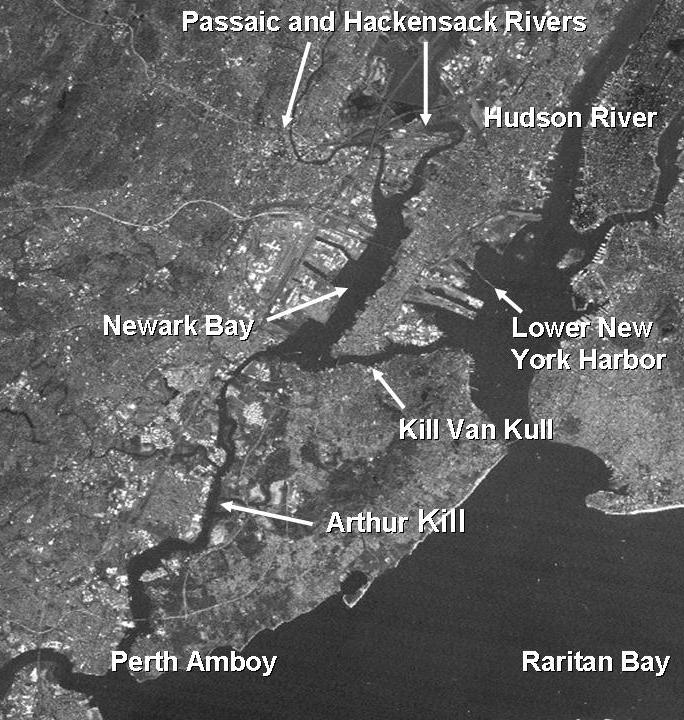
We begin with the age-old debate of when is a good time to throw away old, reliable instrumentation and adopt new technology. Although Stevens Institute had purchased acoustic and electro-magnetic current meters by this time, Professor Hires just couldn’t part with his trusty old Aanderaa recording current meter, which was probably close to 20 years old at the time. So, per Dick’s instructions, the team dutifully deployed the current meter at the center of Newark Bay, a primary water body that empties into the Upper New York Bay via the Kill van Kull and the Lower Bay via the Arthur Kill. Newark Bay is also home to much of Port Newark and Port Elizabeth, two of the busiest components of the Port of New York and New Jersey.

A week or so later, upon returning to the site of the current meter deployment, the acoustic release failed to activate the float (no surprise) and we were unable to retrieve the instrument.

At this point, rational minds play through a number of retrieval scenarios – all unlikely – and balance those scenarios with the value of the instrument – it should have been in a museum – and come up with the only logical conclusion: let’s go home to Hoboken and plan our next deployment.

Nope, Professor Hires and that Aanderaa were inseparable and so we headed home to make a plan to find the instrument, now moored somewhere on the bottom of the channel in Newark Bay.

It turned out, one of my graduate students at the time, Walter McKenna, was also a commercial diver, and a big fan of Professor Hires’. So Walter volunteered to make a surface-supplied air dive in the middle of Newark Bay to search for that beloved current meter.

A week later, the team went out, Walter donned his gear, and proceeded to walk along the bottom of Newark Bay, in zero visibility and difficult currents. But Walter wasn’t coming back up without that instrument, and so he proceeded to conduct an expanding square search pattern, with his eyes closed (to avoid vertigo as a result of the onrushing suspended sediment) and his hands held out in front of him. What he found first was a bit of a surprise.

Walter felt something solid, metallic. “Cool”, he thought, “I found it”. Until further tactile observation indicated that this wasn’t the current meter. It was a handle. In fact, it was the handle to a car door. And there was an entire car attached to it!  Right there, in the middle of Newark Bay, certainly more than a half mile from shore.

Undaunted, Walter made the logical decision to walk away from the car without further investigation. Within another 20 minutes, Walter ran into something else – the current meter. He proudly returned to a relieved crew and an ecstatic Professor Hires with the Aanderaa in his hands.

That Aanderaa is still resident in the Lab at Stevens. But its last adventure out in the water was that fateful day approximately 15 years ago when it shared a temporary address at the bottom of Newark Bay with a wayward automobile.

Posted in urbanoceanographer | Tagged , , , , , , , | 1 Comment

The Big Stink: II. Scents and the Weather

Weather conditions can promote or inhibit bad smells in an urban area.  Warm weather can increase bacterial decomposition of organic matter, which under certain conditions can produce sulfurous smells – this is why it often reeks when you walk past sidewalk garbage bags in summertime, yet you rarely notice these types of smells in winter.  An atmospheric inversion – meaning an absence of normal daytime vertical mixing of the atmosphere – can trap pollutants near the ground.  The conditions during New York City’s 2007 Big Stink episode that I wrote about last week fulfilled both these requirements.

Record-breaking warmth, then an atmospheric inversion

The temperature of 72 °F in Central Park on January 6th, 2007, broke the previous record for that day by an amazing 9 °F.  In our editorial, we explained how this event likely warmed polluted coastal marsh water and sediments, increasing bacterial respiration and sulfur emissions. It was a long duration of warmth – the temperature over the eight days leading up to the event averaged 51 °F, with an average daily high of 57 °F, an exceptionally warm weeklong period for January.

As shown above, a warm front was in the vicinity of Manhattan on Monday, January 8th, between 7 and 8 AM, as first explained by David Wally of the National Weather Service in Upton, NY.  This “warm front” was the ground-level intersection of the top of a northward-moving wedge of cold air. Within such a wedge, there are often inversion layers that can hold pollutants or other foul-smelling compounds close to the ground, by reducing vertical atmospheric mixing. Fog layers, often visible as you drive along a highway in the early morning, are small-scale inversion layers that are made visible due to the moist fog.  The weather system passed through the area by noon, strong winds blew from the west, and any foul smells were cleared out.

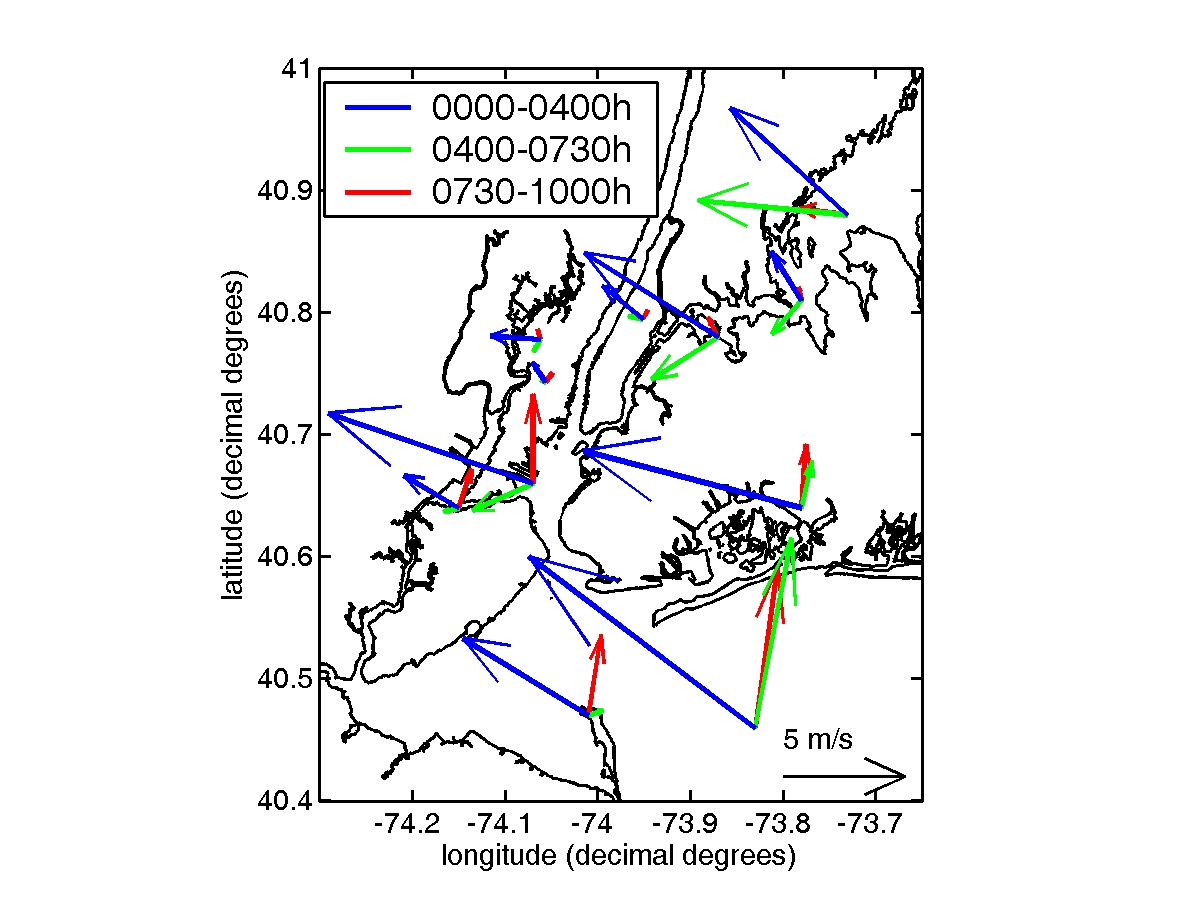
Wind vectors (arrows) above show the direction and speed (arrow length) of winds for three different time periods at several sites on the morning of January 8th, with the wind vector key at the bottom right (5 m/s is roughly equal to 10 mph).  The winds follow a clear pattern where winds blew from Brooklyn (including Jamaica Bay) toward Manhattan between 00:00 and 04:00 hours the night before the big stink.  Then, the winds from 4:00-7:30 AM is that the vectors (green) show a shifting wind pattern suggesting a passing warm front, with northeast winds in the top left and center of the map, and south winds to the lower right.

However, there are two reasons why this does not necessarily implicate Brooklyn as a source: (1) strong winds (~20 mph) are not consistent with a low-lying atmospheric inversion and concentrated stink plume, and would more likely mix up the lower atmosphere and disperse bad smells. (2) The complaint map I posted last week shows that the east side of Manhattan was lacking bad smells, further suggesting Brooklyn was not the source of the smells.

The stagnant or south winds from 7:30 to 10:00 AM from Staten Island and the Jersey Shore northward to Manhattan are more likely identifying sites that could have been the source of the stink.  This air would travel along the coastal corridor of salt marshes, from northern New Jersey to Staten Island, and could easily deliver foul smells from coastal marshes and the Fresh Kills former garbage disposal site.  Unfortunately, “source attribution”, in cases where winds are relatively light and variable, is a can of worms, and this is where my research on this topic ended.

I hope to take this question back up with high-resolution computer modeling of atmospheric flows around the New York City region, as part of my job as a post-doctoral research scientist at the Stevens Institute of Technology.

However, to the best of my knowledge, this cross-river whodunnit was never solved:  Was it New Jersey’s stink or New York’s?

Posted in air pollution, water, weather | Tagged , , , , , , , | Comments Off on The Big Stink: II. Scents and the Weather

The Big Stink: I. Scents and the City

Four years ago, on the morning of Monday, January 8th, 2007, a mysterious foul odor settled upon New York City and surrounding regions, causing confusion, consternation and even building evacuations in some cases.  Many were concerned it might be dangerous pollutants, or even possibly a terrorist attack.  Soon afterward, some colleagues and I published an editorial explaining a leading hypothesis for the event.  I later spent some time digging deeper, seeking to definitively solve the mystery.  Here, I’m posting a summary of what I learned, furthering the argument that local polluted waterways with low oxygen levels released sulfurous gases into the atmosphere, to be trapped by low-level atmospheric stratification (an “inversion”).  However, to my knowledge, there is still no conclusive proof of what really happened on that foul-smelling morning.

The olfactory old factory

A different smelly mystery in New York City was recently solved – specifically, the maple syrup smell that wafted over the city and neighboring regions multiple times over the past decade.  Due to the string of events in 2005-7, the city finally formed a crack maple-syrup team that was well-equipped and ready to collect air samples for laboratory analysis. Winds were coming from the west in each case, and the syrup smell was determined to be Fenugreek from a fragrance factory in North Bergen.

So why can’t someone solve the mystery of more severe episode that partially shut down the city, the Big Stink?

An unsolved cross-river whodunnit

Charles Sturcken, a spokesman for the city Department of Environmental Protection, said on January 9th, 2007, that his agency was “pretty sure” the source of the smell was along New Jersey’s industrialized waterfront, just across the Hudson River from New York.  Naturally, a few rounds of noxious finger-pointing ensued.  But what was his assertion based upon?

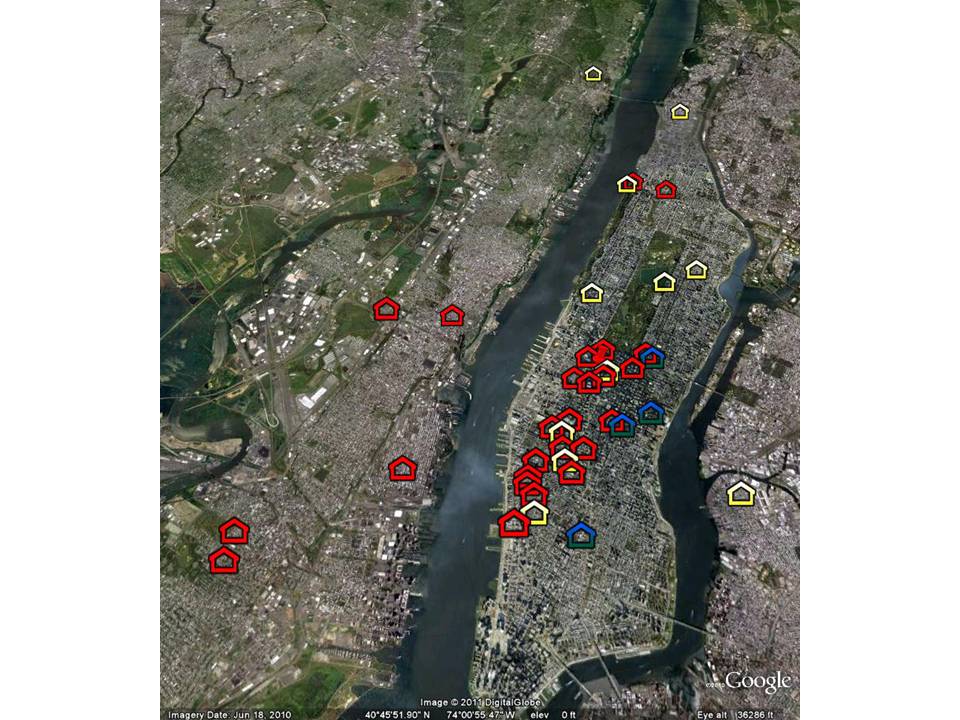
Ideally, one would seek out and map up the over 700 ConEd complaints about gas odors on that morning.  But there were also hundreds of online personal accounts – comments that were posted below news stories, mentioning specific locations (some of which are represented in the map below).  These “data” suggest that there were bad smells of one degree or another all along the urbanized coastal region from Delaware to Connecticut.  There were many people hospitalized in New Jersey across the river, as well as Manhattan, but no reports from Brooklyn.  The mapped comments make clear that the smell was bad in midtown Manhattan and across the river in areas like Jersey City and Hoboken, yet there was also a string of reports of no smell on the east side of Manhattan.

This map represents a portion of the online comment accounts to the east and west of the Hudson (center) for the time period January 8, 2007, 7:00 – 10:30am. These are divided into red for strong smell accounts (e.g. “strong”, “reeked”, “particularly rank” or building evacuations); yellow for moderate smell accounts or accounts with no description of intensity, and blue for no unusual smell.  The Stink doesn’t seem to have been related to the two famously foul-smelling sewage processing/treatment plants in Hunts Point, South Bronx, because the complaint map shows the East Side of Manhattan to have been relatively free of complaints.

In my next post, I’ll summarize the weather conditions surrounding the Big Stink — why warm weather may have caused the stink, why the atmosphere capped it, and why the wind patterns make it difficult to know from where it came.

Posted in air pollution, water, weather | Tagged , , , , | Comments Off on The Big Stink: I. Scents and the City

Urban Oceanographer: The Lights of Manhattan Island

All good sea stories should begin with “no shi#, there I was”. This is one of those. [censored to avoid continuing to get blocked by school obscenity filters …]

Back in the summer of 1994, Professor Tom Herrington and I were taking our small research vessel R/V Phoenix (26 foot, outboard) from Cape May back home to her berth in Jersey City. The trip turned out longer than we expected because of rough seas and we ended up navigating into New York Harbor in the dark. No GPS or electronic navigation back then; thank heavens for the Navesink Light and Ambrose Light.

As we made our way west and north via the Ambrose Channel, we were awed by the scale of everything around us. The commercial vessels soared like skyscrapers above Phoenix as the NYC skyline came into view in the distance. Our small boat had performed admirably on a long, uncomfortable ride along the entire New Jersey shoreline, and now seemed to struggle just to make way in the swift currents and opposing waves during a peak outgoing tide. Not to worry, we were less than an hour from home. Or so we thought.

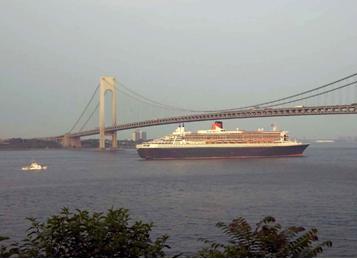
As we turned north in the channel and approached the Narrows – the straight that separates Staten Island from Brooklyn, and the Upper Bay from the Lower Bay, Tom and I marveled again at the scale of it all: the soaring cliffs on either side, the majestic Verrazano-Narrows Bridge (the longest suspension bridge in the world when it was completed in 1964), and of course the enormous cargo vessels to our south and our north.

Just then – no kidding, right underneath the bridge, in the area where the tidal currents are strongest – the Phoenix lunged to a halt. Before Tom and I could say a word, the boat turned broadside to the current and we began rocketing southward in the main channel with absolutely no steerage, and large ships all around us.

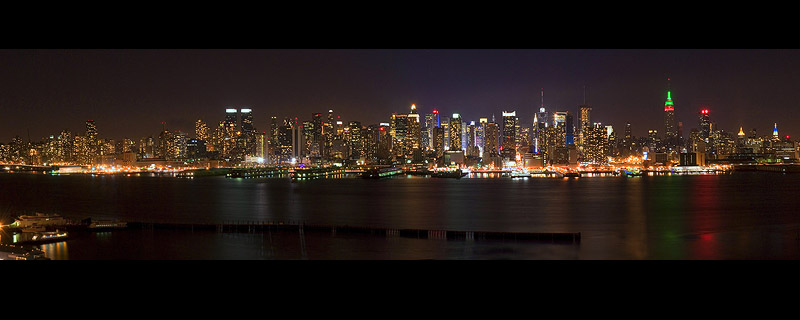
Without even a moment of debate, the two of us shouted the same conclusion – we’re out of gas! We each grabbed what was nearest – Tom the spare gas container that we always carried on board (another story) and me the key to the fuel tank. Within 60 seconds – a record, I’m certain – we had thrown the fuel into the tank and Tom had turned the engine over. Good thing, because we had by now drifted a remarkable distance south, in the center of the busy main channel.  Phoenix quickly came back on course and we headed home. The lights of Manhattan Island never shone so bright or appeared so welcoming as that moment when we cleared the Narrows.

Posted in urbanoceanographer | Tagged , , , , , , , | Comments Off on Urban Oceanographer: The Lights of Manhattan Island

The Hudson’s 20-foot Breaking Waves

The Hudson takes on a tremendous load of pollutants due to its proximity to New York City, yet typically disperses these pollutants without severe environmental degradation. Through field deployments on the Hudson, we have observed vigorous turbulent mixing driven by tidal currents in frictional boundary layers near the riverbed, by winds in surface boundary layers, and also in internal mixing layers by breaking of “internal waves” that travel on the density interface that divides the deep salty ocean waters from the surface freshwater outflow.

Above are two acoustic “images” showing turbulent mixing and internal wave breaking on this density interface in Haverstraw Bay, 10 km north of the Tappan Zee Bridge.  Much like meteorologists measure rain droplet concentration and velocity in the atmosphere using Doppler radars, oceanographers can use Doppler sonars to measure water velocity and acoustic backscatter off ambient particles or off small-scale variations in water salinity.  The vertical profile of water salinity during periods such as this shows sharp layering at about mid-depth, with a surface layer that is nearly undiluted river water, and a bottom layer that is saline and thus had a slightly higher density.

The first period (top panel) was before the period of peak tidal currents, ebbing toward the ocean, and the second period (bottom) was at the time of peak ebb currents, about half an hour later.  Mean water velocities were ~1.4 m/s near the Hudson’s water surface (about 3 miles per hour), and near zero in the lower half of the water column.  The vertical difference in water velocity, called shear, is likely the reason for the wave breaking into turbulence, and for the conversion to a completely turbulent state shown in the lower panel.

Twenty-foot waves on the Hudson – but can you body surf on them?

You would have to hold your breath for quite some time, as the waves are breaking under water between layers of different density.  The waves also move slowly; velocity data show that it would take about a minute just for the wave to pitch over.

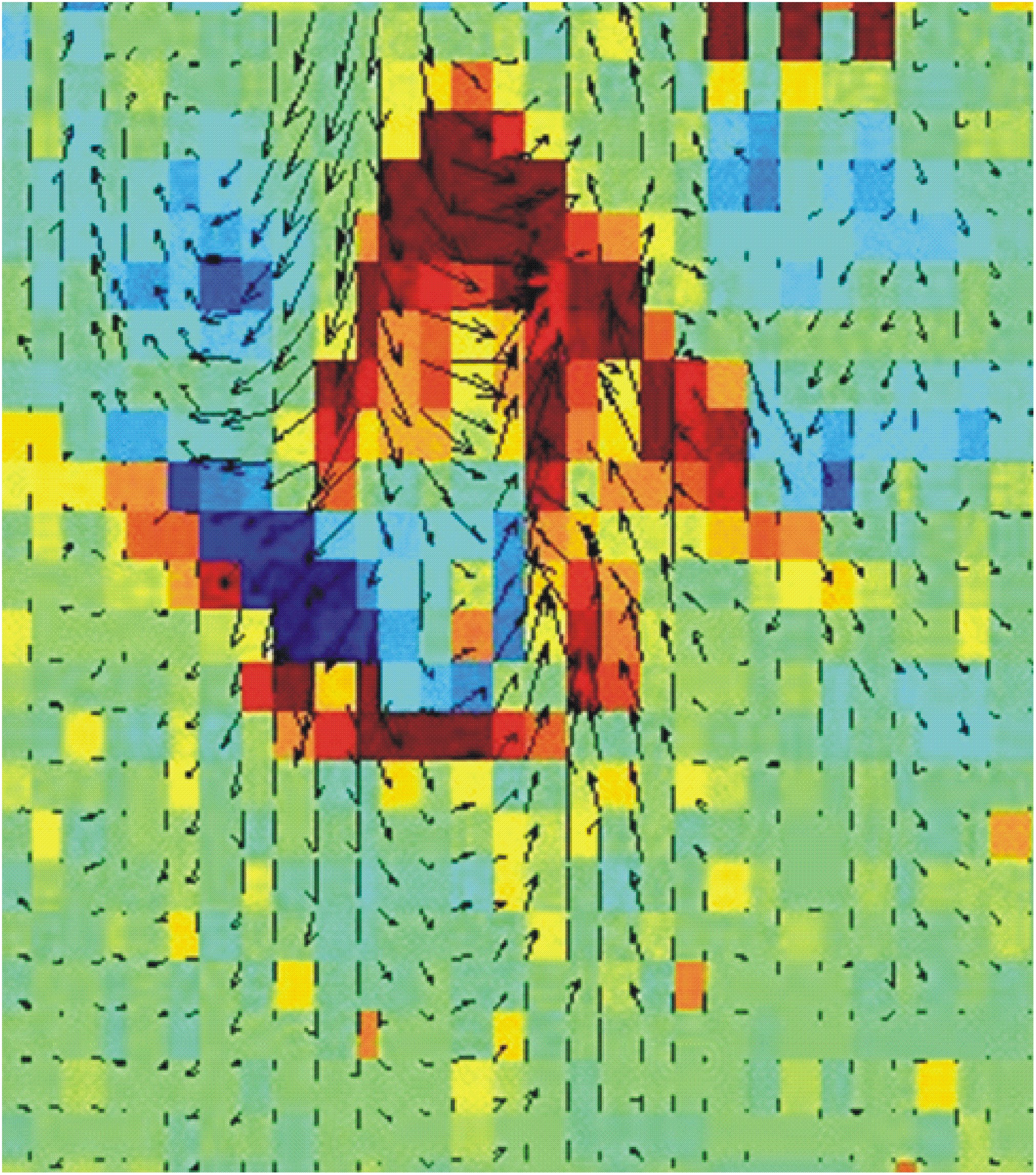
Below is a more detailed image showing velocity vectors on top of the acoustic backscatter, for the breaking wave shown above.  The vectors show the deviations from the 10-minute average velocity at each height above the riverbed.  Similarly, the colors show the deviations from the 10-minute average acoustic backscatter at each height.  By showing the deviations from average conditions, the wave and its velocities are more clearly visible.  The longest vector corresponds to a 5 cm/s deviation velocity, and the vectors are stretched by a factor of five in the vertical dimension to more clearly show the vertical component of velocity.

As mentioned previously, mean velocities during this period were ~1.4 m/s near the Hudson’s water surface, and near zero in the bottom of the water column.  This is why the deviation velocity vectors in the wave crest point to the right even though the crest appears as though it would be “pitching” forward, toward the left – deep water is being brought upward, and is traveling slower than the near-surface water it’s displacing, so its deviation velocity (or relative velocity) is actually toward the right.  In this case, one constituent being “mixed” by turbulence is momentum, whereby the high average momentum of the upper layer is diluted by the low momentum of the bottom layer.  You can read more about this type of turbulent mixing in the Hudson in my recent paper in Continental Shelf Research.

Turbulent mixing in context

Fluid dynamics, the study of fluids in motion, lies at the heart of most questions that humans ask of the ocean.  Evaluating problems such as storm surges, climate change, and pollutant discharges requires a detailed knowledge of ocean and estuary transport processes.  Also, Earth’s climate is conditioned by the ocean’s vast capacity to hold and transport heat, and many of the greatest uncertainties in projections of climate change lie in its depths.

This topic of turbulent mixing is increasingly recognized as one of the most difficult, yet important, problems in ocean physics.  It is difficult because it occurs on a variety of scales from millimeters to hundreds of kilometers – it is impossible to observe all these scales, or simulate them with computers, so scientists seek to develop simple physical rules in the chaotic turbulent patterns.

Generally shear is one of the main variables considered in simplified models of ocean or atmospheric turbulent mixing.  The type of shear-driven instability shown above is likely a Kelvin-Helmholtz instability, which are also commonly found at density boundaries in the atmosphere, magnetosphere, and on other planets.

Posted in water | Tagged , , , , , , , | 2 Comments

Earthquake = Tsunami?

A mild 3.9-magnitude earthquake occurred this morning out at sea off the New York Bight, and was felt by many people across the region.  An obvious question is whether such an earthquake could cause a tsunami.  A large tsunami clearly did not occur, but was a small one produced?  And while we’re on the topic, what is the probability of a tsunami striking our heavily populated coastline?  A large percentage of New York City’s surface area is less than ten feet above mean sea level (MSL), including much of the Financial District in Lower Manhattan and much of the subway system.

Examining water level data at Atlantic City (shown here) or other area stations using the NYHOPS coastal ocean observing and prediction system, it does not appear as though even a small tsunami occurred:

Here, the x-axis is hours from midnight, the red points are the observed water level relative to MSL, and the black line and yellow shading shows the prediction of a model with normal weather and tidal forcing.  The earthquake occurred at 10:46 AM local time, soon after low tide, and the agreement of the model and observations shows that nothing unusual was measured at this station.

Some scientists speculate that the reason Native Americans only had small communities when European settlers arrived in the New York City area was because of a prior tsunami in 300 BC, which is a spooky thought to say the least.  Fortunately, we have a new tsunami detection system, though I am not aware if there is any warning system in place for the population nor of the rapidity of response we’d have if one occurs.

Earthquakes are rare around New York City, but some stronger ones have occurred, as demonstrated on this page from Lamont-Doherty Earth Observatory that lists the largest recorded events to have hit the New York City region.

Good news:  It is extremely rare for earthquakes below 6.0 magnitude to cause tsunamis.  However, if the earthquake occurs at a location where the seabed is unstable, any earthquake could feasibly cause an underwater landslide, then that could send a tsunami.  But also on the positive side, when a landslide produces a tsunami, it usually rapidly decreases in size with distance from the source — a useful rule of thumb is that any slide that is smaller in horizontal scale than the depth of the ocean where it occurs will cause a localized wave that decays rapidly with distance (Parker, 2010).

Reference

Parker, B., 2010.  The Power of the Sea, Chapter 7: The sea’s response to an unpredictable Earth.  Palgrave MacMillan, New York, 292 pp.

Posted in water | Tagged , , , , , | Comments Off on Earthquake = Tsunami?

OceaNYC

Most people are surprised an oceanographer would bother living in New York City.

Before I moved here, I was aware that the Hudson River typically runs brackish for at least its lower 20 miles, but I too failed to comprehend how amazing of a place this would turn out to be for an ocean scientist. Estuaries and tidal straits of every stripe run through or near New York City, from the Hudson to East River, Harlem River, Jamaica Bay, Long Island Sound, and dozens more out on Long Island. You can find mild currents or extreme currents, and heavily polluted waters or clean swimmable waters brimming with fish.

There are so many blue crabs here, that at least one supplier from the Chesapeake regularly looks to our region’s fishermen as a source. There is no shortage of ocean fish migrating through for city dwellers to snare along the banks of these waterways.  Unfortunately, these people are taking chances due to pollution, particularly after rainfall “flushes” pollution into the system, so to speak.

Today I surveyed the view from the top of my apartment building on the east side of Manhattan. Down below are the turbulent currents of Hell Gate, where strong currents from East River, Harlem River and western Long Island Sound all swirl together and hundreds of ships sank through history. I can track the latter two waterways off toward the horizon, and looking across the island I can even see the cabled towers of George Washington Bridge, reminding me that the Hudson is just a few miles away.

A balance has finally been struck here between the needs of millions of people and these natural brackish waterways. In the past, the water suffered extreme degradation, but these days there is a revival due to reductions in pollution inputs. Moreover, the capacity of these waterways to absorb pollution is amazing. It all comes down to the strong dispersive currents that surround the city, which oceanographers measure with instrumentation we deploy on the seabed. If you’ve ever seen East River churning like water at a rolling boil, you’ll know what I’m talking about.

As an oceanographer, I seek to optimize this balance, studying the currents and water quality and improving our predictive capacity.

As an educator, I get excited about the aquatic educational possibilities for the dozens of schools that are built right alongside the water. Most the schools have the water at their backs, with no windows and no waterfront access because when they were built, the water was an eyesore.

Once upon a time, hundreds of years ago, this was an amazing natural fishery with abundant fish, oyster beds, birds, and who knows what more. The most exciting prospect is that our improved environmental regulations and gradual movement away from heavy industry makes at least a partial return to this natural state possible.

Remarkably, a famous developer recently published an editorial in the Sunday edition of the Times recommending that the Harlem River tidal strait be filled with dirt, to provide additional real estate and park land for the city. He argued that neighborhoods need to expand, and schools need football fields, and a very small percent of the people see value in the waterway.

As sure as these tides will always push and pull, I know there will always be room for an oceanographer in this vibrant ocean island city.

Posted in urbanoceanographer, water | Tagged , , , , | Comments Off on OceaNYC

Skyline Seabreeze

Have you ever been at the beach in early summer and had a day ruined by arrival of a cold seabreeze?  I was attempting to have my first barbecue of the year last April 3rd in Morningside Park – the center of Manhattan – and an unusually brutal springtime seabreeze caused temperatures to drop from 68 to 52°F in less than two hours, though this change was not in the forecast.  People were shivering, teeth chattering and cursing the cold strong winds, and my barbecue ended prematurely.

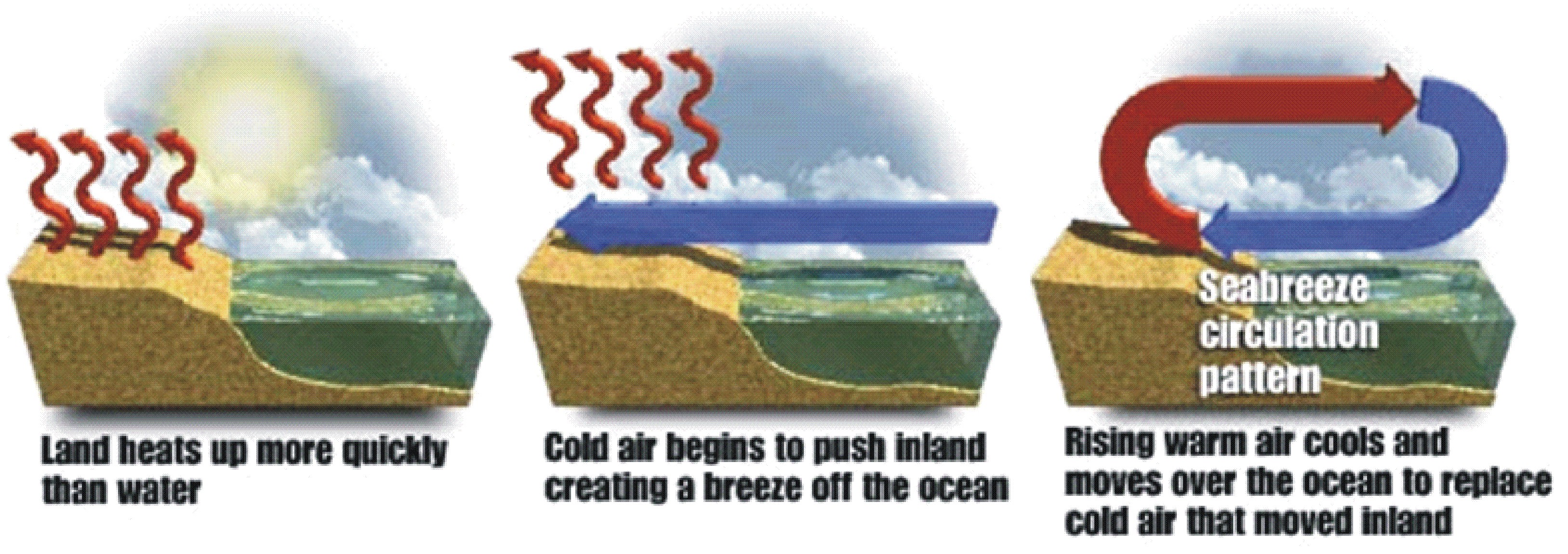
The seabreeze is an inland movement of relatively cool marine air that often arises on sunny, warm days.  It is caused by mesoscale (2-500 km) atmospheric pressure differences that develop as a result of the different solar absorption properties of sea and land.

I just published a paper on the New York City area seabreeze in the science journal Geophysical Research Letters, highlighting a weeklong period where nearly every day had a strong seabreeze blowing northward from the coast.  The observations showed that the seabreeze often traveled with a sharp cold front at its head, and traveled at least 70 km up the Hudson valley (Figure 2 in the paper).

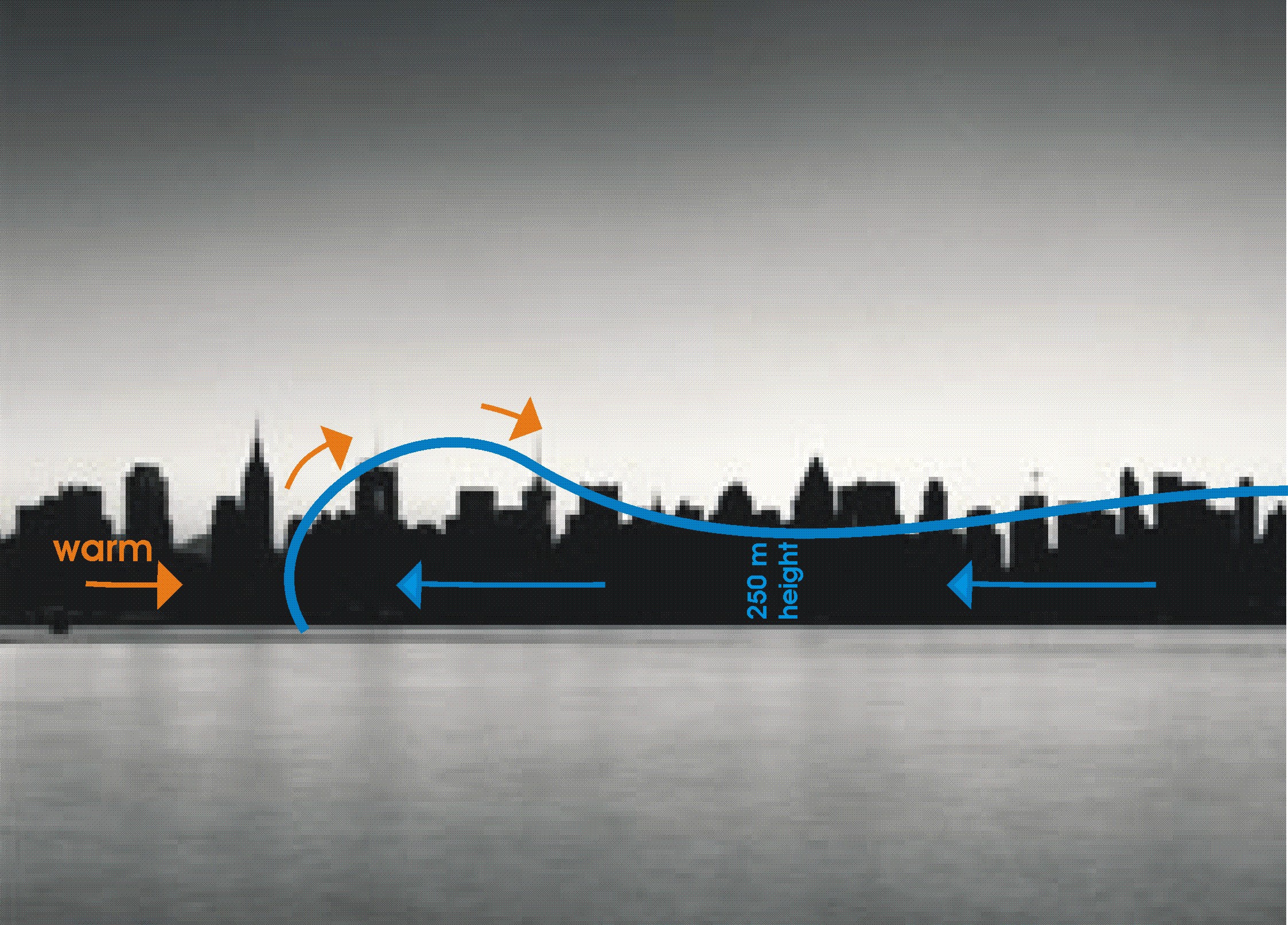
I read more on the atmospheric science and quirks of the New York area seabreeze, and learned that the cool air “marine layer” that propagates inland is often only 100-500 m tall.  On the west coast, due to the extremely cold offshore waters, the marine layer is often tagged with fog that makes it visible (picture the Golden Gate Bridge).  Around New York City, it’s usually invisible, so I drew up the conceptual diagram below.

The seabreeze has characteristics of a gravity current, which is a flow of fluid caused by the fact that it has a different density (colder = more dense) from the surrounding fluid. It’s somewhat like what happens when you crack open a window on a cold winter’s day, and cool dense air rushes in and down along the floor by your ankles. Other forms of gravity currents are avalanches, mudslides, as well as many other environmental flows.

The southerly seabreeze is an integral part of New York City urban weather, often ameliorating the urban heat island effect that is caused by heat-retaining pavement and buildings.  Sunbathers escape the hot city on summer days, to cool off at the beach or on piers along the Hudson.  Sailors in the Hudson and Long Island Sound often take advantage of spring and summer afternoon winds.  My paper was mostly about the impacts of the seabreeze on the Hudson River, but I hope to study the New York area seabreeze more in the near future with my new position at the Stevens Institute of Technology, where I study the New York area atmosphere and ocean.

Some interesting questions include:

Is the sea breeze Manhattan’s summertime air conditioning unit, or does it only have an impact on the waterfront?

Could things be done, in future decades of NYC development, to make use of the northward-flowing sea breeze … in terms of architecture of the waterfront skyline?

The seabreeze is surprisingly strong at New York Harbor, likely due to funneling by nearby topography — could a wind farm be installed outside the shipping lanes to help handle the large summertime power demand for air conditioning on hot days?

Posted in weather | Tagged , , , , , | 1 Comment