Rain- and Wind-Driven Coastal Flooding

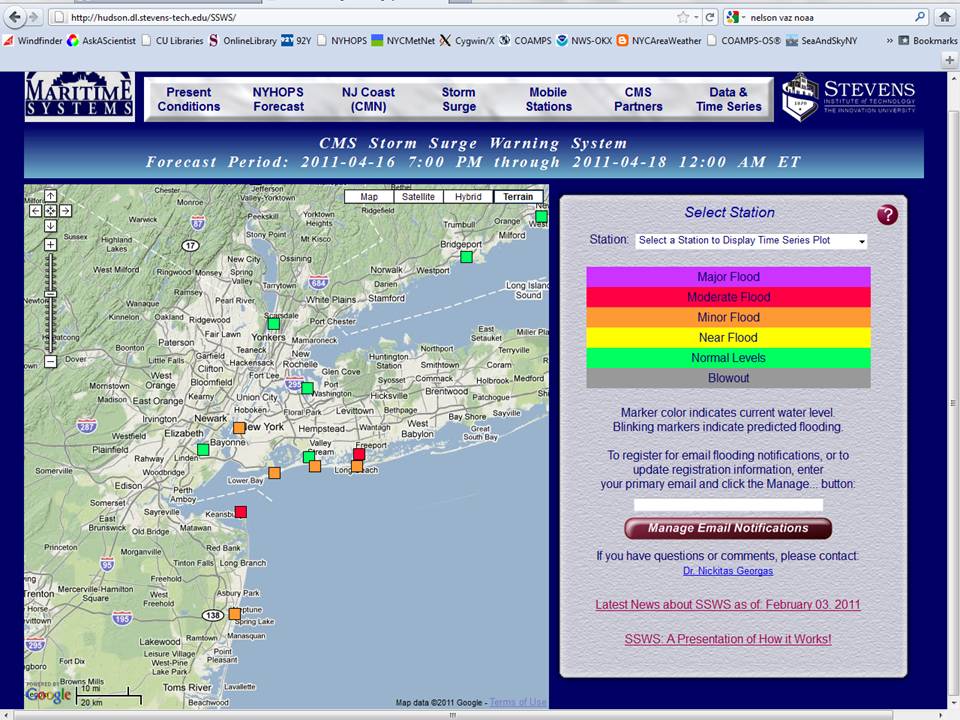
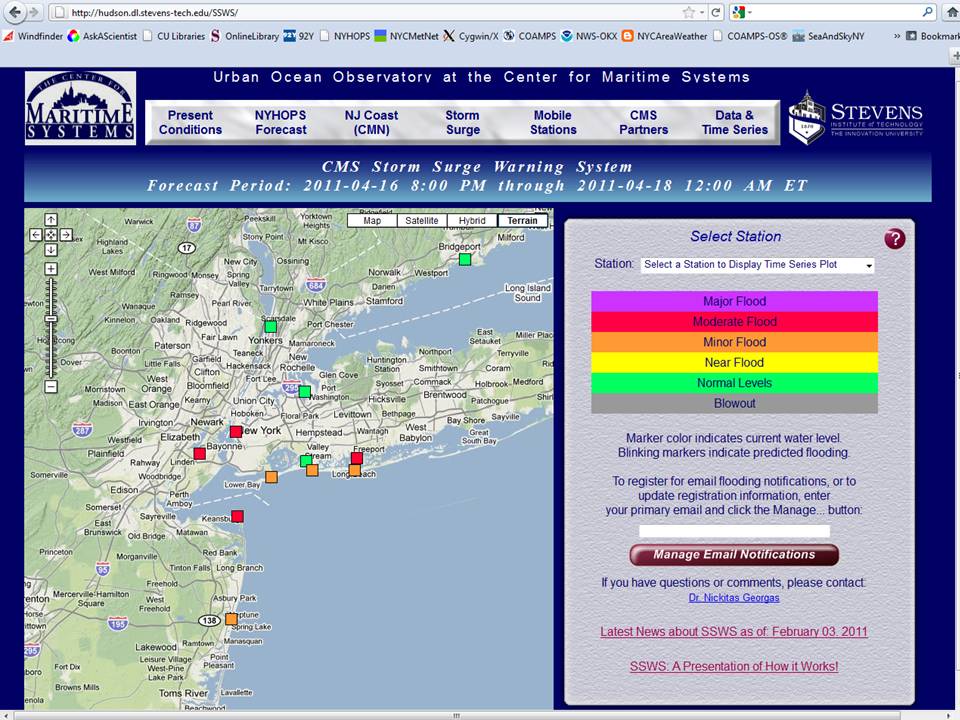
I’ve been receiving automated notifications on coastal flooding from the Storm Surge Warning System today.  The nor’easter that is hitting us is packing 20-40 mile per hour winds, and driving water against our shorelines.  Water levels are expected to peak at 2 feet above normal high tide, and with a moderately large high tide this evening superimposed on that, we are seeing moderate flooding at several coastal locations.


This event is an interesting example of a rain- and wind-driven flooding event, which has the potential to pack some surprises for people in the business of predicting flooding.  The problem is, flooding is divided into “coastal flooding” and “inland flooding”, meaning that the problem of wind-driven flooding (storm surge) and rain-driven flooding (river stage), are studied by oceanographers and hydrologists, and in spite of it all being water, the two fields and prediction systems generally mix like … water and oil.

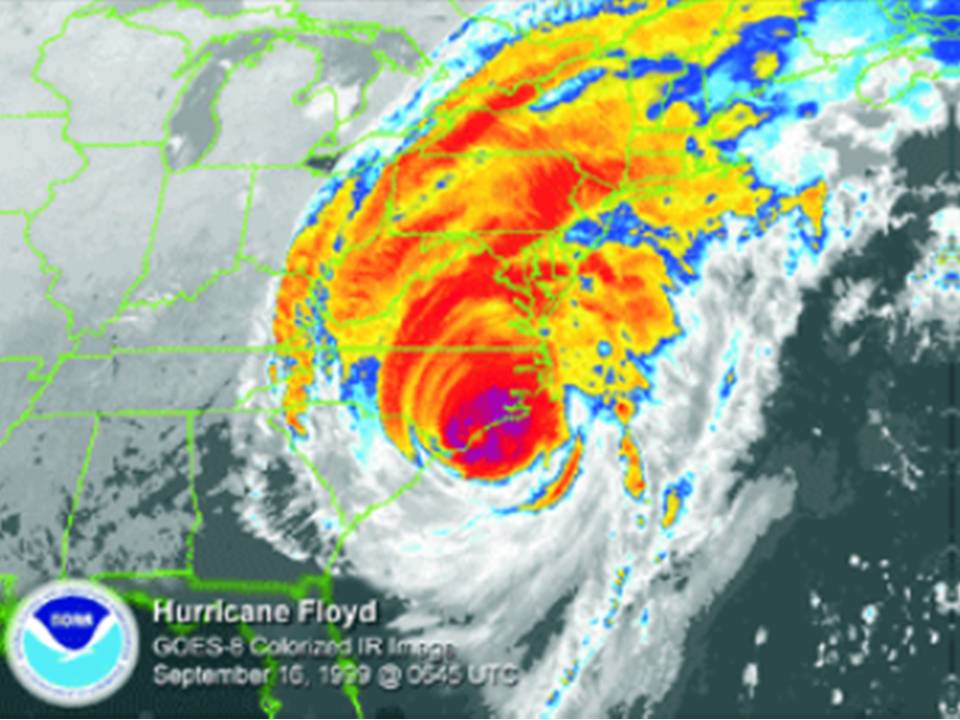
The problem is, the worst wind-driven storm surges typically come from wet systems that also cause heavy precipitation (e.g. Hurricane Floyd, below), yet storm surge, rainfall and hydrology have never been merged into one computer model.  There are many freshwater confluence zones near the coast where both kinds of flooding are important, such as some low-lying parts of The Bronx and Brooklyn, of New York City.  It just happens that people tend to like living near the coast, and often live in this “nether region”. Therefore, if we want to serve society, the scientists have some catching up to do.

Hurricane Floyd in 1999 caused both high storm surges and extreme precipitation, exceeding 12 inches of rain in some coastal counties. Shown here are satellite-derived colorized cloud top heights.

While it isn’t incorporated in their coastal flood models, I also noticed the National Weather Service also has a warning out, saying “locally heavy rainfall is likely to exacerbate coastal flooding.”  So while it isn’t modeled, it is at least being acknowledged.

Posted in water, weather | Tagged , , , , , , , , | Comments Off on Rain- and Wind-Driven Coastal Flooding

Hudson River or Estuary? (you may be surprised)

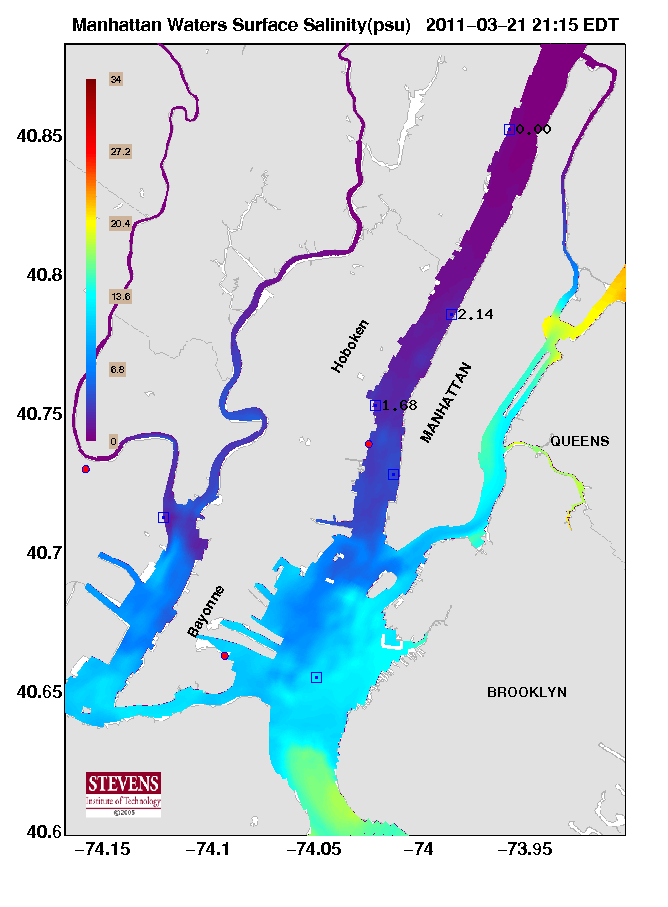
Salinity in the lower Hudson River and other NYC waterways, 3/21/11. Ocean salinity is ~35 (red), freshwater is 0 (purple).

An estuary is defined as a semi-enclosed body of brackish water – a mixture of salty and fresh water.  So strictly speaking, the Hudson by Manhattan and northward past the Tappan Zee is normally an estuary and typically has more ocean water than river water in the mix.  Brackish water can actually work its way about 70 miles north of NYC to Poughkeepsie in droughts.

But this week, things are different.  Due to the melting of this winter’s heavy snows and also recent rains, the springtime freshwater flood in the Hudson — the freshet — is fairly large.  An interesting result of this and to a lesser extent the supermoon spring tide is that salt water is being pushed out to sea with a rarely seen ferocity and the Hudson is actually a RIVER along nearly all of its length, running freshwater at all depths all the way to the northern part of Manhattan.  Freshwater floats over saltier (denser) water, and the surface waters could actually be fresh all the way to New York Harbor after ebb tides.

USGS has a nice webpage for checking the estimated location of the salt front, or to see a detailed map similar to that above with the latest salinity observations and predictions, check NYHOPS.  Mind you, salt transport is a different thing than wave transport, which doesn’t require molecules to go along for the ride — the tide is a long-period wave and travels all the way up to the dam at Albany, and the Native Americans referred to the Hudson as the river that runs both ways because of the reversing tidal currents.

Posted in water | Tagged , , , , , | 1 Comment

The Hudson’s Supermoon Spring Tides and Freshet

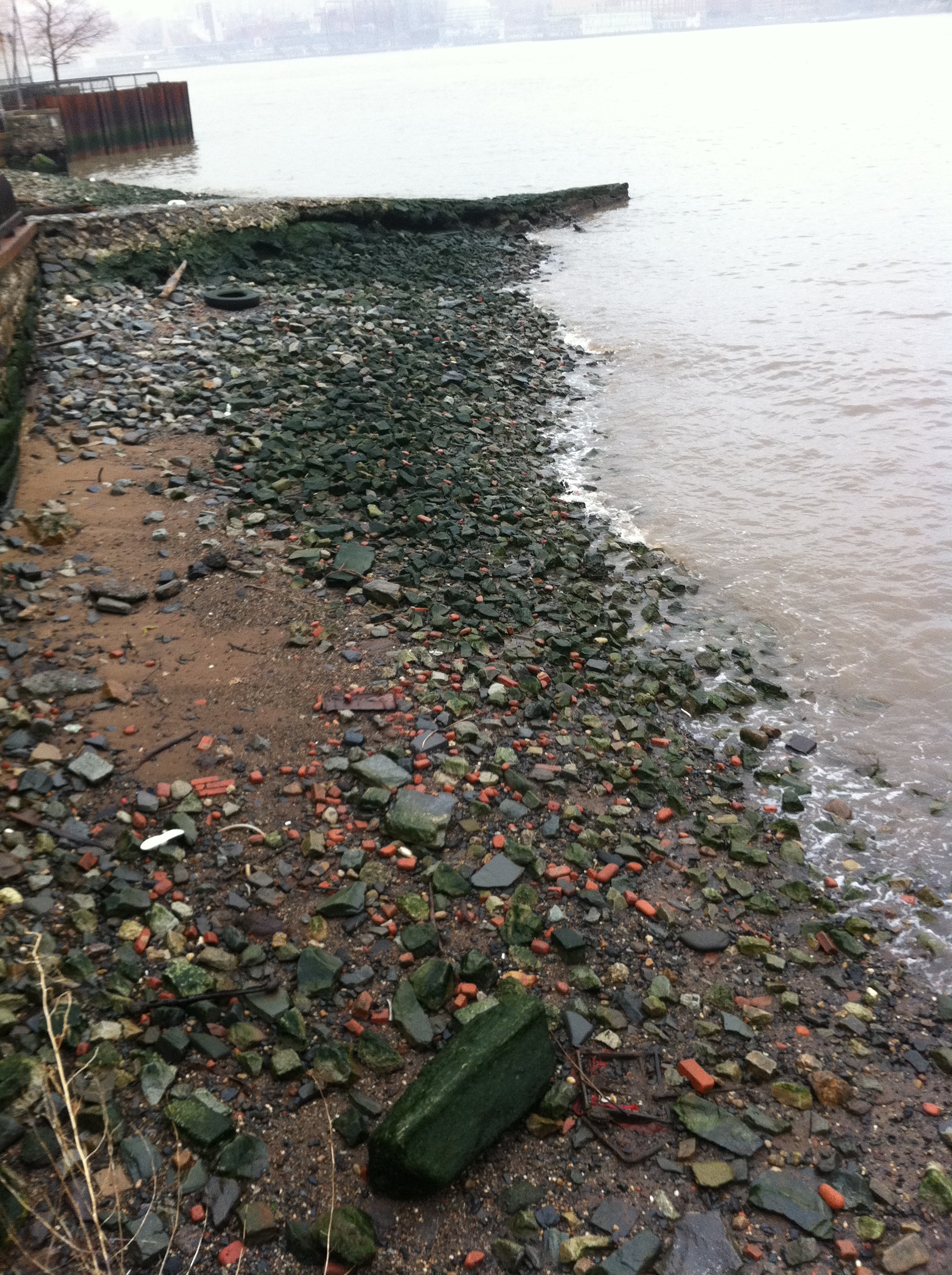
A rare Hoboken beachcombing opportunity at perigean spring low tide, Monday 5 pm

In the off-chance that you haven’t heard about the supermoon – it’s the name someone came up with for the time that occurs every few decades when the moon is at the closest point of its elliptical orbit around Earth, called Perigee, and the moon and sun are also oriented on opposite sides of Earth so that we see a full moon.  This leads to a slightly larger looking full moon – the supermoon – but also leads to much larger ocean tides than are normally the case.  “Spring” tides occur soon after the full moon (and new moon), and the supermoon makes for unusually large spring tides.

As a result of the sun and moon “pulling” the oceans in unison (spring tide), and the moon’s pull* being largest due to its point on its orbit (perigee), the past two days have had large tidal ranges in the Hudson and strong tidal currents as the water levels undulate every 12.4 hours between unusual highs and lows.  We’ve been fortunate there hasn’t been a nor’easter, which often add 2-4 more feet of water level – even without that extra water, we’ve had minor flooding at several locations. Two extra feet would lead to flooding over many seawalls and three or four would likely shut down the subway system, but that water level is extremely rare.

An interesting additional factor out on the Hudson River these past few weeks has been the ongoing “spring freshet” pulse of snowmelt and rainfall flood waters.  This adds an additional force to the mix—the enhancement of seaward ebb-tide currents due to the force of additional water added into the Hudson from river tributaries.

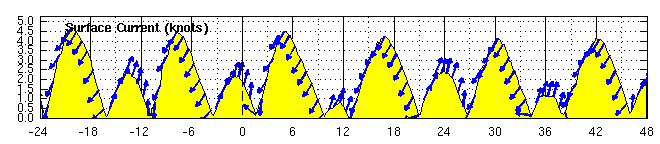
The combined effect has been the strongest non-storm currents you’ll ever see in the Hudson, as high as 5 miles per hour (2.2 m/s), relative to normal daily peaks of half that.  (Nevertheless, this is only roughly equivalent to the typical daily peak tidal currents on East River, which gets stronger currents because it is actually a tidal strait between Long Island Sound and New York Harbor.)

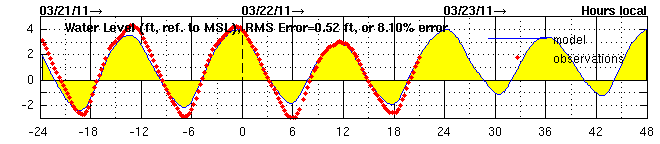
Modeled (past and predicted) and observed Hudson currents (arrows show direction) and water levels (relative to mean sea level, MSL) at the center of the Hudson west of 79th St boat basin, with hour from midnight on 3/22/11 on the x-axis. Figures are from NYHOPS, http://stevens.edu/maritimeforecast.

Also noticeable during the freshet and especially with a coincident spring tide is that the water is also muddier than any other time of year, more of a grey-brown, and with almost no hint of the chlorophyll green that you get in summertime.  The exact color depends on where you are along the Hudson, as the Harbor has more ocean water and Haverstraw and Tappan Zee are shallower and muddier.

* Note – the gravitation of the moon doesn’t simply pull on the ocean to create a tide — it is strong enough that the Earth and moon rotate as a pair around a central point, and as a result there is a bulge of the ocean on both the same side as the moon AND the opposite side.

Posted in water | Tagged , , , , , , | 1 Comment

Latest plume forecast for Japan

Future Japan air and water radiation plume updates will continue at a different blog site so change your bookmarks.

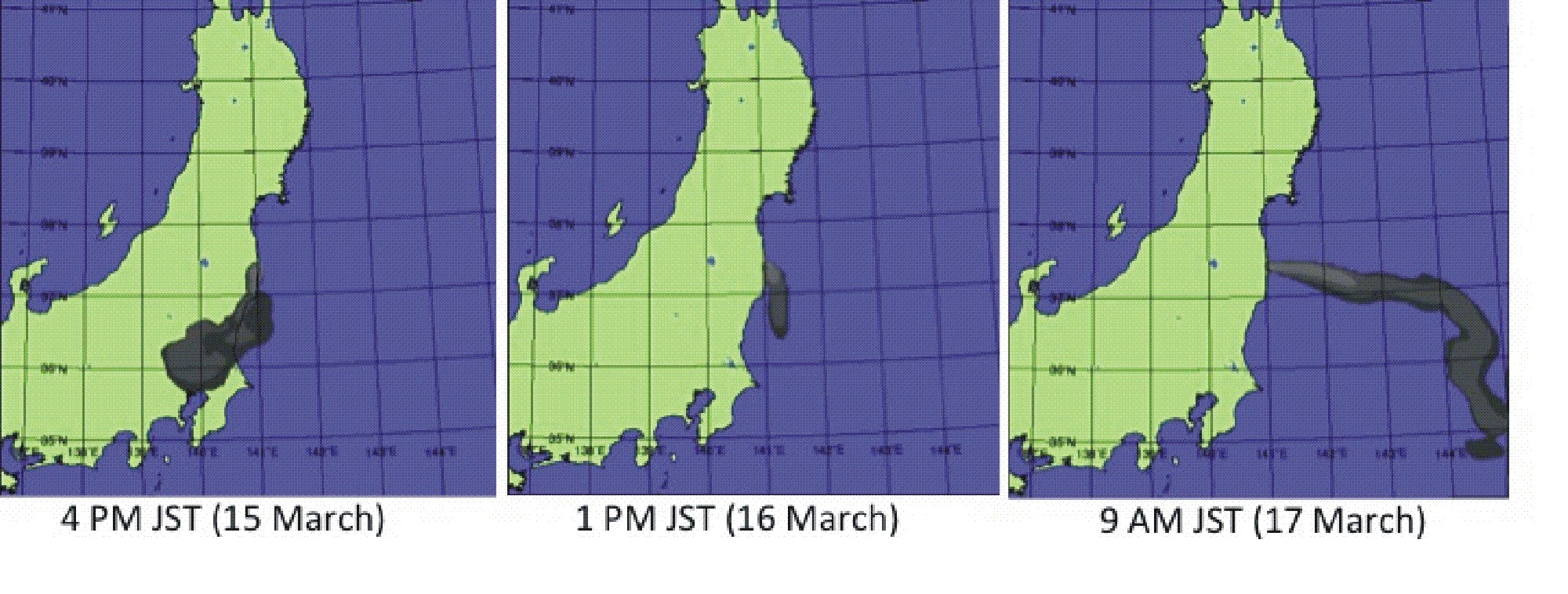
Predicted plume dispersion over the next 36 hours (through morning of 17 March, Japan Standard Time).  Although the plume was directed toward Tokyo and surrounding areas during the day on March 15 [left panel] (presumably causing the increase in radiation there), the plume is now projected to remain offshore through Thursday morning 17 March local time) [right panel].  This should provide time for workers to continue efforts to get the reactors under control. [Plume images are a research tool; contours are arbitrary units for visualization purposes.]

Posted in air pollution, security | Tagged , , , , , , | 2 Comments

Airborne plume dispersion in coastal areas

New York City, like most megacities including Tokyo, does not have mechanisms in place to evacuate the population of the entire city.  Even the direst catastrophic scenarios entail a strategy of sheltering in place for at least some of the affected population.  It’s simply too challenging to evacuate 13 million people, in the case of Tokyo.  And given the compounding devastation and dislocation wrought by the tsunami and earthquake, further evacuations are even more problematic.  That is why the intermittent low-level radiation releases over the coming weeks and months envisioned even in the best case is so troubling to a densely inhabited island.

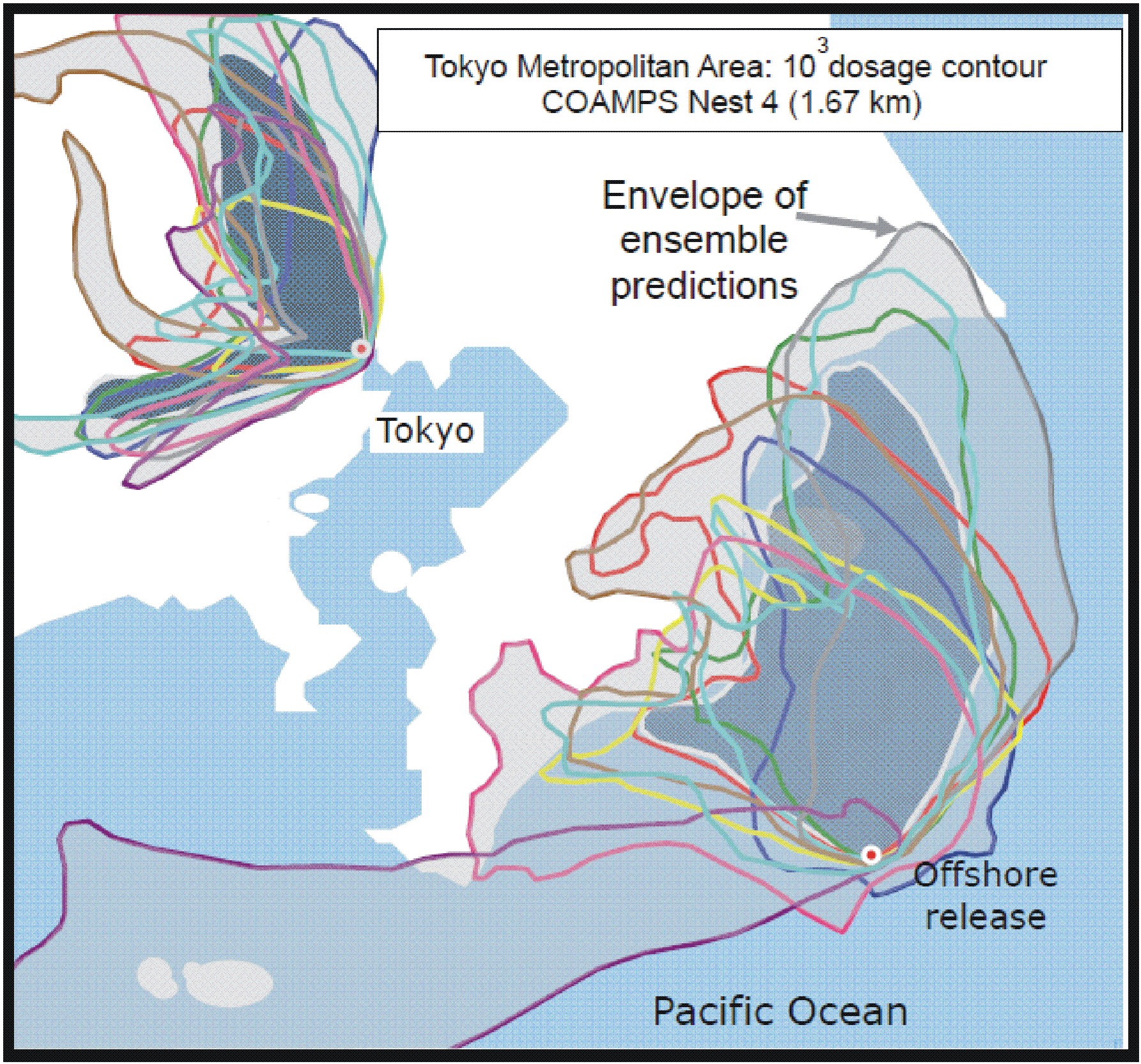
A few years ago we published a paper showing high-resolution (~1 km) simulations of tracer releases in various coastal areas of Japan.**   We demonstrated an “ensemble” framework that allowed a more accurate estimation of plume shapes and exposed population.  Our technique involved varying key ocean and atmosphere parameters used by a meteorological model (e.g., sea surface temperatures, urban sources of heat, building heights) to better capture the variability and produce more realistic wind forecasts.  Our results showed that coastal releases are subject to fluctuating conditions so that even though the average direction of winds is off-shore at most locations along the east coast of Japan, events like weather fronts and sea breezes can still drive the plumes toward large inland cities.

Model simulated accumulated 12-hour dosage for two arbitrary tracer releases in Tokyo and offshore of Tokyo. The different shaded contours represent different realizations in the model ensemble. The bi-pronged distribution for Tokyo is due to the timing of the release relative to the sea breeze. (Westward is before sea breeze; northward is after sea breeze).

After experiencing airborne radiation at their location 60 miles offshore of the reactors, U.S. Navy ships providing assistance to the Japanese relocated today.   This is indicative of widespread low-level radiation release.  The impact on sites inland remains worrying given the coastal variability that we documented in our research.  And indeed, high-resolution model forecasts that I have seen for Japan for the next few days predict a pattern of onshore and southwestward winds of 5-10 knots in the vicinity of the reactors.

New York City has an average wind direction blowing toward the east, but plume transport on any given day could be in any other direction.  This variability can result from weather fronts, northward sea breezes, and the reverse, weaker southward land breezes.  The Indian Point nuclear power plant is located 35 miles north of midtown Manhattan.  Although vulnerabilities to earthquakes are minimal, terrorist activity against the three-unit site remains a concernEvidence suggests Al Qaeda had originally targeted Indian Point for 9/11 attacks.

**Teddy Holt, Julie Pullen, and Craig Bishop, “Urban and ocean ensembles for improved meteorological and dispersion modeling of the coastal zone,” Tellus, 61A, 232-249, 2009.

Posted in air pollution, security, weather | Tagged , , , , , , , , , | Comments Off on Airborne plume dispersion in coastal areas

Can NYC Beaches get Swallowed by the Sea in a Storm?

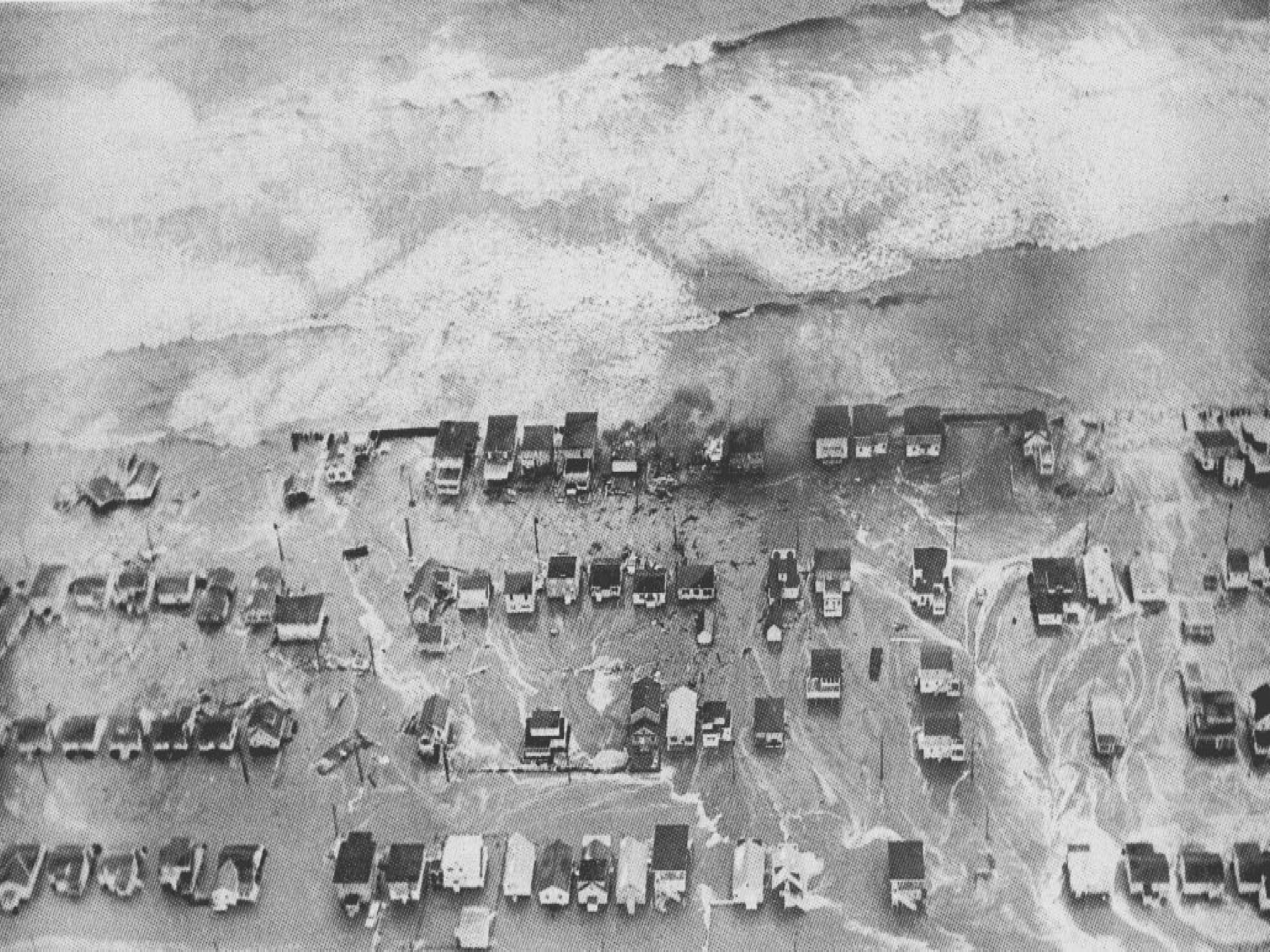
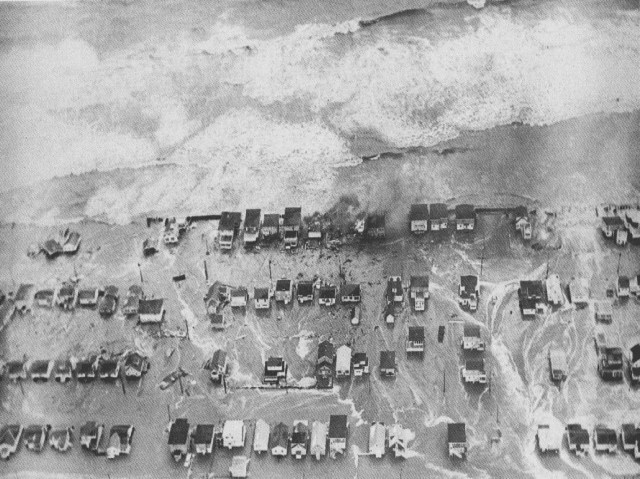
Aerial view of surge flooding at Ocean City, Maryland, 1962

There’s some recent alarming news yet simultaneously comforting news for those in the New York City region concerned about coastal flooding.  On one hand, two geologists have assembled a 2000-year record of hurricane storm surges that washed over the area’s barrier islands, leaving layers of ocean sand in the muddy bays behind them as evidence.  Your ears might perk up if you live on Rockaway, Long Beach or other area barrier islands.

On the other hand, their results suggest that there were very long periods with no flood layers, so probably no hurricane strikes.  The periods in the records that are thought to have had warmer tropical ocean temperatures actually had fewer hurricane strikes near NYC.  Due to global warming, we are likely to have warmer ocean temperatures, so this may reflect the surprising result that global warming might reduce the number of hurricanes striking NYC’s plentiful shorelines.

Insert sigh of relief here.

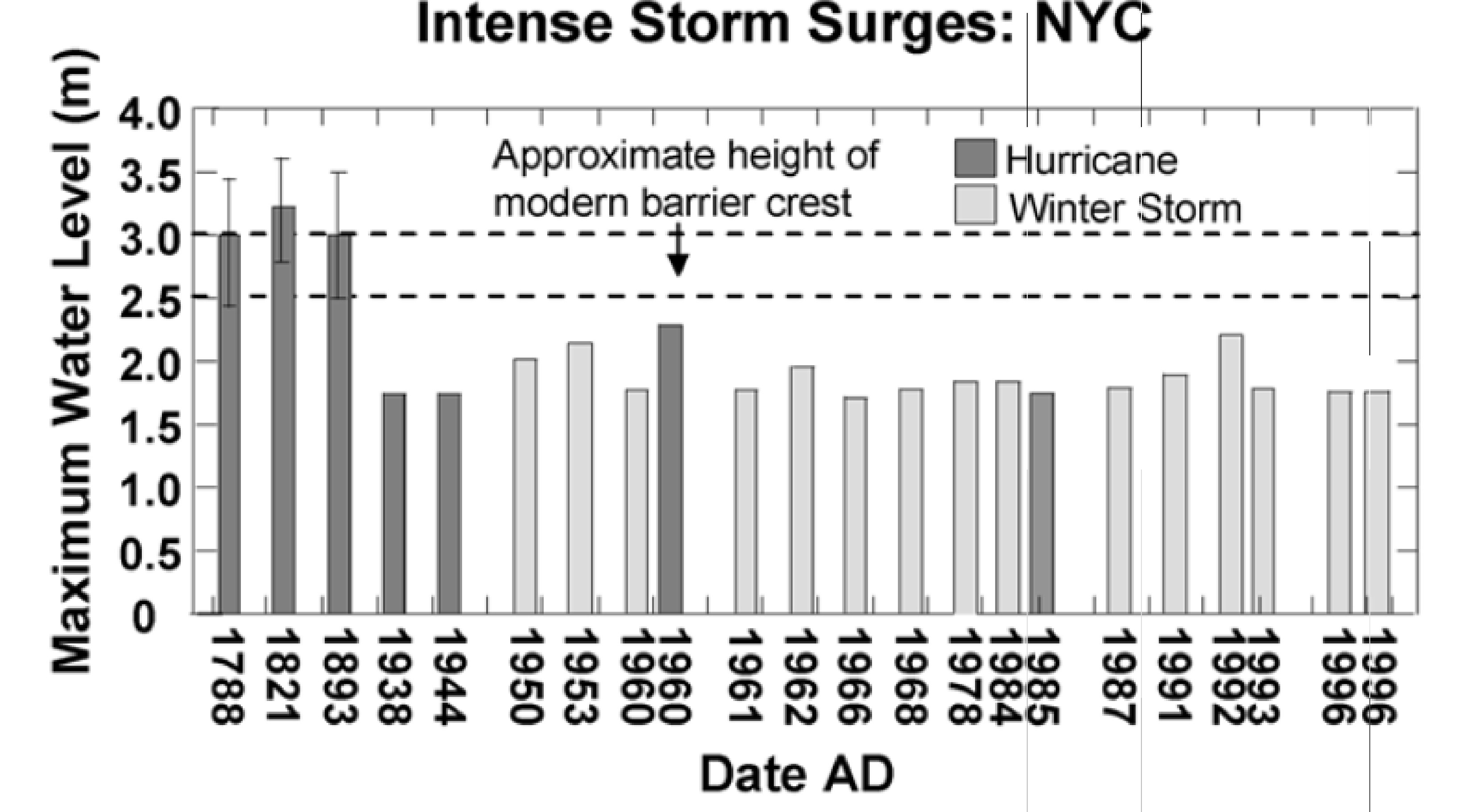
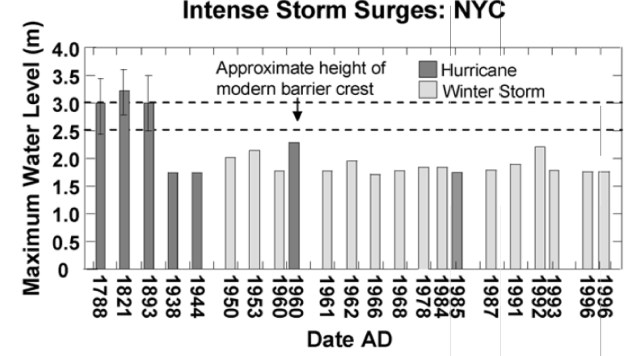
This figure below from their paper shows the water levels for several of the worst storms in recent centuries, measured at the southern tip of Manhattan – the storms at or above the second dashed line were also observed as sand layers in the sediment cores behind Long Beach. The average height of the modern (2002) barrier island crest (2.5-3.0 meters) is shown with the two dashed lines. Note that these are water levels in the Harbor – water levels at the beaches are higher due to (a) periodic wave run-up and (b) piling up of average water levels due to wave breaking – called wave set-up.
Of course, this doesn’t change the fact that we need to be ready for The Big One.  For one thing, this is only one scientific study, though it seems robust.  Even if the results are solid, the difference between one hurricane in fifty years and one in five hundred is still all about probabilities.  The damages of a direct hit would likely be in the tens of billions, and millions of New Yorkers might need to be evacuated, so we still need to take some basic precautions and be ready for the worst.

Thinking further ahead, there’s one factor I haven’t mentioned – if global warming causes a meter of sea level rise by the end of the century, you can see from the figure above that an intense winter storm that occurs perhaps every decade or so (2.0 meter surge) will begin to feel like The Big One (3.0 meter surge) when it comes to storm surge flooding.

But that gives us plenty of time to put the homes on stilts, build seawalls in place of beaches, and get the grandkids swim lessons!
Aerial view of surge flooding of Ocean City, Maryland, 1962

There’s some recent alarming news yet simultaneously comforting news for those in the New York City region concerned about coastal flooding.  On one hand, two geologists have assembled a 2000-year record of hurricane storm surges that washed over the area’s barrier islands, leaving layers of ocean sand in the muddy bays behind them as evidence.  Your ears might perk up if you live on Rockaway, Long Beach or other area barrier islands.

On the other hand, their results suggest that there were very long periods with no flood layers, so probably no hurricane strikes.  The periods in the records that had warmer tropical ocean temperatures actually had fewer hurricane strikes near NYC.  Due to global warming, we are likely to have warmer ocean temperatures, so this may reflect the surprising result that global warming might reduce the number of hurricanes striking NYC’s plentiful shorelines.

Insert sigh of relief here.

This figure from their paper shows the water levels for several of the worst storms in recent centuries, measured at the southern tip of Manhattan – the storms at or above the second dashed line were also observed as sand layers in the sediment cores behind Long Beach. The average height of the modern (2002) barrier island crest (2.5-3.0 meters) is shown with the two dashed lines. Note that these are water levels in the Harbor – water levels at the beaches are higher due to (a) periodic wave run-up and (b) piling up of average water levels due to wave breaking – called wave set-up.

Of course, this doesn’t change the fact that we need to be ready for The Big One.  For one thing, this is only one scientific study, though it seems robust.  Even if the results are solid, the difference between one hurricane in fifty years and one in five hundred is still all about probabilities.  The damages of a direct hit could be in the hundreds of billions, and millions of New Yorkers might need to be evacuated, so we still need to take some basic precautions and be ready for the worst.

Thinking further ahead, there’s one factor I haven’t mentioned – if global warming causes a meter of sea level rise by the end of the century, you can see from the figure above that an intense winter storm that occurs perhaps every decade or so (2.0 meter maximum water level) will begin to feel like The Big One (3.0 meter level) when it comes to storm surge flooding.

But that gives us plenty of time to put the homes on stilts, build seawalls in place of beaches, and get the grandkids swim lessons!

Posted in water, weather | Tagged , , , , , , , , , , , , , | Comments Off on Can NYC Beaches get Swallowed by the Sea in a Storm?

Blast-proofing the PATH tunnels

For the past several months the Port Authority has led a concerted effort to enhance the security of the PATH tunnels that cross beneath the Hudson River.   The four underwater railway tunnels connect New Jersey to lower and midtown Manhattan.  They serve a substantial commuter population and were the target of a foiled terrorist plot in 2006.

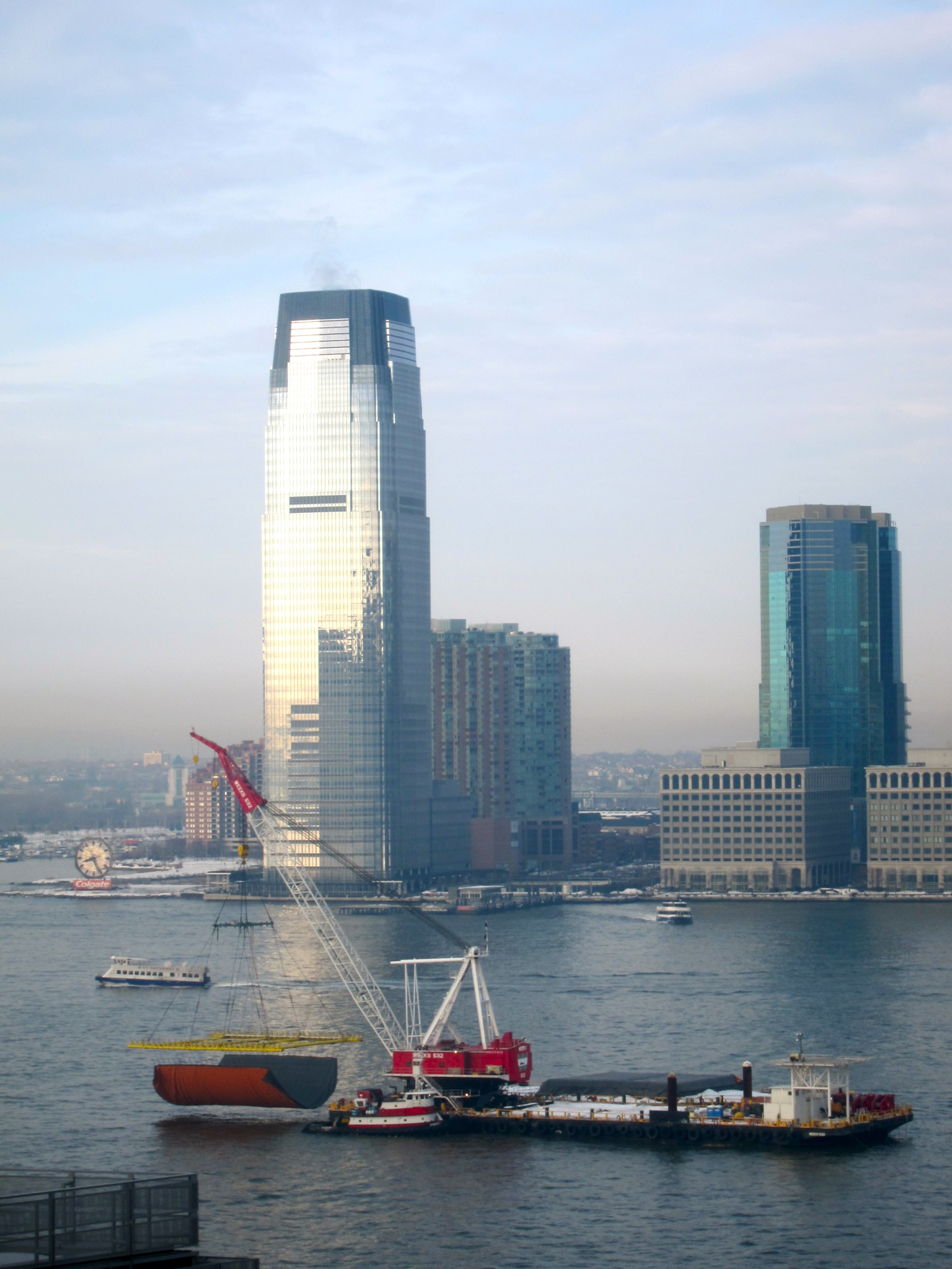
Blast-resistant "blanket" preparing to be lowered to the bottom of the Hudson.

Efforts underway include lowering blast-resistant “blankets” over the top of the tunnels to lessen the impact of detonation from within.  Other measures include floodgates at the entry points and reinforcement of the tunnel structure itself.  All of these measures are important for critical infrastructure security.

Posted in security, water | Tagged , , , , | Comments Off on Blast-proofing the PATH tunnels

New York Harbor Seals

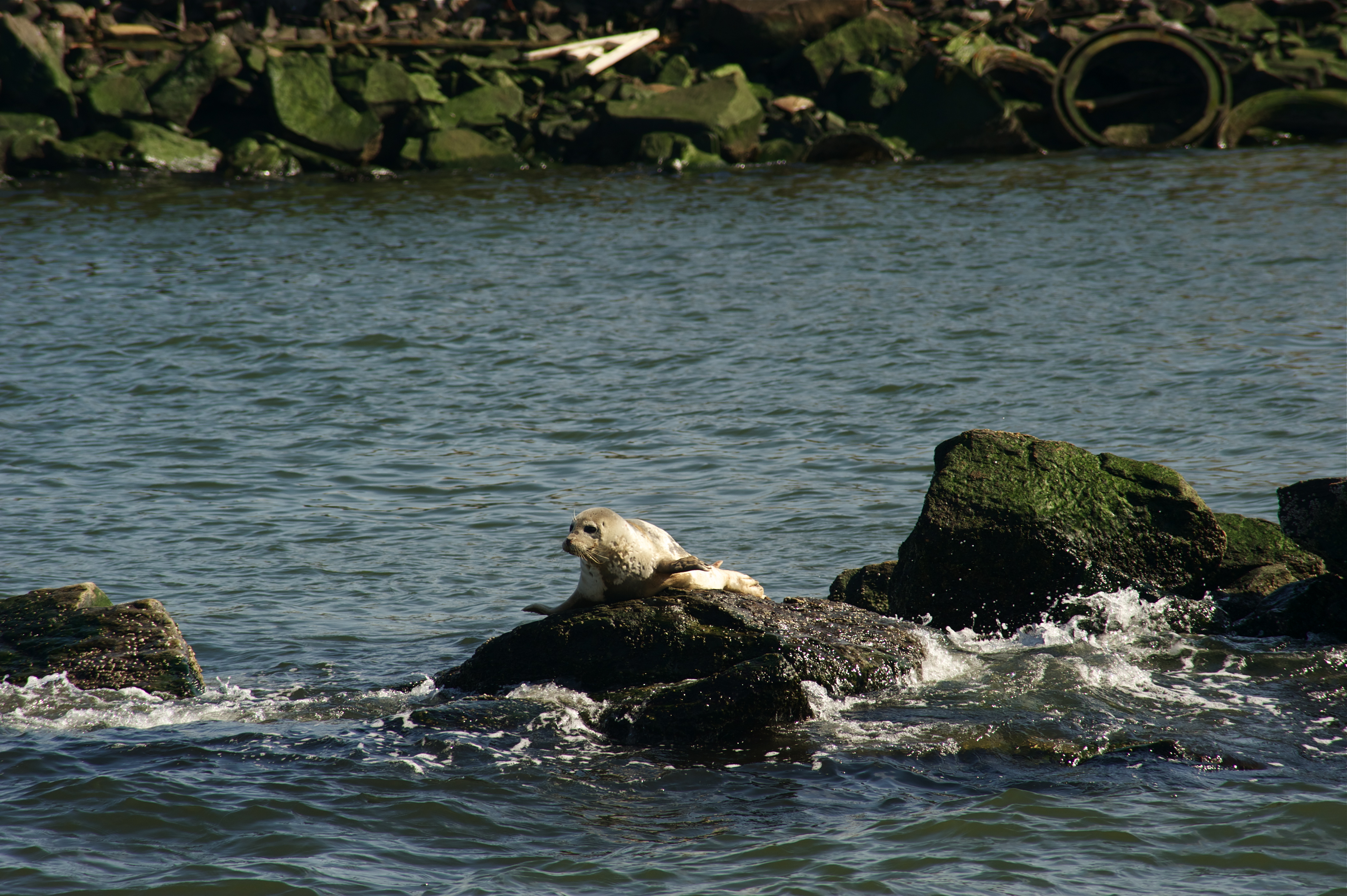
I went on an amazing annual boat tour on Saturday, put on by the Audubon Society, called Winter Seals and Water Birds.  About a hundred or so participants cruised out of South Street Seaport on a Water Taxi, past Red Hook and out to Lower NY Bay toward the ocean.  It was the wintertime version of a weekly summer tour for watching water birds, but in winter the prime attraction is the harbor seals.

Apparently there are roughly twenty seals that call New York City’s waterways home.  This is a relatively new population, and the NY Aquarium estimates that their number has been growing in recent years – testament to the improving water quality and food available in our waters.


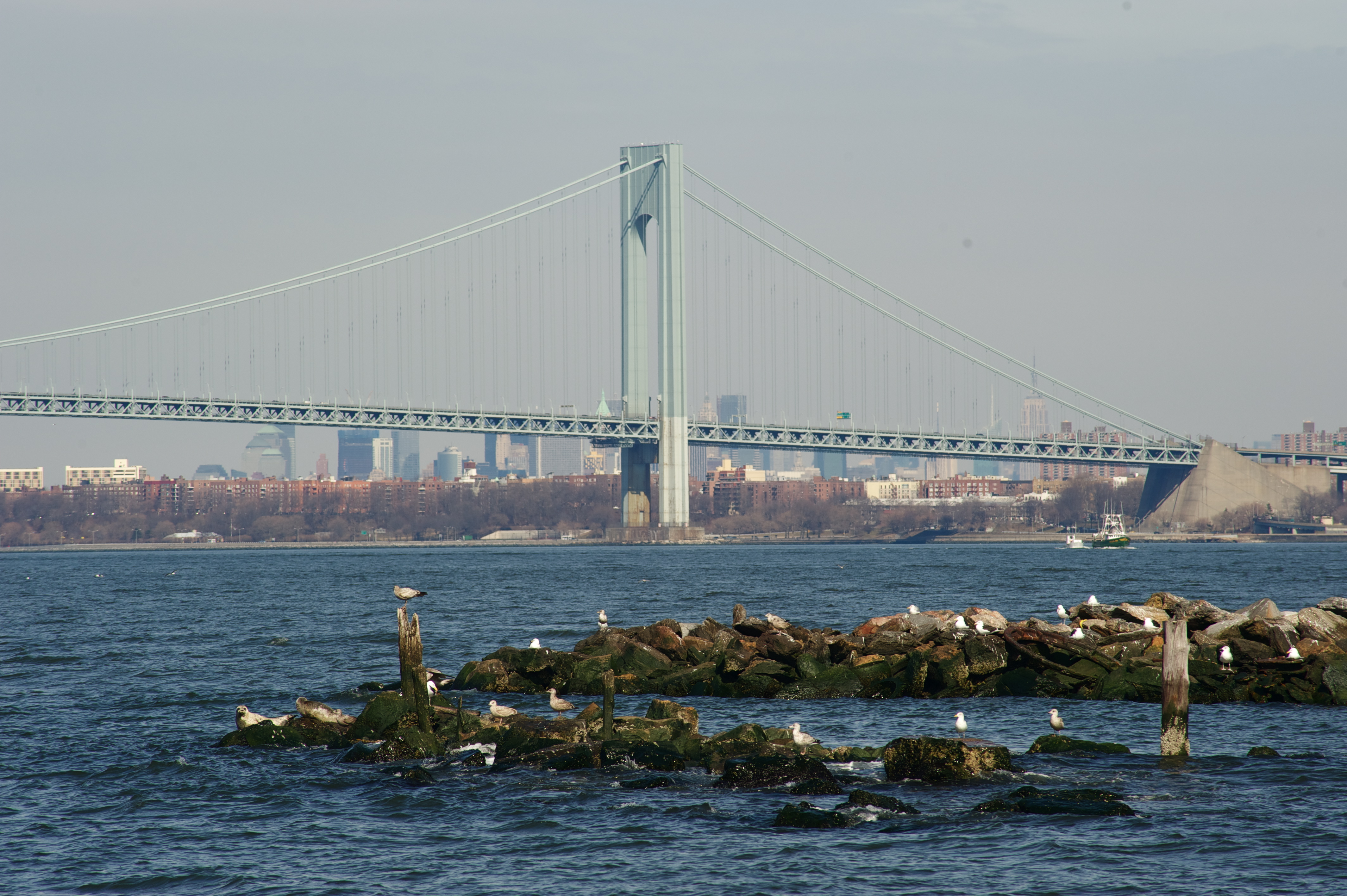
Here, a few seals are on the far left side of the rocks, with the Verrazano-Narrows Bridge and skyline in the background. Credit: Gavin Guerra.

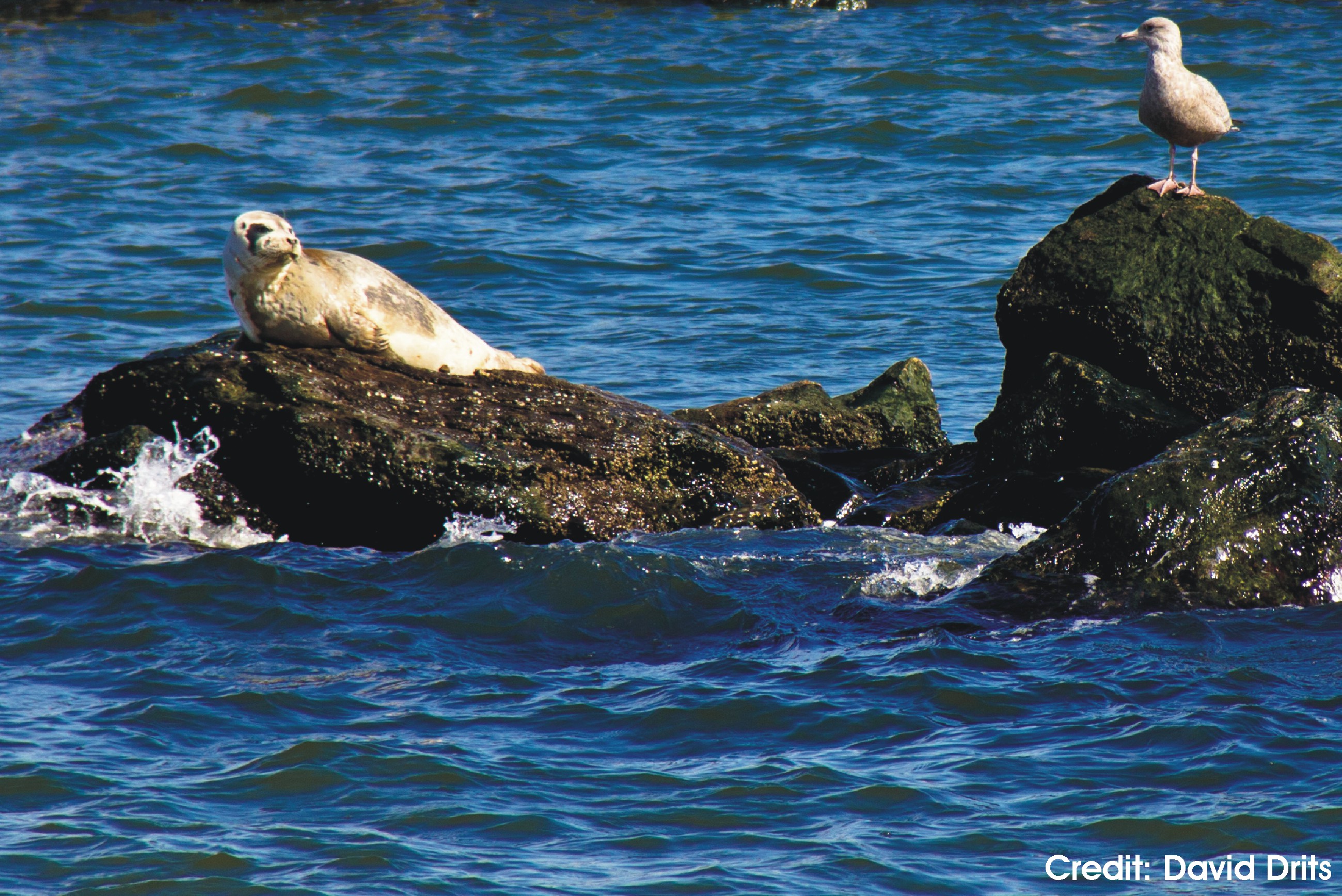
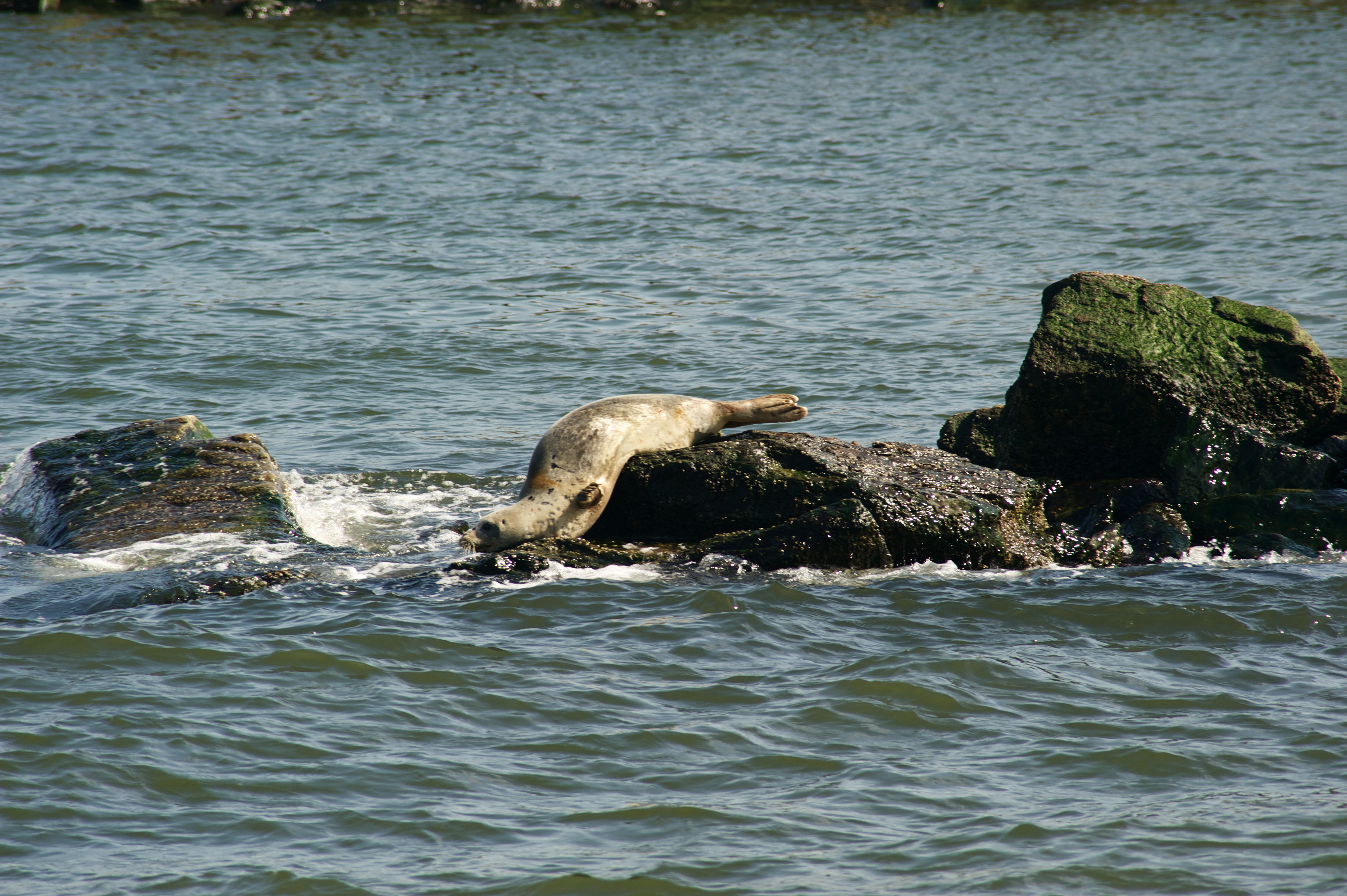
The pictures are from Swinburne Island, which is between Coney Island and Staten Island.  There were eleven seals visible at first, but unfortunately, our boat spooked them into the water.  Here’s is the last of the seals, waddling off its rock and doing a face-plant before finding its way back into the sea.

Credits: Gavin Guerra

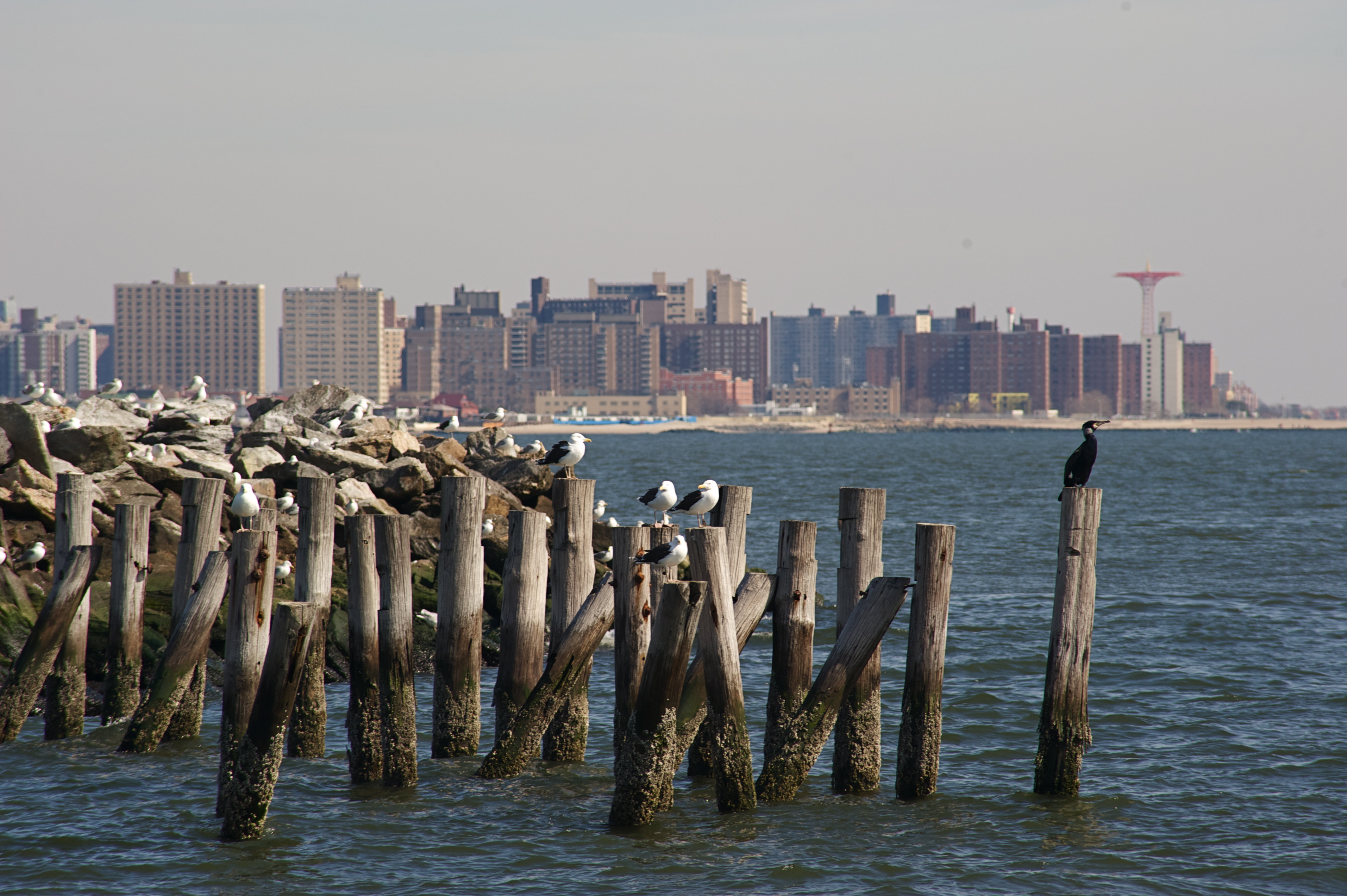
… Not to sell short the charming cormorants, which seem to combine the looks and swimming ability of a skinny penguin, the fish-diving ability of a pelican, and the vomiting ability of a fraternity brother.  They have also re-established their colony in our waters, as small fish have become more abundant and pollutants less so.

A cormorant (right) in front of the view of Coney Island. Credit: Gavin Guerra

<!–[if gte mso 9]> Normal 0 false false false EN-US X-NONE X-NONE <![endif]–><!–[if gte mso 9]> <![endif]–> <!–[endif]–>Apparently there are roughly twenty seals that call New York City’s waterways home.  This is a relatively new population, and the NY Aquarium estimates that their number has been growing in recent years – testament to the improving water quality and food available in our waters.
Posted in photography, water | Tagged , , , , , , , , , | Comments Off on New York Harbor Seals

Fish found a solution to PCB pollution

Fish found a solution
To G.E.’s grand pollution:
To P.C.B.s
They say, “Yes, please!”
It’s modern evolution.

– Kat Allen

Read or hear the NPR story here:

And the peer-reviewed scientific article is in the journal Science, here.

[This is a guest poem by Katherine Allen, PhD student at Columbia University’s Lamont Doherty Earth Observatory.]

Posted in poetry, water | Tagged , | Comments Off on Fish found a solution to PCB pollution

The NYC Storm Surge Threat

New York City is highly vulnerable to a hurricane strike due to its location near the coast where winds and storm surges are usually at their maximum.  On one hand, we are fortunate that direct hurricane strikes are extremely rare – four hurricanes have struck NYC since 1600. On the other hand, residents have been lulled to complacency by this recent long period without a hit. Storm surges in these hurricanes were 10-13 feet, which flooded about half of Manhattan below 34th Street and large swaths of East Harlem, Queens, Brooklyn and Staten Island.

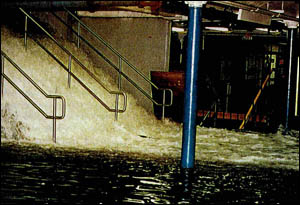
Flooding in the Hoboken PATH station during a 1992 nor'easter, which shut down the entire NYC subway system (Metropolitan NY Hurricane Transportation Study 1995).

Even a powerful nor’easter can cause serious damage in NYC, and the most recent severe flooding incident occurred in December, 1992.  Seawalls around the city are mostly only a few feet above normal high tide levels, so a relatively modest peak storm surge of 4.3 ft during that storm flooded into and shut down the subway system for several days.  The funnel-shaped coastline offshore can focus and build a storm surge to a greater height, and the two water pathways through New York Bay and Western Long Island Sound can cause a merging surge that is difficult to predict.

As one part of a project called Consortium for Climate Risk in the Urban Northeast, we are quantifying storm surge risk in NYC, Philadelphia and Boston, in our current climate as well as future climate with sea level rise.  Climate change is likely to increase the storm surge threat due to sea level rise and also potentially due to ocean warming, which may (or may not) increase the number of intense coastal storms. Sea level rise has proceeded at a rate of 1.8 cm per decade over the past century, but is projected to be between 5 and 30 cm per decade in the 2080s. Even conservative sea level rise projections, when combined with historical storms, can triple the frequency of key planning metrics such as the 1 in 10 year coastal flood event (Horton et al., 2010).

Storms occur infrequently, so it is useful to use computer simulations of thousands of storms and the ocean’s response, to understand flood probabilities.  We are running storm surge simulations using the ocean model sECOM, the Stevens Institute version of the popular ECOM (Estuary and Coastal Ocean Model).  Coastal water level predictions are available for the New York and New Jersey, and Connecticut coastlines through the New York Harbor Observation and Prediction System (NYHOPS) and the Stevens Storm Surge Warning System.

Posted in water, weather | Tagged , , , , , , , , , , , | 1 Comment