Irene Update: 11am Thursday

[a more recent forecast followed this one – go straight to SeaAndSkyNY.com and scroll down to find the latest update]

This morning, the Hurricane Irene forecast from the National Hurricane Center has deteriorated for New York and New Jersey interests.  Irene is currently forecast to pass right along the NJ coast and across the eastern boroughs of New York City as a strong Category 1 Hurricane on Sunday August 28th.  As before, the forecast at three days lead time is still highly uncertain.
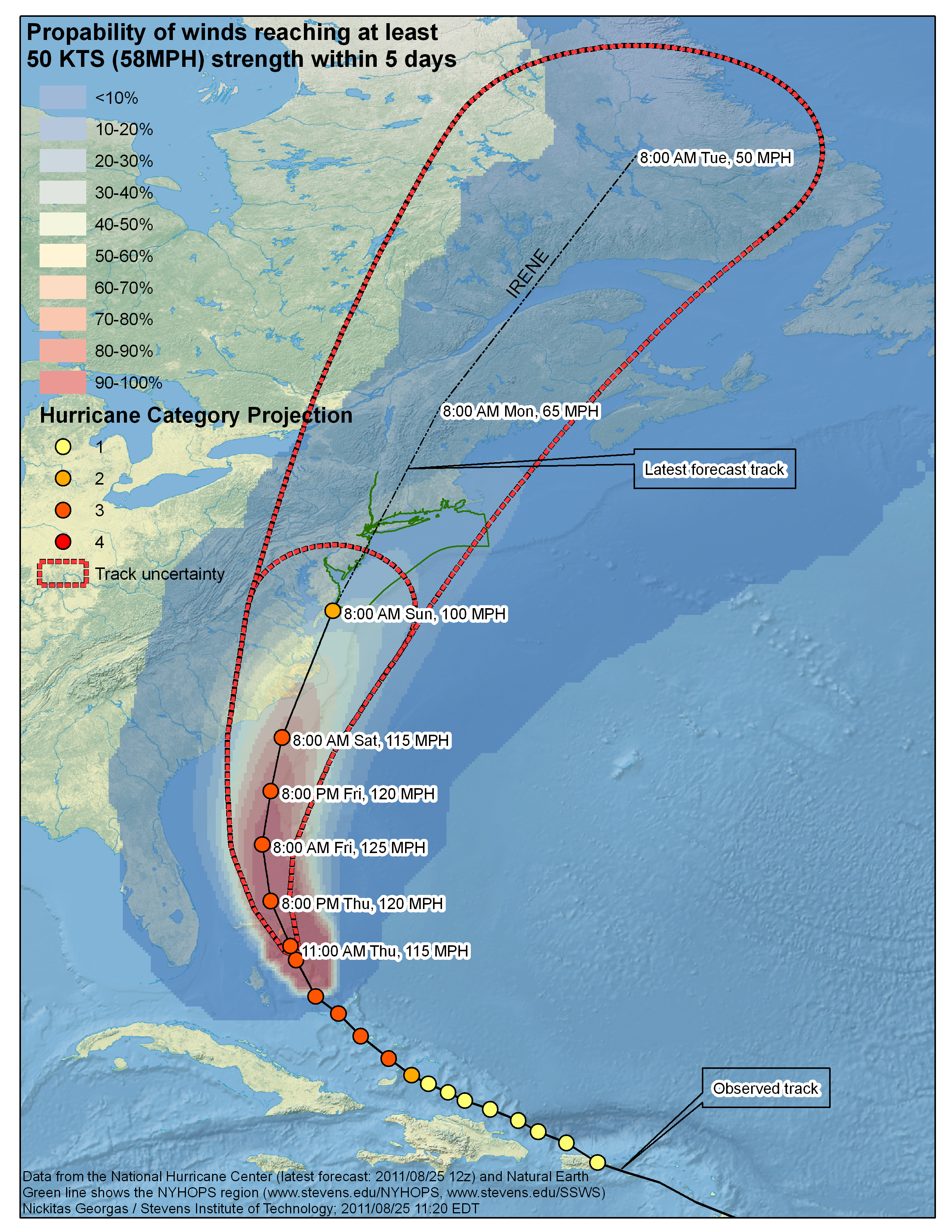
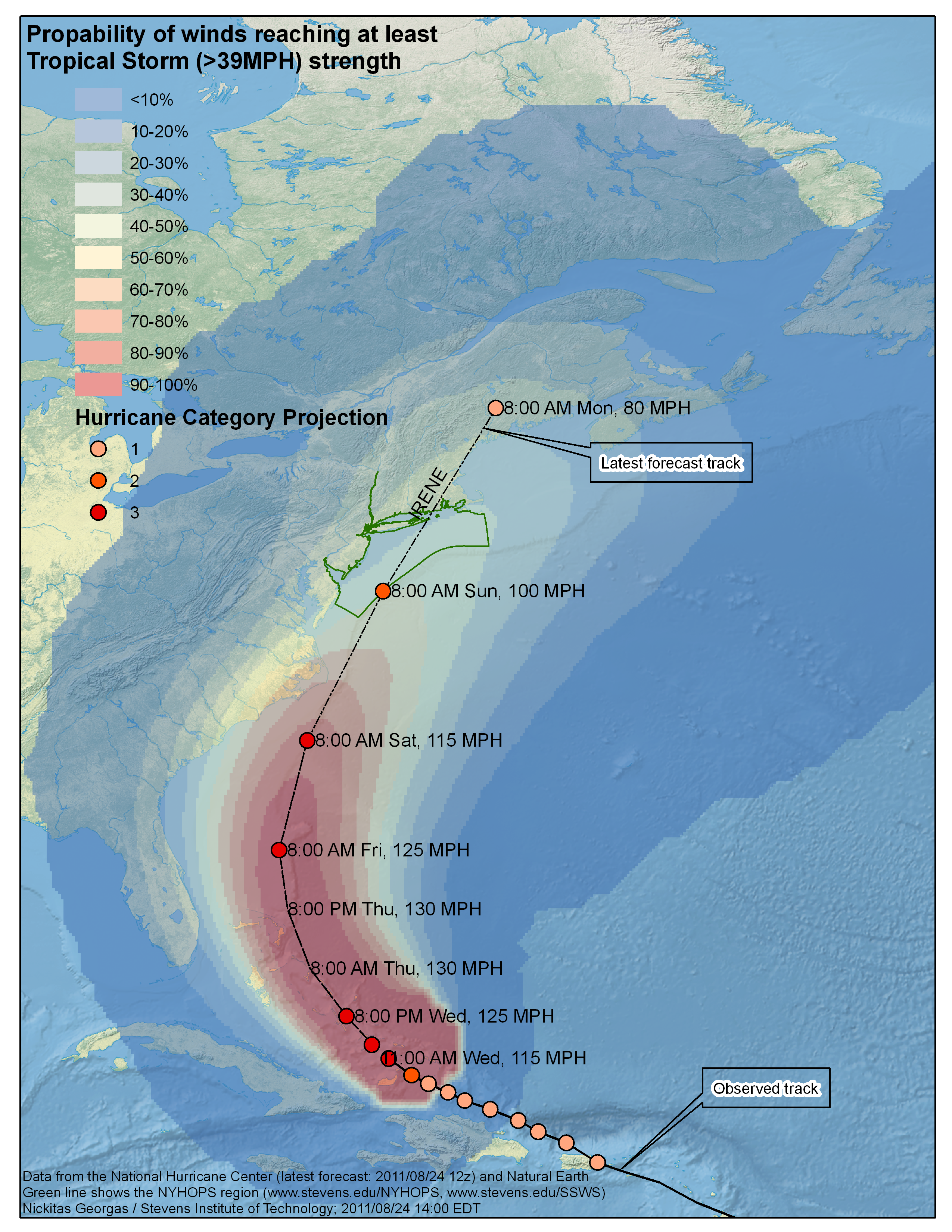
NHC forecast track for Hurricane Irene, including probabilities of Tropical Storm force winds. Our NYHOPS/SSWS domain is superimposed with a green border. Courtesy of Dr. Nickitas Georgas.

The chances of NYC getting very dangerous 58+ mph steady winds are about 15% (see above), and the chances of having hurricane force (74+ mph) winds in NYC are still listed by NHC as being below 5%.  However, the deadliest part of a hurricane is typically its storm surge, and even if the eye doesn’t hit NYC, we could see our worst storm surge in over 100 years.

All of the models have now shifted the position of Hurricane Irene westward, with some tracks going inland in the mid-Atlantic states, many over New Jersey or near New York City, and a few over Long Island.  The only silver lining is that the storm is expected to weaken due to interaction with land, but it is still likely to be hurricane strength at landfall.  This is also a large storm, so impacts will be felt for hundreds of miles.

The likely worst case scenario was spelled out in a recent post, comparing the storm to a hurricane that hit NYC in 1821.  Stevens Institute two-day advance forecasts of storm surge, as well as waves and currents for NYC, NJ, Long Island waterways, are posted at about 1:30 AM daily, so look for them Saturday morning to give highly detailed forecasts for Irene’s impacts.  In the meantime: Later today, NOAA’s storm surge model (SLOSH) will begin providing useful information for our area, with probabilities of various water levels.  However, at this point, their model only projects out to Sunday morning so it highly misleading in its probabilities.

The timing of the passage of Irene, during a new moon (Aug 29) at perigee (Aug 30), means that the spring tide range on Sunday will be one of the highest of the year.  Presently, the Hurricane is forecast to approach the southern NJ coast late Sunday morning, passing Atlantic City at about the time of Low Tide (1pm).  The hurricane is forecast to move slowly up the coast, making landfall along the South Shore of Long Island at about the time of High Tide (8pm).  This timing is significant in that the incoming tide will increase the potential storm surge from south to north along the coastline of the NY Bight.
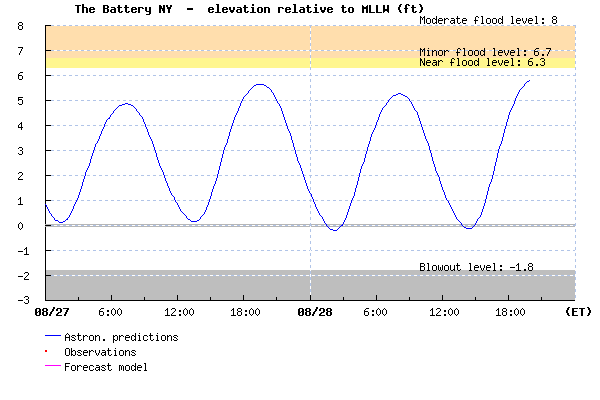
Predicted Tide (NOT including storm surge) at The Battery, New York City, for Saturday and Sunday August 27-28. High tides along the Jersey Shore are about one hour earlier.

Due to the more westward forecast track, the predicted ocean wave heights have decreased slightly to 6.5 – 7.5 m (21 – 25 ft) on the shelf waters but will still generate extreme breaking waves and significant beach erosion (NOAA’s WavewatchIII).  Waves can also cause higher water levels at area beaches, due to wave run-up and wave set-up, and this isn’t typically included in storm surge forecast models.

It must be emphasized that the exact track of the hurricane can vary by 200 miles beyond the 24 hour forecast, however; this is a large hurricane that will broadly impact the entire region.  The National Weather Service and local Offices of Emergency Management (NJ, NYC, Nassau and Suffolk counties) are now urging people to begin to make preparations for the storm.  For the most current storm guidance, watches and warnings go to the NOAA Tropical Prediction Center: http://www.nhc.noaa.gov/index.shtml

Tom Herrington and Nickitas Georgas also contributed to this post.
Posted in water, weather | Tagged , , , , , , , , , , , , | Comments Off on Irene Update: 11am Thursday

Irene Update, 2pm Wednesday

[a more recent forecast followed this one – go straight to SeaAndSkyNY.com and scroll down to find the latest update]

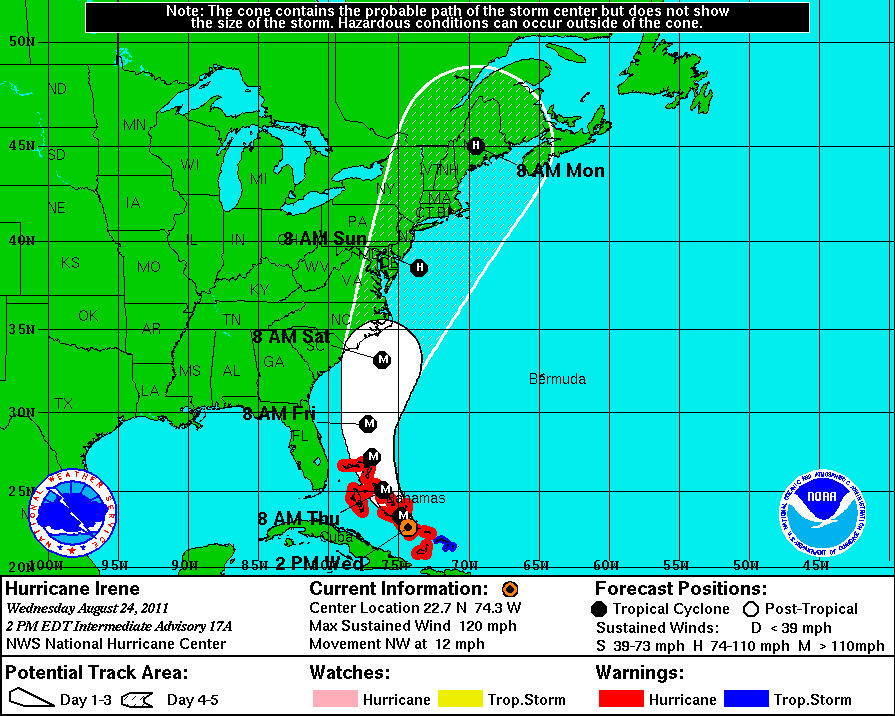
The 2pm update from the National Hurricane Center shows a “best estimate” forecast track for Hurricane Irene clipping the Outer Banks at Category 2-3 (110 mph winds), then making landfall near Providence at Category 1 (90 mph winds) on Sunday night.  As always, they make clear that there is substantial track uncertainty beyond a few days forecast (average error of 200 miles at 4 days).  This distance suggests a range of likely landfall from North Carolina to Nova Scotia, so things are still highly uncertain.

Uncertainty still reigns, and hurricane landfall on the Jersey Shore, hammering New York City, or along Long Island is still a reasonable possibility.  Straight from the NHC forecast discussion: “THE GFDL AND HWRF MODELS REMAIN ALONG THE WEST SIDE OF THE GUIDANCE ENVELOPE AND SHOW A TRACK OVER OR VERY CLOSE TO THE MID-ATLANTIC COAST. THE UKMET AND NOGAPS ARE ALONG THE EASTERN SIDE AND KEEP THE CORE OF THE HURRICANE WELL OFFSHORE. GIVEN THE TYPICAL MODEL AND OFFICIAL TRACK ERRORS…BOTH SCENARIOS ARE VIABLE OPTIONS AT THIS TIME…”

Here is a map of probabilities of tropical storm force winds, based on NHC data.  Superimposed is the NYHOPS and Storm Surge Warning System model domain (green), where we provide storm surge forecasts two days into the future.

NHC forecast track for Hurricane Irene, including probabilities of Tropical Storm force winds. The NYHOPS/SSWS domain is superimposed with a green border. Courtesy of Dr. Nickitas Georgas.

The regional National Weather Service Office says, “THE EXACT TIMING IS STILL UNCERTAIN…BUT HEAVY RAIN…STRONG WINDS…AND COASTAL FLOODING COULD BEGIN AS EARLY AS LATE SATURDAY.”  Add to this, the possibility of damaging waves and coastal erosion, for the New Jersey and Long Island coastlines.  The NOAA Wavewatch model predicts waves hitting the New Jersey and Long Island shores of 16 to 23 ft if the storm passes offshore.

Keep your fingers crossed that it’s a curve ball out into the Atlantic.

Posted in water, weather | Tagged , , , , , , , | Comments Off on Irene Update, 2pm Wednesday

Updated Irene Forecast: Storm Still Targeting NYC

[a more recent forecast followed this one – go straight to SeaAndSkyNY.com and scroll down to find the latest update]

Recent updates from the National Hurricane Center show a forecast track for Hurricane Irene over the Outer Banks at Category 3, then making landfall close to New York City at Category 1.  As always, they make clear that there is substantial track uncertainty beyond a few days forecast (average error of 200-250 miles at 4-5 days) — we hope to post a probability map in the coming hours.

As I said 18 hours ago, this is very similar to the track of the worst hurricane to ever hit NYC, back when it had a much smaller population in 1821.  Fortunately, the forecast strength of the storm is generally weaker.  Nevertheless, a storm track along the Jersey Shore or onto New Jersey is very bad for NYC storm surge flooding (see here, or here), as both the onshore winds and the strongest winds are to the right of the propagation path.

Posted in water | Tagged , , , , , , , | Comments Off on Updated Irene Forecast: Storm Still Targeting NYC

Hurricane Irene: Parallels with 1821?

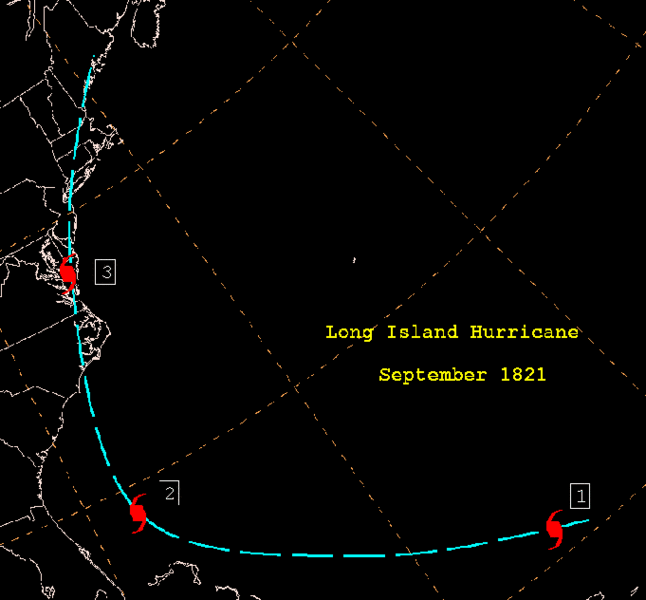
The Norfolk and Long Island Hurricane of 1821, the most damaging hurricane to strike NYC in over 500 years (Credit: NOAA).

[temporary note:  With Irene approaching our area, I’ll mention that it has shown some weakening instead of strengthening on Friday, so it extremely unlikely to have a similar strength or impact to the Hurricane of 1821.  Check the latest updates at http://SeaAndSkyNY.com%5D

Hurricane Irene is approaching the Bahamas, and models suggest it is likely to hit the U.S. Southeastern coast somewhere around the Carolinas.  The forecast storm track and intensity is similar to the most destructive storm to have hit NYC in the past 500 years, the “1821 Norfolk and Long Island Hurricane“, that caused a 13-foot storm surge which inundated large low-lying tracts of NYC.  Moreover, it could arrive in the area around the day of spring tide (next Wednesday), potentially adding a few more feet to the surge.  There remains a great deal of uncertainty with the storm so far off, but this should definitely be on our radar.

Surprisingly, the Norfolk storm is believed to have had its eye over land for much of it’s final few days preceding NYC landfall, just inside the North Carolina, Delmarva, and New Jersey coasts.  However, this coastline contains a great deal of warm surface water in bays and estuaries, so can still help supply fuel to support a hurricane.

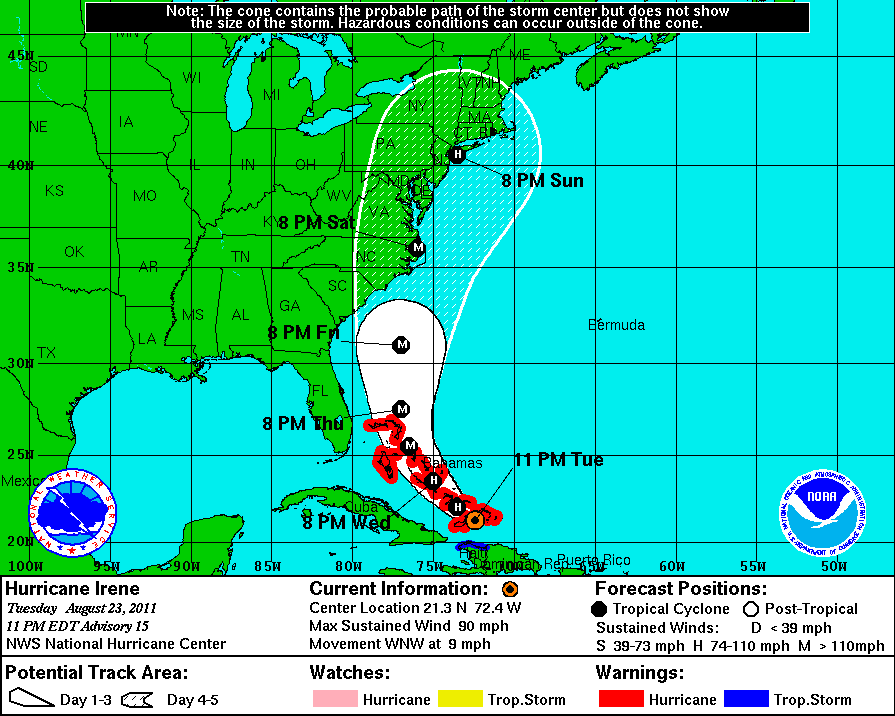
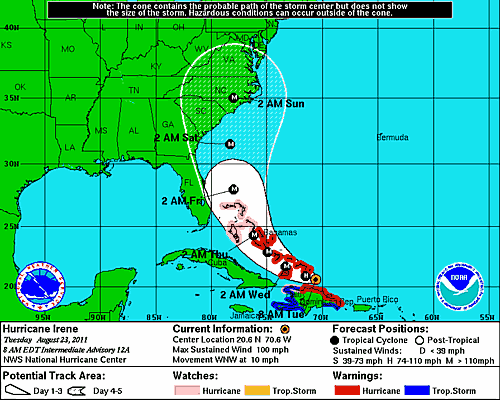
Forecast track of Hurricane Irene, projected to be a major hurricane with wind speeds of 135 mph when it makes landfall around North Carolina (Credit: National Hurricane Center).

Evacuation of 1-2 million people in low-lying NYC neighborhoods deemed vulnerable to a 15-foot storm surge would require advance notice of two days … so some difficult choices would have to be considered this coming weekend if the storm hits North Carolina and appears on track to maintain hurricane strength and approach our shores around Tuesday [note that a newer forecast suggests Sunday].  An excellent simulation of the city’s response to such an event is available from the NYC Office of Emergency Management (follow the link, then drag the red timeline bar to see the progression to Day 0, the day of landfall).

The likelihood of Irene striking the Southeastern U.S. Coast is moderately high, but the NHC’s forecast discussion makes clear that “IT IS IMPORTANT TO REMIND USERS NOT TO FOCUS ON THE EXACT FORECAST TRACK…ESPECIALLY AT DAYS 4 AND 5 (or beyond) … SINCE THE MOST RECENT 5-YEAR AVERAGE ERRORS AT THOSE FORECAST TIMES ARE 200 AND 250 MILES… RESPECTIVELY.”

My interpretation is that the likelihood of Irene striking near NYC as a hurricane is still low, below one-in-ten.  This is because there is still a week of travel between us and the storm.  There is plenty of time for it to diverge inland or out to sea, or for it to weaken due to tracking over land, cold water, or due to wind shear.  Let’s hope it veers eastward of its forecast track and stays out in the Atlantic with no continental landfall whatsoever.  At the minimum, this storm will provide a real-time test of early hurricane preparedness plans…

Posted in security, water, weather | Tagged , , , , , , , , , , | Comments Off on Hurricane Irene: Parallels with 1821?

Pathogen Forecast for the Latest Hudson Sewage Spill

There was another sewage spill in the Hudson, from a broken sewage pipe at Ossining, New York.  Fortunately, this time the volume was about one hundred times less than the North River Wastewater Treatment Plant spill back in July.  Nevertheless, Hudson River beaches in Westchester and Rockland Counties have been closed.  [Note that actual bacterial measurements from the Hudson Riverkeeper are in, as of Sunday, showing low risk for swimmers and fishing from pathogens, likely due to simple dilution, but possibly also due to high amounts of chlorine added at the source.  We are back to normal conditions, where rainfall events are the primary reason for sewage overflows].

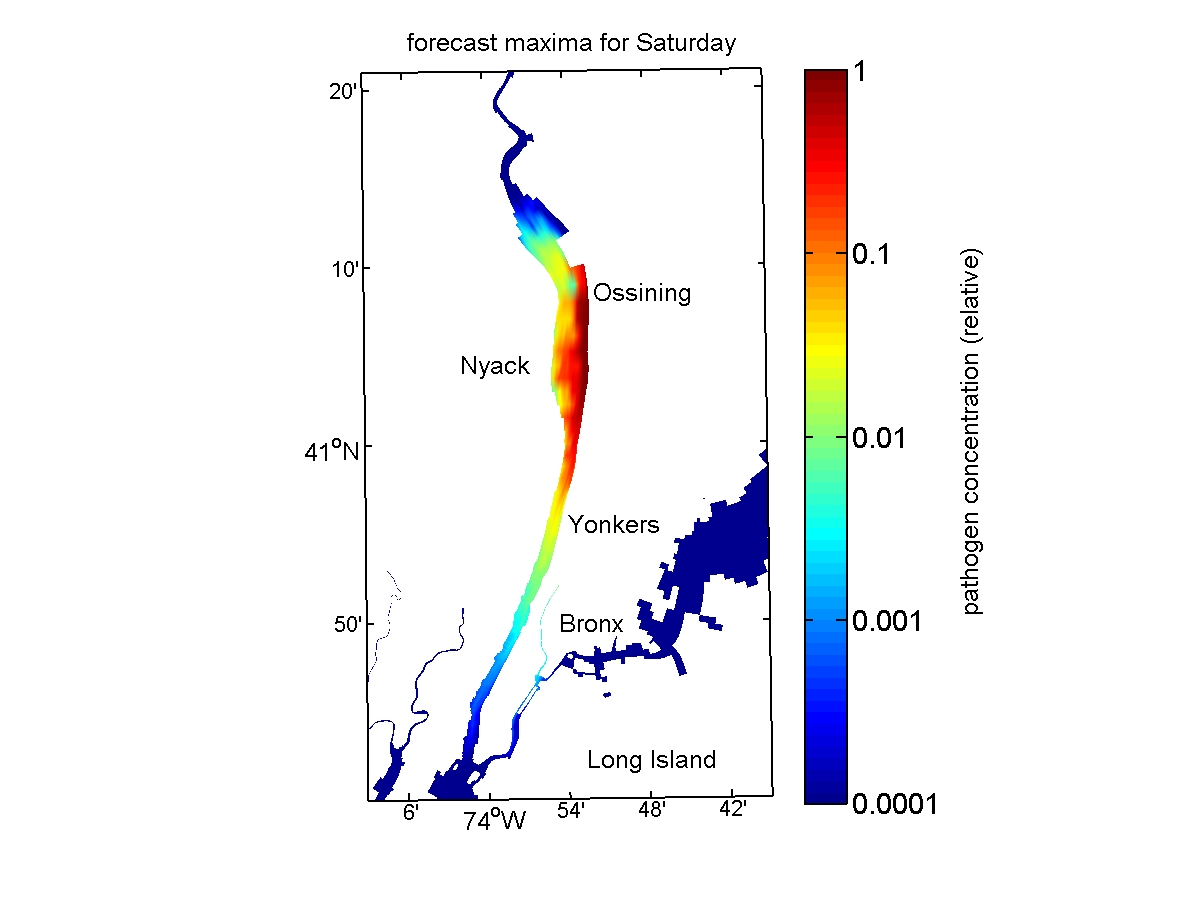
Here is the pathogen forecast for Saturday, covering the area’s waterways, based on the Stevens Institute of Technology’s sECOM ocean model, used for the New York Harbor Observing and Prediction System (NYHOPS).

Saturday's maximum pathogen concentrations in surface waters, relative to a source of 1.0. A full movie of the 3-day simulation is linked from the next figure, below.

The simulation shows how dilution and mortality reduce the concentration of pathogens from an unknown source concentration (assumed to be 1.0) in the Hudson near Ossining.

The main conclusions I draw from the simulation are:

  • Maximum (relative) concentrations in Westchester County from Croton Point southward to Yonkers are high, close to the source concentration
  • Transport northward is minimal — maximum concentrations at shorelines along Haverstraw Bay (north of Croton Point) are ~1/100 the source concentration. They are even lower beyond Indian Point, below 1/1000 around Peekskill.
  • Maximum concentrations off Yonkers and Rockland County (west side of the Hudson) are ~1/10 the source concentration – potentially dangerous*!
  • Maximum concentrations off northern Manhattan (Hudson and Harlem Rivers) are ~1/100 the source concentration, possibly (but unlikely) of danger for swimming or fishing*
  • Maximum concentrations off southern Manhattan are ~1/1000 the source concentration
  • Maximum concentrations at Staten Island and Brooklyn beaches are <<1/10000 the source concentration, definitely negligible

*The various counties and cities Departments of Health are in charge of making decisions on public safety, and is taking observations and running detailed microbiological models in place that should be more useful for determining where beach closures are necessary.  So one should consult the Westchester County DOH website , Rockland County DOH website, and NYC Dept of Health website for questions of water safety.

Here is a full 3-day movie of the entire simulation:

Click on the figure to go to YouTube for a full movie of the 3-day simulation

The simulation and sewage spill starts at 12:00 AM, Thursday August 11th.  The sewage spill ends at 5:00 PM on Friday, and the simulation ends at 11:55 PM on Saturday August 13th.  The time the sewage spill began is currently unknown, but we assume it started at midnight on the 11th.  The model simulation simulates transport in all three spatial dimensions, though the forecast maps above are for near-surface waters.  The pathogens have a standard (published) die-off rate, with temperature and salinity dependence.  The effects of particle settling and sunlight (phytotoxicity) were not included in this model run for lack of detailed information, but would both act to further reduce the concentrations.

Posted in water, water pollution | Tagged , , , , , , , , , , , , , , , , , | 3 Comments

Where Is The Sewage Spill Plume Going?

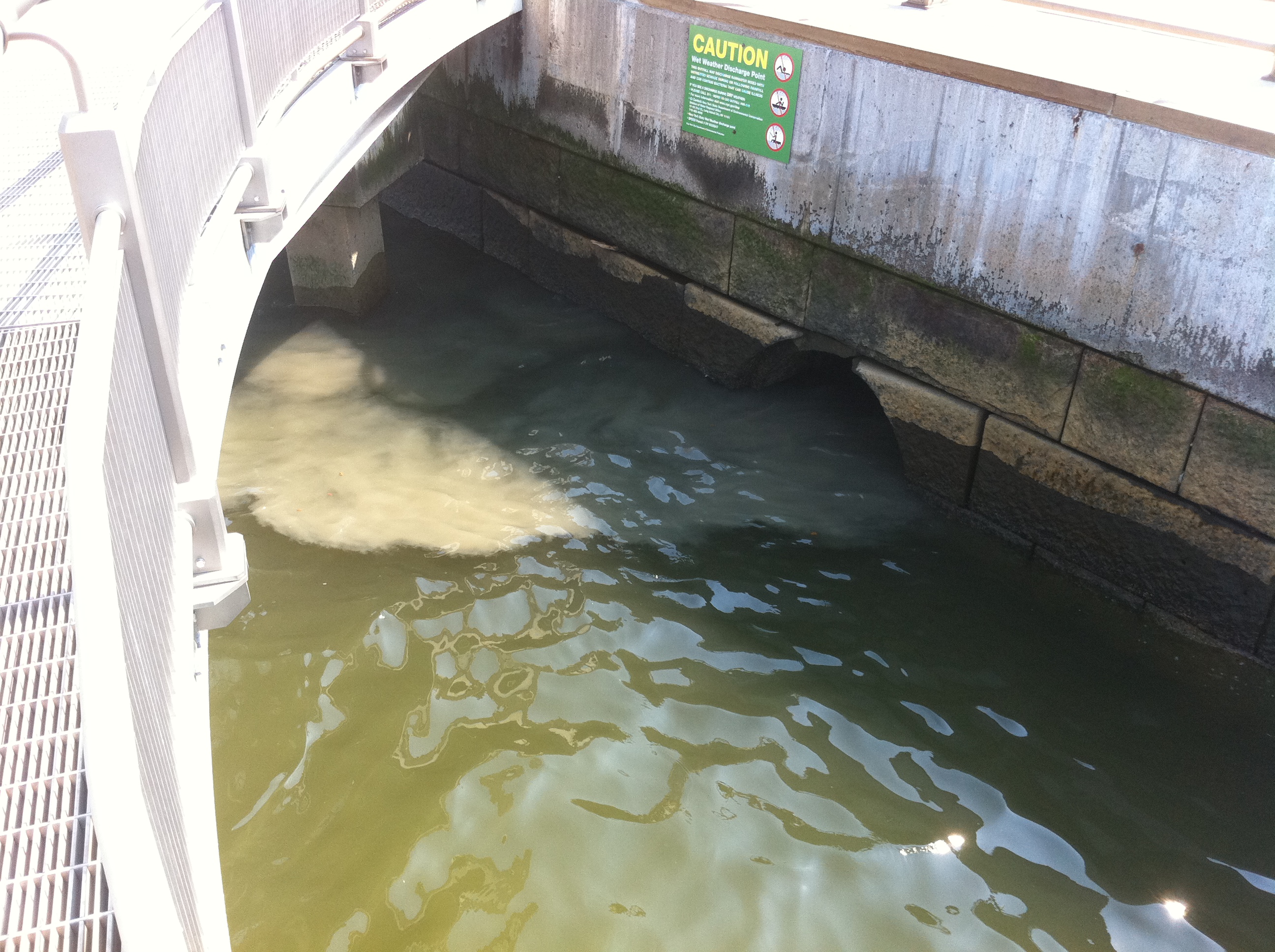
Sewage from the plant disabled at Riverbank State Park is being re-routed to several sites on the Hudson and Harlem Rivers. Here is one sewage source into the Hudson River, 10am on July 22nd, located a few blocks north of Christopher Street, Manhattan.

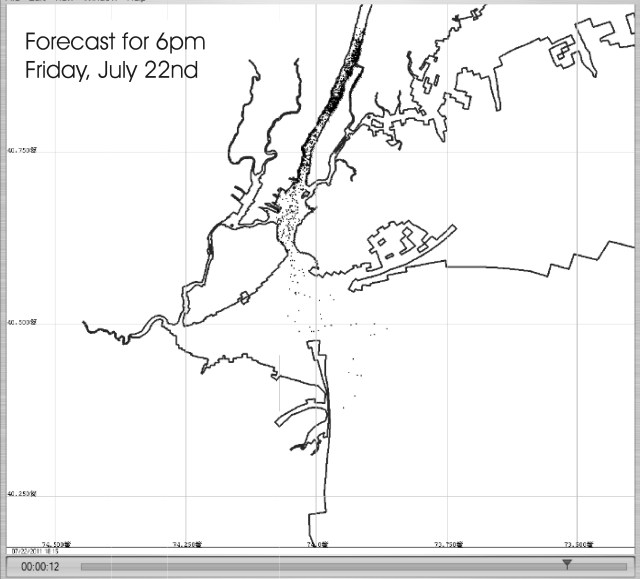
Linked below is today’s updated sewage plume hindcast/forecast video based on the Stevens Institute of Technology NYHOPS ocean model and created using NOAA’s GNOME particle tracking tool.  The simulation runs from 5:15 PM, Wednesday July 20th to 12:00 AM, Saturday July 23rd, 2011 (tonight at midnight).  This forecast information is being utilized by the NYC’s Department of Environmental Protection (DEP) and the New Jersey State DEP.

Note that the simulation simply shows where water “parcels” (black dots) travel from the six (reportedly) primary spill sites, and does not directly simulate the sewage or pathogens, which would be significantly more complicated.  The dangerous bacteria in the sewage are thought to survive less than one day, and this is an area where the physics can only tell you so much.  Based on continuing visual observation, the sites in Harlem are sourced with five times the outflow of the sources in lower Manhattan.

The New York City DEP is in charge of making decisions on public safety, and is taking observations and running detailed microbiological models in place that should be more useful for determining where beach closures are necessary.  So one should consult the DEP website for questions of water safety.

Plume simulation movie -- click to watch. Black dots simulate discrete parcels of water moving through the system. The material in the plume model does not decay or biodegrade, so the dispersion of black dots gives a conservative estimate of where pathogens may be present. Also note the caveats below about whether the plume reaches Long Island Sound.

We have moderately high confidence in a few conclusions about the plume transport.  These relate to the forecast model results in the Hudson, New York Harbor and out to the ocean, and these are also based on our assessment of the extensive observations that are also available in NYHOPS.  Tides are dominating the plume movement, and cause it to pulse back and forth up the Hudson.  The plume gets spread mostly through the lower Hudson along Manhattan, The Bronx, and New Jersey, but also in smaller amounts to near the ocean beaches of Brooklyn and Staten Island.  (See below about Long Island Sound).  The results also suggest that transport northward up the Hudson (e.g. upstate New York, Westchester County) may be small, compared to transport out toward the ocean beaches, though caution should still be exercised and measurements made to check water quality.  They suggest that transport across the Hudson to New Jersey takes less than one day, so contamination could occur there – incidentally, Hoboken has put out a warning.

We do not have confidence in the results for the sewage outfall(s) apparently occurring in Harlem River, and whether or not it is transported to the upper East River – the results there don’t seem to match the physics we know exist, and we cannot comment on the impact to Western Long Island Sound beaches with confidence.  However, based on our previous experience, the western sound should be monitored carefully too, and may be dangerous for swimming.  The problem is presumably due to having water currents flowing through narrow tidal channels with only a few model grid cells fed into the NOAA GNOME tool we use to simulate the plume.

Yesterday’s post demonstrated how a spill site can be identified, including smooth water surfaces, bad smells, and seagulls feeding on the small fish that are attracted to the plume.

Additional credit for producing the plume simulations goes out to Dr. Alan Blumberg, Dr. Julie Pullen, Liang Kuang, and the Center for Secure and Resilient Maritime Commerce (CSR) Summer Institute students: Fernando Arroyo, Chris Filosa, Chris Francis, Drew Orvieto, Brian Paul, Greg Sciarretta.

Posted in water, water pollution | Tagged , , , , , , , , , , , , , , , | 2 Comments

Bike Touring the Aftermath of the Riverbank Sewage Meltdown

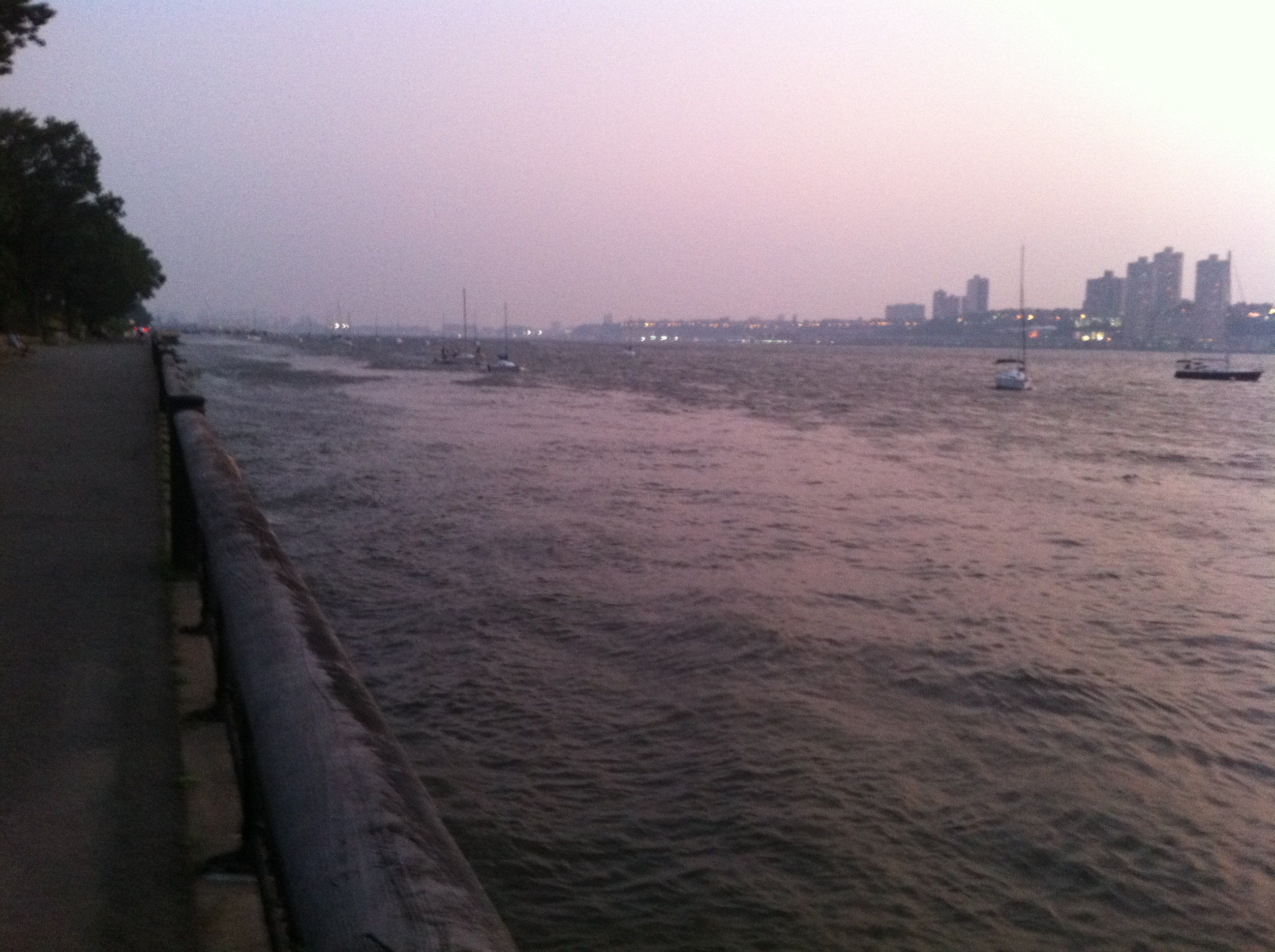
Raw sewage/freshwater plume (smooth water) about 40 feet wide on the Manhattan side of the Hudson at 96th Street, looking south

You likely heard the news, that a fire at the North River Wastewater Treatment Plant, which lies beneath Riverbank State Park, disabled the facility Wednesday afternoon.  As a result, the city cannot treat sewage from roughly half of Manhattan, and the only obvious solution is to send it straight out of pipes into the Hudson River (possibly also the Harlem River, though the City has not put out ANY warning of that to this point …).

I did a little bicycle tour of the east side of the Hudson this evening, from 26th St to 125th St., then crosstown on 120th Street to the Harlem River.

Heading from south to north, I saw and smelled no evidence of spills south of about 79th St. Boat Basin, and kayakers at Manhattan Kayak Club (27th St.) had only heard a few sightings of “floaters”, which might even have been mistaken identity.

Starting after 79th Street Boat Basin, a slick appeared close to shore (picture above).  The slick was erratic at first, but got wider as I went north, until it was about 100 feet wide at 125th Street (below).

Raw sewage/freshwater plume (smooth water) about 100 feet wide on the Manhattan side of the Hudson at 125th, looking south. Rougher and darker looking water marks the offshore boundary.

There at the south end of West Harlem Piers Park, I took pictures of the outfall (uck!), though it was a bit dark by then, well after sunset.  This was in line with the fact that the Riverkeeper patrol boat only observed sewage spills occurring at 125th Street and Dyckman Street to the north.

Raw sewage plume of brown smelly water spewing into Hudson from pipe at 125th St, at south end of Harlem Piers Park

The tide was ebbing toward the ocean, with wind and waves coming from the south.  The fact that the plume dwindled as it went south with the ebb currents and choppy wavy waters (causing mixing) made good sense.

It is very likely that this smooth-water region was the sewage and freshwater plume — I have a lot of field and research experience tracking freshwater plumes from rivers, from boats, helicopters and radar imagery from satellites.  The smoothness of the water surface and the sharp gradient offshore, coupled with my actually following it to the source, strongly supports this interpretation.  The water surface can be made smoother when there is freshwater at the surface because the estuary water is salty and has a higher density. Therefore, the water becomes density-stratified (or layered, like some cocktails) and resists vertical motions.  Additionally, the sewage-tainted water is ladened with high amounts of organic matter and oils, which also act to smooth the sea surface, due to weaker surface tension — this relates to a famous story about Benjamin Franklin, who sprinkled oil on a lake with his cane like a sorcerer to “magically” stop waves.

It is worthy to note that the “sewage” was basically just brown water, with no obvious floaters.  I am beginning to realize from this experience and other online footage, that’s just how raw sewage looks after running for miles through the pipes…  and it smelled, but not much except right at the outfall (perhaps due to strong winds and dispersion).  Yet, this is still very dangerous water, which can cause severe illness if people come into contact.

It was totally dark by the time I reached Harlem River, but I saw and smelled no obvious sewage problems in my short survey from 120th Street to 96th Street.

In my next post, I will show and discuss our model results for sewage plume dispersion, which we have been sharing with the Department of Environmental Protection and the Hudson River Foundation.  Those model results suggest that the dispersion is likely much more broad than my personal observations at this one time would imply.  However, the model results do not include decay.  The dangerous bacteria are thought to survive less than one day, and this is an area where the physics can only tell you so much — it will require more collaboration and understanding of the microbiology to determine where the plume is actually dangerous, much like with last summer’s oil spill in the Gulf.

Posted in water, water pollution | Tagged , , , , , , , , | Comments Off on Bike Touring the Aftermath of the Riverbank Sewage Meltdown

Surf Temperatures Rising in Time for the Weekend

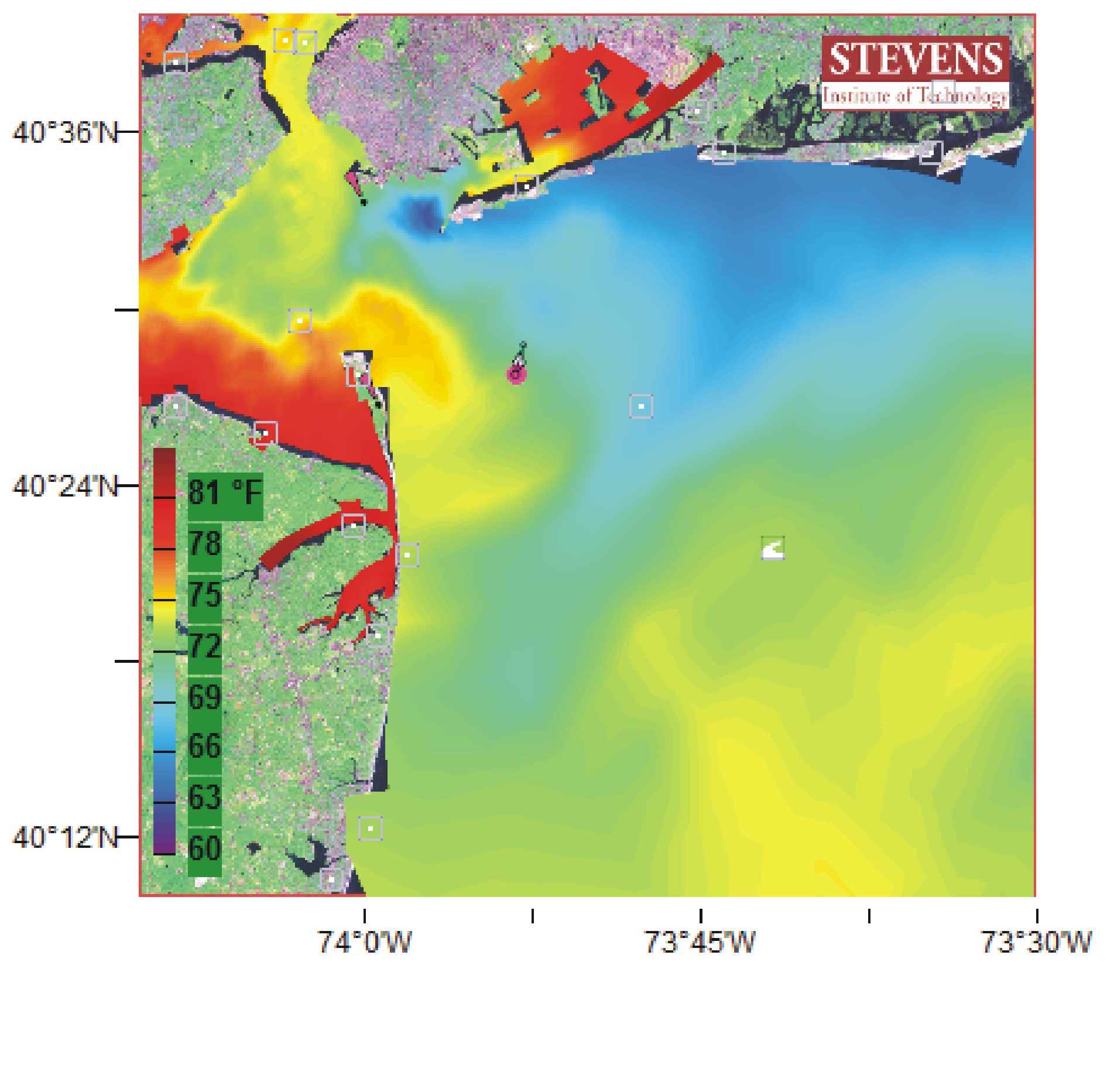
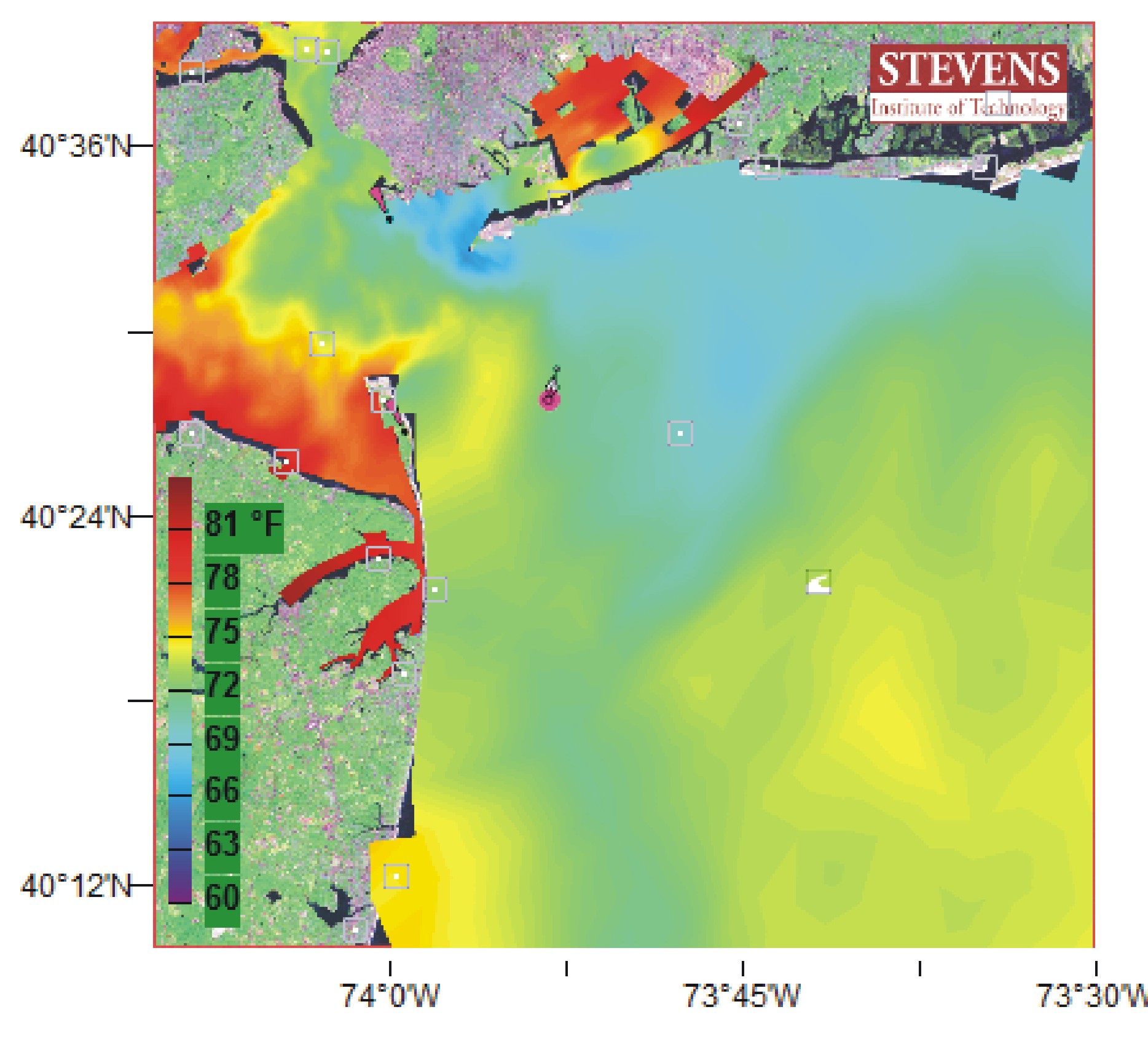
As our summertime weather turns spectacular in time for the weekend, the beach is getting pretty tempting.  While the past two days have seen a dropoff in water temperatures along Long Island, the good news is that they are back on the rise.  They briefly fell down to the low-to-mid-60s, but are projected to rise back to 70 degrees for Saturday and Sunday.  Below, you can see that while the Jersey Shore is basking in low-70’s water temperatures, Long Island beaches are much cooler.

NYHOPS modeled sea surface temperature map for the afternoon of July 14th, 4:00pm. Long Island is at the top.

The reason for this dropoff appears to have been coastal upwelling — we had 10-20 knot west winds at the coast for two days, and due to Earth’s rotation and the Coriolis Effect, a multi-day period with west winds will begin to drive surface waters toward the right of the wind, offshore in this case.  Deep waters up-well from below to replace the lost surface waters, and things get chilly.

Due to winds weakening and turning to come from the southwest and south, a more common summertime pattern, the upwelling pattern will “relax”, warm waters will come back onshore, and Long Island’s coastal waters will warm to near 70 degrees by tomorrow evening.  That is the furthest that today’s NYHOPS forecast extends ahead.

NYHOPS modeled sea surface temperature map for the evening of July 15th, 11pm -- note how the shading off Long Island has turned from a darker blue to light blue, indicating temperatures are rising from mid-60s to about 70 degrees F.

To you surfers and beach-goers:  One can access these predictions using the New York Harbor Observing and Prediction System (NYHOPS), by clicking NYHOPS Forecast tab, then the New York Bight Apex button.

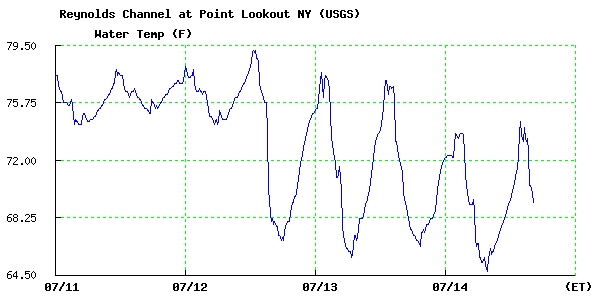
Of course, models aren’t always right, so it is useful to check these predictions against observations.  NYHOPS has already been extensively compared against observations, and generally performs very well.   Unfortunately, there’s no beach site in our observation database, but one place with water temperature data that might be useful is Reynolds Channel at Point Lookout, for Long Island beaches.  Click on the “Data and Time Series” tab, then choose this station to look at actual observations.  The site is at an inlet, so tides affect the temperature, but it can be informative.

Here, it shows how temperatures took a dive the middle of this week … in terms of the twice-daily cycles you see, at this time of year, the minima reflect the cool ocean water coming into the inlet, while the maxima reflect the warm inland waters when the tides run out to sea.

Posted in water | Tagged , , , , , , , , , , , | Comments Off on Surf Temperatures Rising in Time for the Weekend

Jamaica Bay Restoration for JFK Airport Expansion?

Would you consider a trade-off of JFK Airport expansion for billions of dollars in funding to improve the environment of Jamaica Bay and surrounding neighborhoods?

What is the expansion of JFK Airport worth to New York City, State, and the Federal Government?  According to the Regional Plan Association, tens of billions of dollars per year in commerce, as well as tens of thousands of jobs.  Airports in the New York City metropolitan area are already severely over-committed, and JFK flight delays are by far the worst in the country.  Airport expansion is not only crucial to our region’s economy, but is a national issue because these delays “ripple through the national aviation network”. Moreover, continued constraints on air travel growth in the future will likely “weaken the nation’s ability to compete for global business”.

The Regional Plan Association has proposed fixes for the runway shortage, including expansion of JFK into 400 acres of Jamaica Bay as one option.  This represents only 1.6% of the current bay area, but several groups have joined together in protest of the additional degradation this would cause.  They happen to have a good hand to play – it is explicitly written into federal law that JFK cannot be extended further into Jamaica Bay.

My feeling is that this stalemate presents a golden opportunity – instead of resisting the effort to expand JFK, New Yorkers should seek an airport expansion deal that generously funds a long-term restoration effort.

As I laid out in a recent post, Jamaica Bay has many problems, such as sewage spills, low-oxygen dead zones, and disappearing marshes and islands.  Restoration of the bay can return it to something closer to its historic character, where it was filled with marshes, islands, and oysters.  Furthermore, it can protect hundreds of thousands of residents who live on land within range of a realistic 13-foot hurricane storm surge that could happen tomorrow — in that same post, I outlined how dredging of the bay’s entrance channel has led to a system that would amplify a hurricane storm surge.  New York City is already making great strides to reduce wastewater pollution in the Bay, but this doesn’t appear to be stopping the island erosion, as some had hoped.  A more bold restoration effort would in turn have a powerful positive effect on property values and reduce flood insurance costs in future decades.

What do you think – would you consider a trade-off of JFK Airport expansion for billions of dollars in funding to improve the environment of Jamaica Bay and its surrounding neighborhoods?  Or is the system already in good enough shape as it is?

Posted in opinion, water | Tagged , , , , , , , , , , , , , , , , , , | 1 Comment

Jamaica Bay Restoration: Anything is Possible if You’re Strategic

[This is a guest post from Charles “Si” Simenstad, Research Professor; Wetland Ecosystem Team, School of Aquatic and Fishery Sciences, University of Washington, in response to the question posed in a prior post, “What specific actions would you propose, if several billion dollars were available to improve the environment of Jamaica Bay and its surrounding neighborhoods?”]

Philip,

I’ve enjoyed reading the SeaAndSkyNY blog, and was particularly attracted to your earlier post about how Jamaica Bay is not exactly New York City’s “crown jewel” and the plethora of problems not only affecting the estuary’s ecosystems (e.g., low-oxygen dead zones and disappearing marshes and islands) but the future livelihood of hundreds of thousands of people living in neighborhoods surrounding the bay. However, I might from some experience caution you to not discount either the resilience of the Bay’s ecosystems or the capacity of the stakeholder community to respond with initiatives that would enable adaptation to future degradation.

My experience with restoration initiatives in Puget Sound, San Francisco Bay and other coastal regions, which has included extensively urbanized systems, suggests that all but the most extensively degraded estuaries have the capacity for resilience.  Even when residents think that their shorelines have become permanently anchored and contaminated by development and industry, as you say, “anything is possible!” San Francisco Bay is a case in point, where the somewhat modest Baylands Ecosystem Habitat Goals project in 1999 synoptically identified and mapped areas for improvement and recovery of the Bay’s shoreline ecosystems, much to the disparagement by many stakeholders; but, likely due simply to identifying the potential capacity of marshes, tidal flats, lagoons and other wetlands to recover, we now find restoration actions like the ~15,000 acres of the South Bay Salt Pond Restoration Project on a trajectory to recovery. While not without its conundrum of complications, inherent in shifting baselines and being situated in the “most invaded estuary in the world”, the promise of emerging wetlands is enlivening a broad spectrum of stakeholders.

Not that we necessarily can or even have the political will to reverse 100-200 yr of coastal change. The historic template is a noble goal, but many of the fundamental ecosystem processes—such as fresh water and sediment delivery—as well as new phenomenon—such as introduction and colonization by non-indigenous species—have changed the way estuaries function. As a result, the estuary’s response to restoration may alter the structure and composition of component ecosystems in a way that may not be part of the historic template. Thus, a fundamental criterion is for both restoration practitioners and stakeholders to acknowledge system constraints and understand and work with extant ecosystem processes. In the case of Jamaica Bay, where like many urban estuaries the shoreline has been extensively hardened, and nearly all of the fringing wetlands have been removed historically, the only feasible goal is to establish sites that are self-regulating and integrated within their mosaic of the developed landscape. But, if there is any opportunity to reconstitute natural processes that we know can recover more sustainable estuarine landscapes, features and biota, we have the opportunity to advance beyond the less-than-satisfactory mitigation represented by parks and esplanades even if we often have to settle for rehabilitation rather than rigorous restoration. Initiatives in urban estuaries offer the opportunity for expansion of public understanding, appreciation and even direct involvement in restoration that is actually often harder to mobilize in less disturbed landscapes.

While the functions, goods and services that humans value from natural ecosystems may not be easily, rapidly or totally recovered from multiple-stressed environments such as urban estuaries, understanding how we have constrained natural ecosystem processes can move us beyond just the “random acts of kindness” that tend to characterize urban shorelines (some of these ideas are expanded upon in http://www.sciencedirect.com/science/article/pii/S092585740500193X). We need to be more strategic and less opportunistic; more comprehensive and less project-specific; and more imaginative and less circumspect. In Puget Sound, where I am involved in the stimulating, albeit challenging, planning of comprehensive restoration and protection of the Sound’s ~4,000 km of nearshore ecosystems (see PSNERP; http://www.pugetsoundnearshore.org/) we have found considerable scientific and social traction by shifting the paradigm from opportunistic, “structure-based” (e.g., focus on ‘designing’ habitats) restoration approaches to repairing impaired and degraded nearshore processes that account for a broad spectrum of ecosystem functions, goods and services. This “process-based” concept also implies greater sustainability and adaptation to future stressors such as sea level rise and other climate change impacts at the coastal margin (see http://www.sciencedirect.com/science/article/pii/S092585740500193X). In fact, the innovative restoration planner would view climate change just as much an opportunity as a constraint.

But, as you well know, tackling restoration at these comprehensive scales and approaching it through the improvement of ecosystem processes requires more science that we have typically accumulated for these systems. And, the multiple stressors inherent in urban estuaries require more disciplines, skills and tools than suburban and rural landscapes.  Interdisciplinary science and engineering teams must be assembled to confront the complex issues of rehabilitating highly developed landscapes. Given the persisting uncertainty in urban estuary restoration, two science and technology approaches are almost essential: models – from conceptual to hydrodynamic, sedimentological, and ecological – to formulate predictions of ecosystem responses to restoration actions, and an adaptive management structure to reduce that uncertainty through more experimental learning. Based on our PSNERP experience, I suggest you will find that initiating scientific and technical white papers and other guidance documents, developing conceptual models that bring stakeholders to the table, instituting rigorous external peer review, and other “lessons learned” mechanisms that provide timely dissemination of results to the broader restoration community will instill both trust and confidence in the feasibility and value of taking on restoration at Bay-wide scale.

I applaud the incentive that through SeaAndSkyNY you have introduced to the concept and reality of restoring Jamaica Bay. Good luck!

Charles (“Si”) Simenstad, Research Professor; Wetland Ecosystem Team, School of Aquatic and Fishery Sciences, University of Washington (http://fish.washington.edu/people/simenstd/)

Posted in opinion, water | Tagged , , , , , , , , , , , , | Comments Off on Jamaica Bay Restoration: Anything is Possible if You’re Strategic