King Tides, a Window to Future Sea Level Rise

In late October, there was a little photo op, an NYC runway show for climate change, so to speak.  People were asked to go out and take a picture of the unusually high “king tide” which was about one foot higher than normal high tides around the area.  Put another way, this extra foot simulates what global warming induced sea level rise may bring about as soon as 20 years from now.
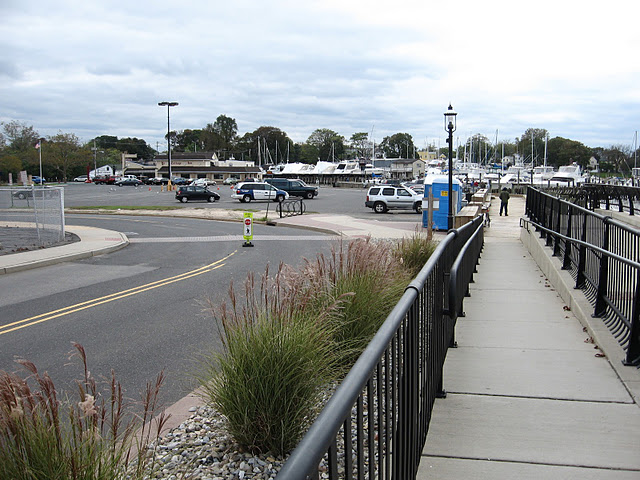
Picture of the normal high tide level at Keyport Harbor, New Jersey. Credit: Mark Fedosh.
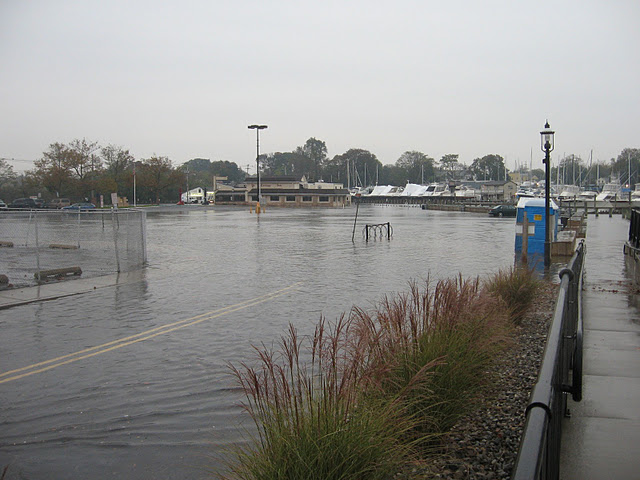
King tide shot at Keyport Harbor, October 27th. Credit: Mark Fedosh.

Looking further ahead at our warming world, one foot every twenty years is roughly the rate at which sea level rose as Earth emerged from the last ice age, mainly due to melting glaciers.  This provides our one observation of how sea level rises when our climate rapidly warms over a long period of time.  In my opinion, this rate of sea level rise is unlikely to occur yet, because the processes that cause such rapid ice melt take a long time to get fully underway, probably many more decades.  It is more likely that we will see a foot of sea level rise around about 2050.
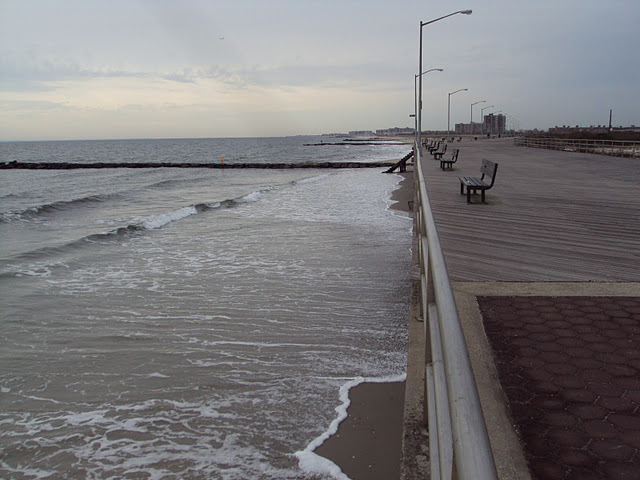
King tide at Rockaway Beach 36th Street, October 26th, 8:30am. Credit: Jill Weber, NYC Parks.

As shown above, this is a precarious situation for our area beaches, which already lack protection from storm surges that dunes would provide.  Unless property owners are willing (or required) to give up beachfront land, we are headed toward a time when finding a spot at the beach will mean laying out on the boardwalk.

Put another way, the king high tide was forecast to raise the water to 3.6 feet above the local average sea level, simulating what the average sea level may look like later this century — sea level is expected to rise around NYC by 1 to 4.5 feet by the 2080s. Here is a set of photos I took that show 3.6 feet of sea level rise from average sea level to king high tide:
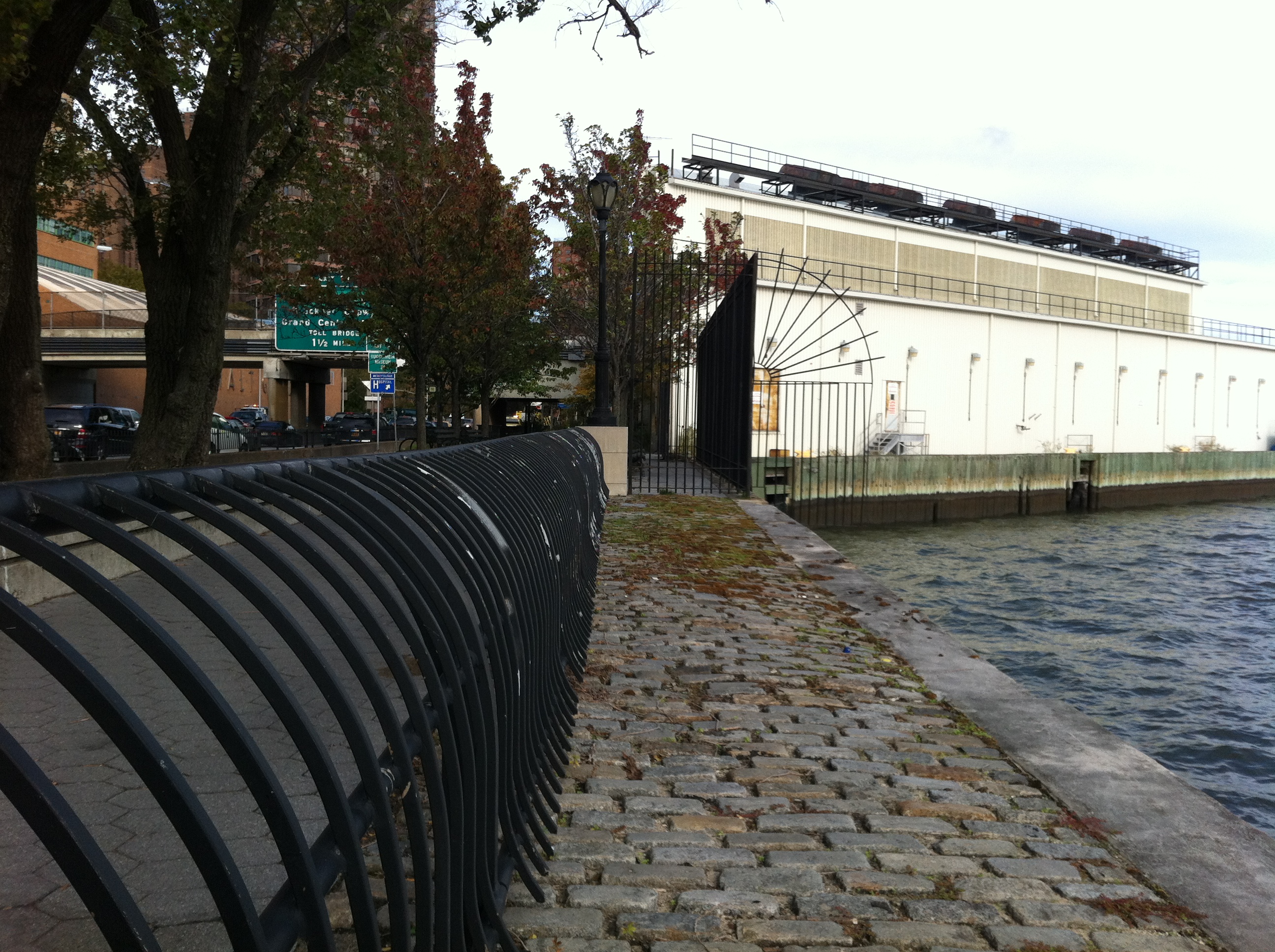
Average sea level at East River on the Upper East Side. The building is the 91st Street marine garbage transfer station, and FDR Drive is on the left.
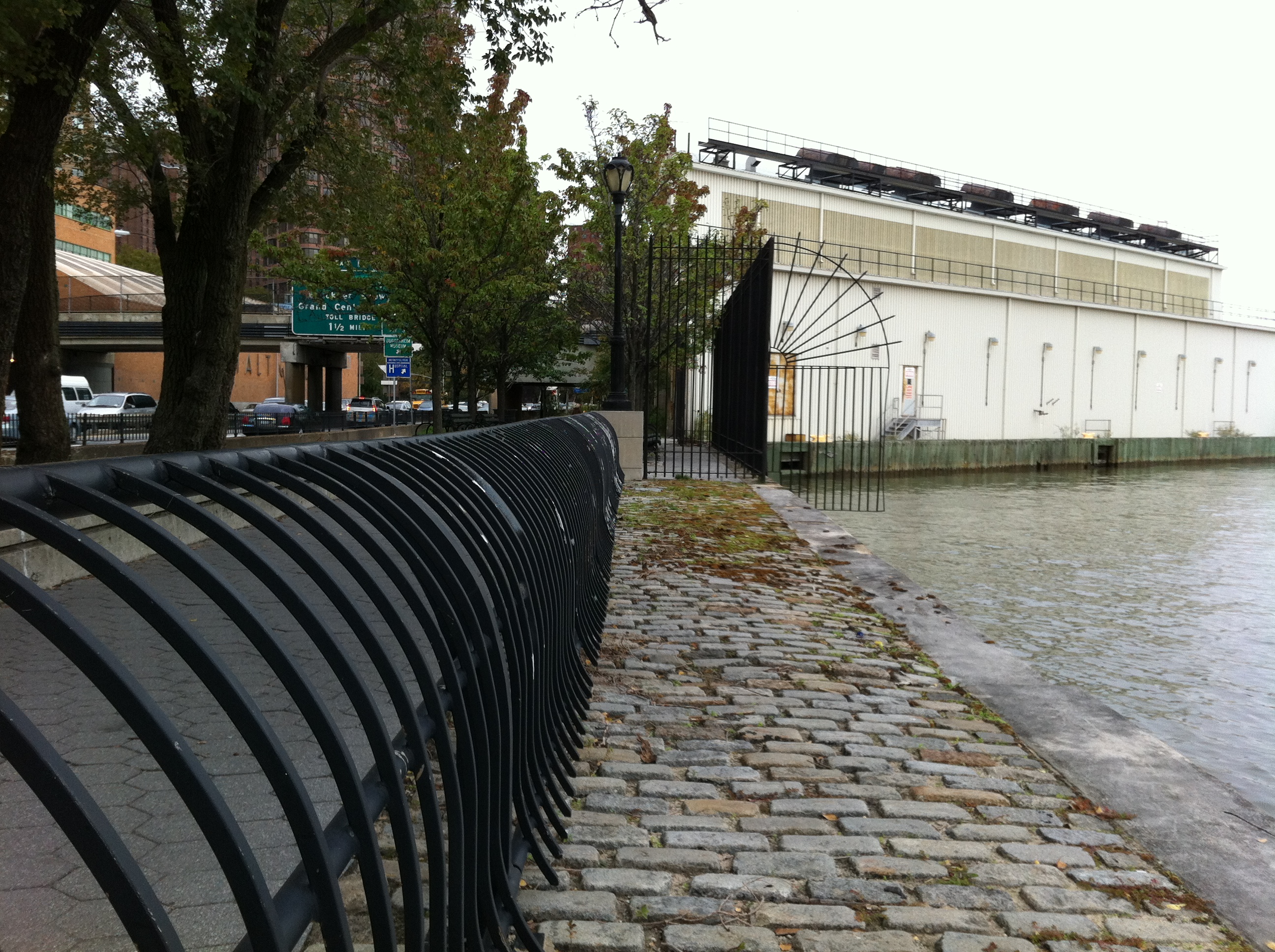
King Tide on East River on the Upper East Side, October 26th, 2011. This simulates what average sea level could be in the 2080s.

The simulated rise of 3.6 feet from today’s mean sea level to the 2080s mean sea level is compelling because a typical high tide adds another 3 feet on top of this, which would flood FDR drive, shown on the left side of the photos.  This situation could require a re-build of these low-lying parts of the highway system around New York City.  The planned new marine garbage transfer station will also need to be built a few feet higher to account for several decades of expected future sea level rise.

Many more pictures from all over the region are posted on a Google Map on the NY/NJ Harbor Estuary Program webpage.  I think this was a great group project, not only to show people how sea level rise will impact their local coastline, but also for connecting people who care about this issue.
Posted in climate, water | Tagged , , , , , , , , , | 1 Comment

King Tides and Sea Level Rise (and beachcombing!)

Extreme high waters occurred along East River during the landfall of (formerly) Hurricane Irene, about a 1-in-10 or 1-in-20 year sea level event. Similar high water levels are expected to occur much more frequently in future decades due to sea level rise. Water levels during this week's king high tide should be about 3 feet lower, as no storm surge is predicted to occur.

Some of the highest tides of the year are coming in the next two days, and an event is being organized to raise awareness of sea level rise.  Kate Boicourt at the New York / New Jersey Harbor Estuary Program Office is requesting that people email her at boicourt.kate@epamail.epa.gov to sign up and photograph the high tide water level at one of several locations around the region.

For NYC, the tidal height (without any wind-driven surge effects) will be about a foot higher than normal high tide levels, simulating what global warming induced sea level rise may bring about in about 20 years.  Or, put another way, the high tide will raise the water to 3.6 feet above local mean sea level, simulating what the mean sea level may look like later this century — while there is a lot of uncertainty, sea level is expected to rise around NYC by 1 to 4.5 feet by the 2080s.

As a result of the sun and moon “pulling” the oceans in unison (spring tide), and the moon’s pull* being unusually large due to its point on its orbit (perigee), the next two days will have large tidal ranges in the region’s waterways as the water levels undulate every 12.4 hours between unusual highs and lows.

Not only will the high tides reach higher than normal, but beachcombers may find it to be a very good time to visit beaches and mudflats to forage during unusually low water levels at low tide.

A useful place to select a site to photograph and get the times of high and low tides is from the tide prediction database at http://www.saltwatertides.com/ .  That site has many locations, but doesn’t include as much flexibility as I’d like, so for more details (but less locations), you can also look at the Storm Surge Warning System.  There, select a station and then set both the start and end dates to only the day of interest.

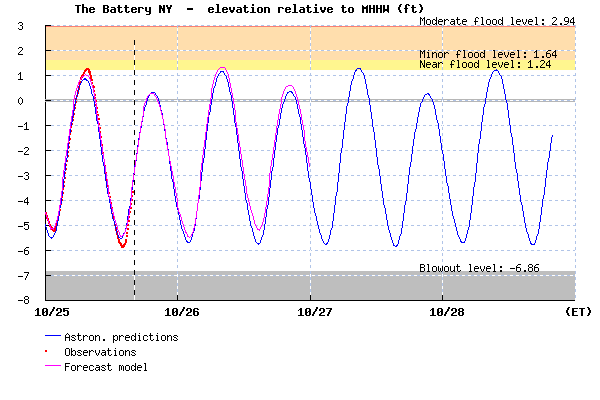
Tides, water level forecast and observations for Battery Park through Friday, relative to mean higher-high water (MHHW), the average daily high tide level.

Look at the “astronomical prediction”, which is simply the forecast tide.  The “forecast model” also shows you what to expect of the water elevation, combining the tides with the wind-driven surge (or blow-out).  So far the offshore forecast today is for northwest winds, and the water levels are heading lower than tidal predictions.  The forecast for tomorrow is for moderately strong southwest winds, which may continue this trend, but the departures from the high tide level predictions probably won’t be more than several inches.

One other request made by Kate is for accompanying photos of normal daily high tide levels, which are also available on SSWS if you choose the option “Datum” of mean higher-high water (MHHW).  Look at the time where you can expect MHHW to be crossed, and try to get a photo at that time for contrast (roughly 2 hours before or after high tide).

* Note – the gravitation of the moon doesn’t simply pull on the ocean to create a tide — it is strong enough that the Earth and moon rotate as a pair around a central point, and as a result there is a bulge of the ocean on both the same side as the moon AND the opposite side.

Posted in climate, water | Tagged , , , , , , , , , | 3 Comments

Fall Colors and The Urban Heat Island

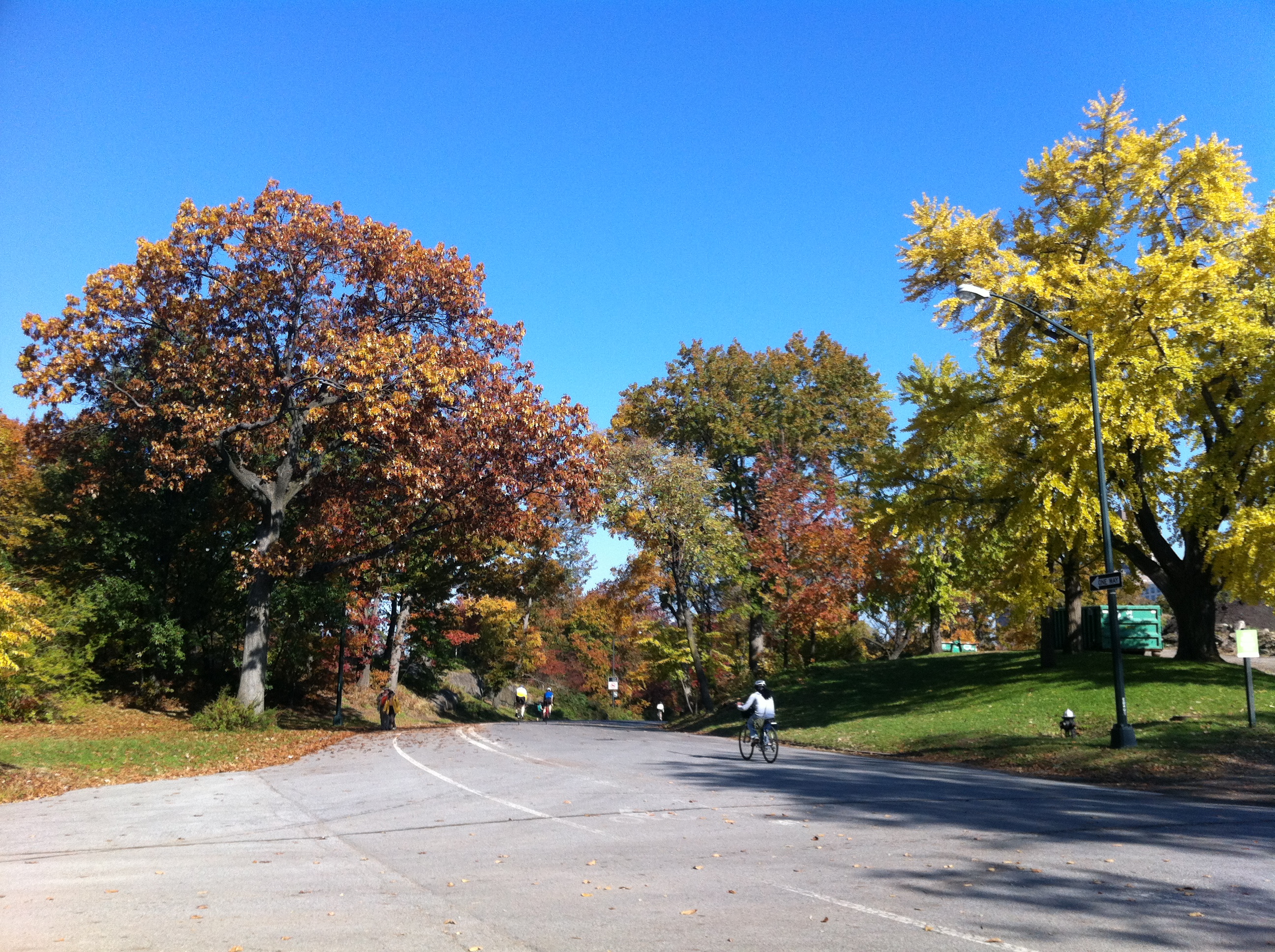
Fall colors in Central Park on Nov 5, 2011

One of my favorite things about living in New York City is checking out the fall colors on my bike commute through Central Park.  However, for subway commuters and tourists who don’t get to cruise through the park every day, this can be a tough thing to catch, because the leaves in the heart of the city don’t change color until roughly two weeks later in the season than nearby suburban and rural areas to the north and west.  A visitor consulting the Weather Channel’s maps, or other common resources, might be misled by the lack of detail focusing in on New York City.

Peak color in Central Park occurs between the last weeks of October and the last weeks of November, depending mainly on whether or not there are cold nighttime conditions.  An excellent resource is “How to enjoy autumn leaves in NYCs Central Park“.  That site includes phone numbers for checking on the current leaf colors.  The Central Park Conservancy webpage can also be a great resource.

So, why do the leaves change color later in NYC?  This is a question I’ve been looking into for fun, but also because it relates to our research on the Urban Heat Island and the city’s microclimates and the impact of the nearby ocean on city temperatures.  The atmospheric heat island keeps temperatures warmer overnight and is caused by the prevalence of paved surfaces instead of plants, as well as the reduction in wind speed and air movement caused by buildings.

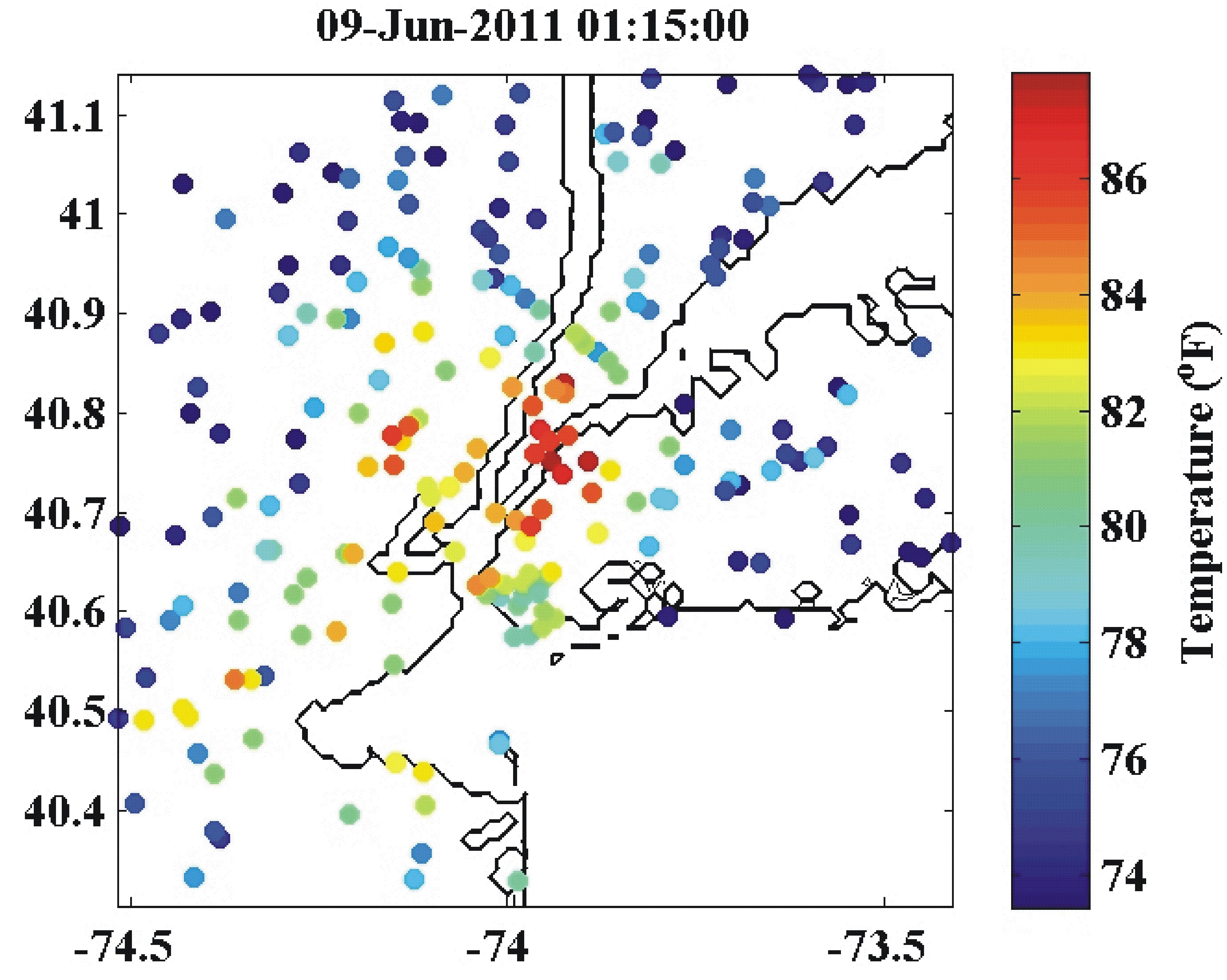
Leaves change color in response to having cold nights, which typically occur when there is little cloud cover.  Yet, in Manhattan, the heat island typically causes temperatures on clear nights to remain 5-10 degrees F warmer than rural areas outside the city:

Air temperature measurements at 1:15 AM during a recent heat wave. The 240 weather stations demonstrate how some neighborhoods around New York City were as much as 15 degrees warmer than rural areas. Data credits given below.  Also see a similar map for January.

This shows a map of temperature for one of our summer heat waves, not for fall season — I’ll be looking at the new data that comes in this fall, to see if the same large temperature difference exists on cold fall nights, but I suspect it will.  Of course, the heat island effect inside Central Park may be weaker than surrounding parts of the city, as it is full of greenery.  However, the evidence I have seen, including temperature data from Central Park (Belvedere Castle), suggest that the city’s heat overwhelms this localized effect — during our summer’s heat waves, Central Park’s nighttime low temperatures were only a degree or two cooler than the other interior urban sites.

So, this likely explains the long delay in color change we have here.  However, the ocean may also help explain the delay, particularly if you are looking for leaf changes along the Hudson River, Long Island Sound, or out on Long Island — the ocean can moderate nighttime temperatures, too.  But my hunch is that the difference for Central Park is due to the heat island.

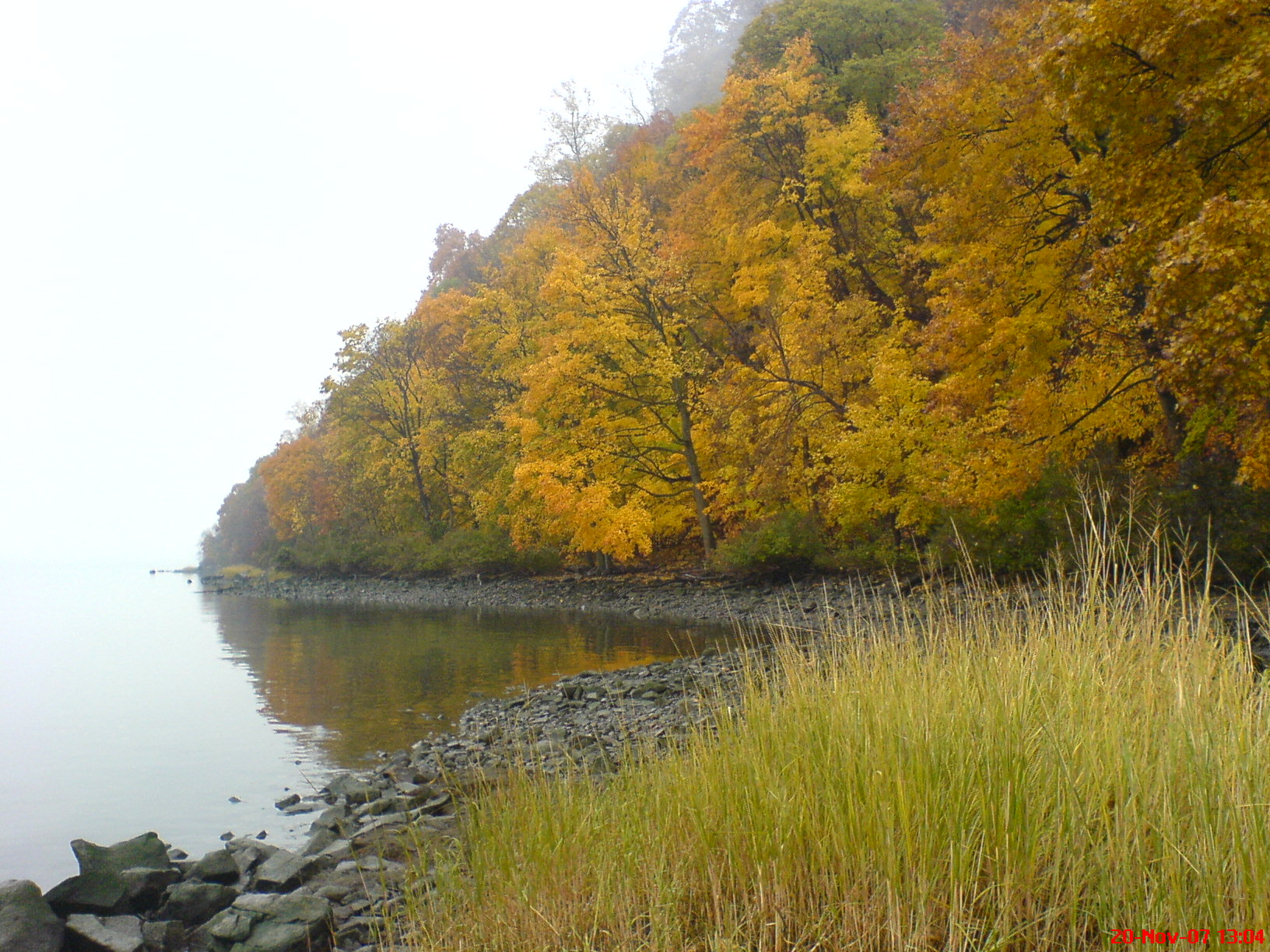
Photo taken along the western bank of the Hudson River, below Lamont-Doherty Earth Observatory at the NY/NJ State Line, on November 20th, 2007. 

[Temperature figure data credits:  NOAA (NOS-PORTS, NWS-ASOS, NWS-HADS, Urbanet), Rutgers NJ Weather and Climate Network, APRSWXNET, AWS Convergence Technologies, Inc. (WeatherBug), and Weatherflow, via Mark Arend (NYCMetNet).]

Posted in water, weather | Tagged , , , , , , , , , , , , , , , , , | 1 Comment

Ancient, Dusky Rivers

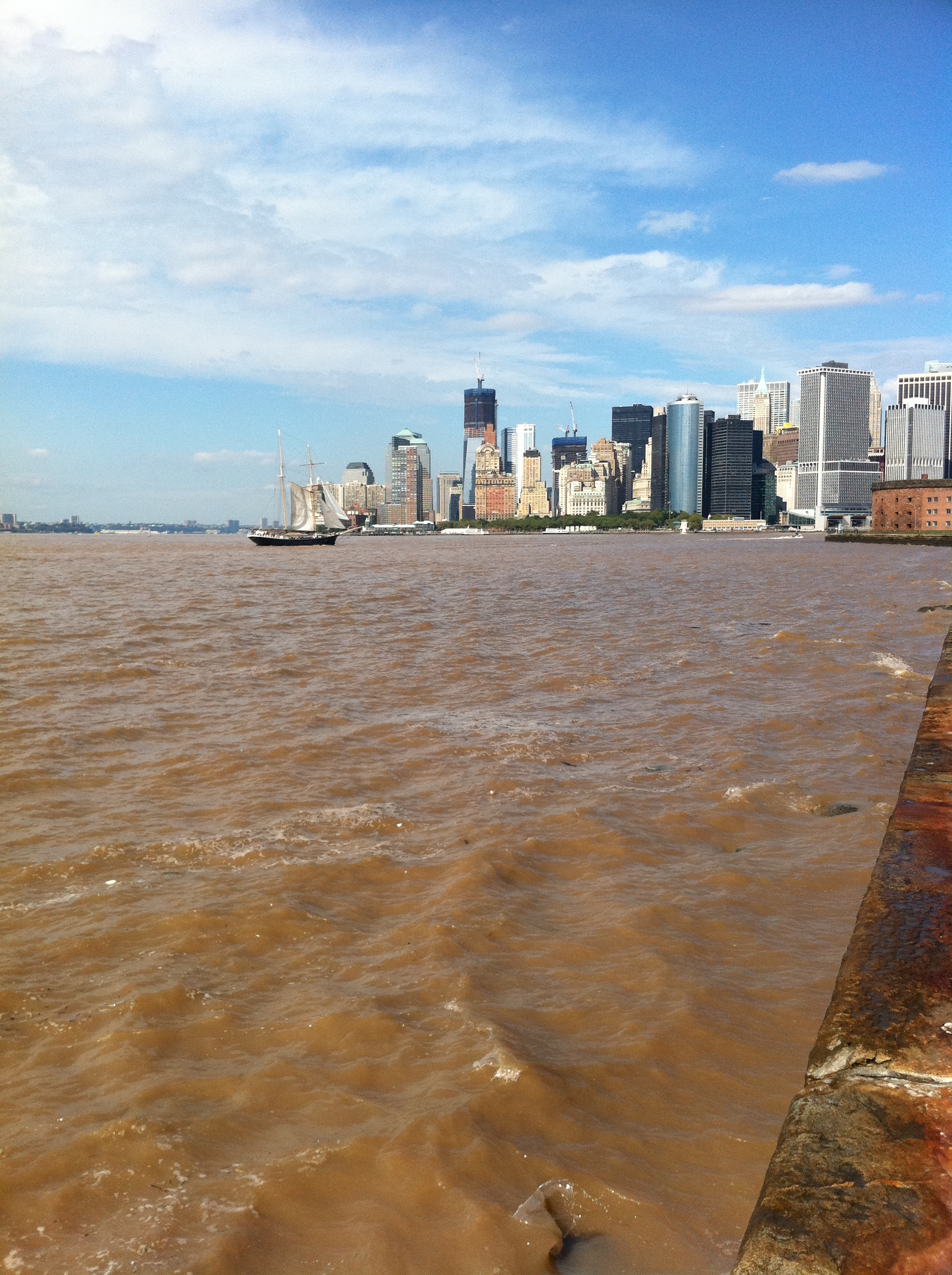
The view of muddy Upper New York Bay, toward the Hudson and Lower Manhattan, taken from Governor's Island

The muddy waters of the Hudson and other nearby rivers these past few weeks are a result of Hurricane Irene’s heavy rains and river flooding.  You generally see the Hudson get muddy from tropical storm floods or in springtime if there is heavy rain on top of melting mountain snow (the “freshet”), causing strong currents, entrainment of soils and river muds, mudslides, and eventually leading to a huge pulse of mud coming down the river.  Some of the coolest pictures are of the different waterways merging with their different shades of brown and black in a great post on the blog Wind Against Current.

It brings to mind one of my favorite poems, by a New Yorker of yesteryear:

THE NEGRO SPEAKS OF RIVERS

By Langston Hughes, 1920

I’ve known rivers:
I’ve known rivers ancient as the world and older than the flow of human blood in human veins.
My soul has grown deep like the rivers.

I bathed in the Euphrates when dawns were young.
I built my hut near the Congo and it lulled me to sleep.
I looked upon the Nile and raised the pyramids above it.
I heard the singing of the Mississippi when Abe Lincoln went down to New Orleans, and I’ve seen its muddy bosom turn all golden in the sunset.

I’ve known rivers:
Ancient, dusky rivers.
My soul has grown deep like the rivers.

… Some of the most profound words I’ve ever read, so sorry to change the subject back to dirt, but I’ll wrap up by saying that the region of the Hudson from mid-town Manhattan to George Washington Bridge often traps these sediment pulses, and is called the estuarine turbidity maximum.  The mud eventually settles to the river bed after the flood subsides, but then often gets re-suspended with the stronger spring tide currents that occur every two weeks.  The various brown and red river colors that have been observed in thousands of tweets apparently derive from different soil colors of regions of upstate New York.  Today is a spring tide, but look for the mud to settle out and water to return to a more normal, darker color by next weekend’s slow-moving neap tide.

Posted in poetry, water | Tagged , , , , , , , , , | 1 Comment

Irene Update, 1:00am Sunday: Goodnight Irene, Goodnight

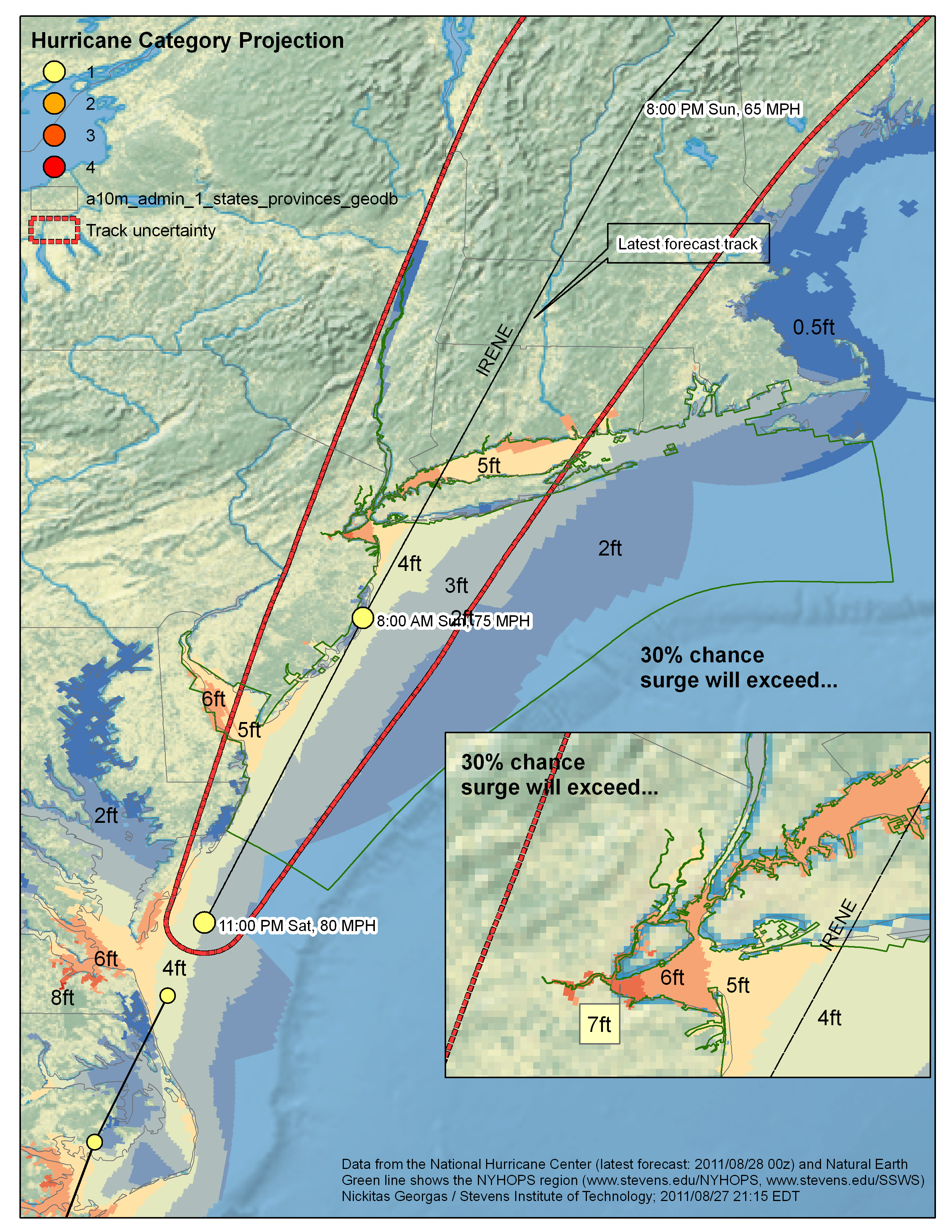
Irene’s eye and peak intensity are now about 9 hours away, and most of NYC is either sleeping or regretting that third 16 oz hurricane.  The latest National Hurricane Center forecast (11 pm) calls for the center of Irene to pass right along the New Jersey coast as a Category 1 Hurricane (75 mph winds) and make landfall around the eastern boroughs of NYC at about 10:00 AM on Sunday August 28th.  Fortunately, this is two hours after high tide at NYC’s coastal sites and The Battery.  However, due to large storm area with strong winds, the peak storm surge for NYC will still merge somewhat with the morning high tide, and this could add as much as 2.5 feet of water to the surge.

NHC forecast track for Hurricane Irene, including the storm surge heights that have a 33% likelihood of being exceeded (from NOAA's P-SURGE). Courtesy of Dr. Nickitas Georgas.

NOAA’s storm surge model (P-SURGE) is a useful system for hurricanes with uncertain storm track and winds — it uses many possible weather forecasts instead of just one for the forcing of its storm surge model, so gives a broader perspective than a single forecast.  P-SURGE results suggest a probability of a 4+ ft storm surge for New York City’s inland waterways are about 75%.  If added on top of the morning high tide, this water level will lead to overtopping of seawalls around the New York City inland waterways, and flooding of low-lying infrastructure (subways, PATH train, tunnels, FDR highway, etc.).  They list the probability of a more devastating 8+ foot surge at 5%, though higher around Staten Island and inside Raritan Bay.  This is in addition to expected heavy rainfall, which will merge with the storm surge some in low-lying areas.

The National Hurricane Center now maps the chances of the NYC area getting very dangerous 58+ mph steady winds at about 55%, and the chances of having extreme, hurricane force (74+ mph) winds 10%.  (However, at this point, you might simply peer through your taped-up windows to examine to how fast the flying objects are actually moving.)  Winds on high-rise structures are going to be stronger — here’s a quote from the latest NHC forecast discussion:

MORE SO THAN WITH MOST STORMS…THE WINDS WITH IRENE INCREASE SHARPLY WITH HEIGHT ABOVE THE SURFACE.  AS IRENE MOVES THROUGH AREAS WITH HIGH-RISE STRUCTURES…THESE STRUCTURES WILL EXPERIENCE WINDS SIGNIFICANTLY STRONGER THAN INDICATED BY THE ADVISORY INTENSITY.  WINDS AT THE 30-STORY LEVEL WILL LIKELY BE 20 PERCENT HIGHER THAN AT THE SURFACE…AND WINDS 80-100 STORIES UP COULD BE ABOUT 30 PERCENT HIGHER THAN AT THE SURFACE.

Posted in water, weather | Tagged , , , , , , , , , , , , | Comments Off on Irene Update, 1:00am Sunday: Goodnight Irene, Goodnight

Irene Update: 8am Saturday – 24 Hours Away [4pm update]

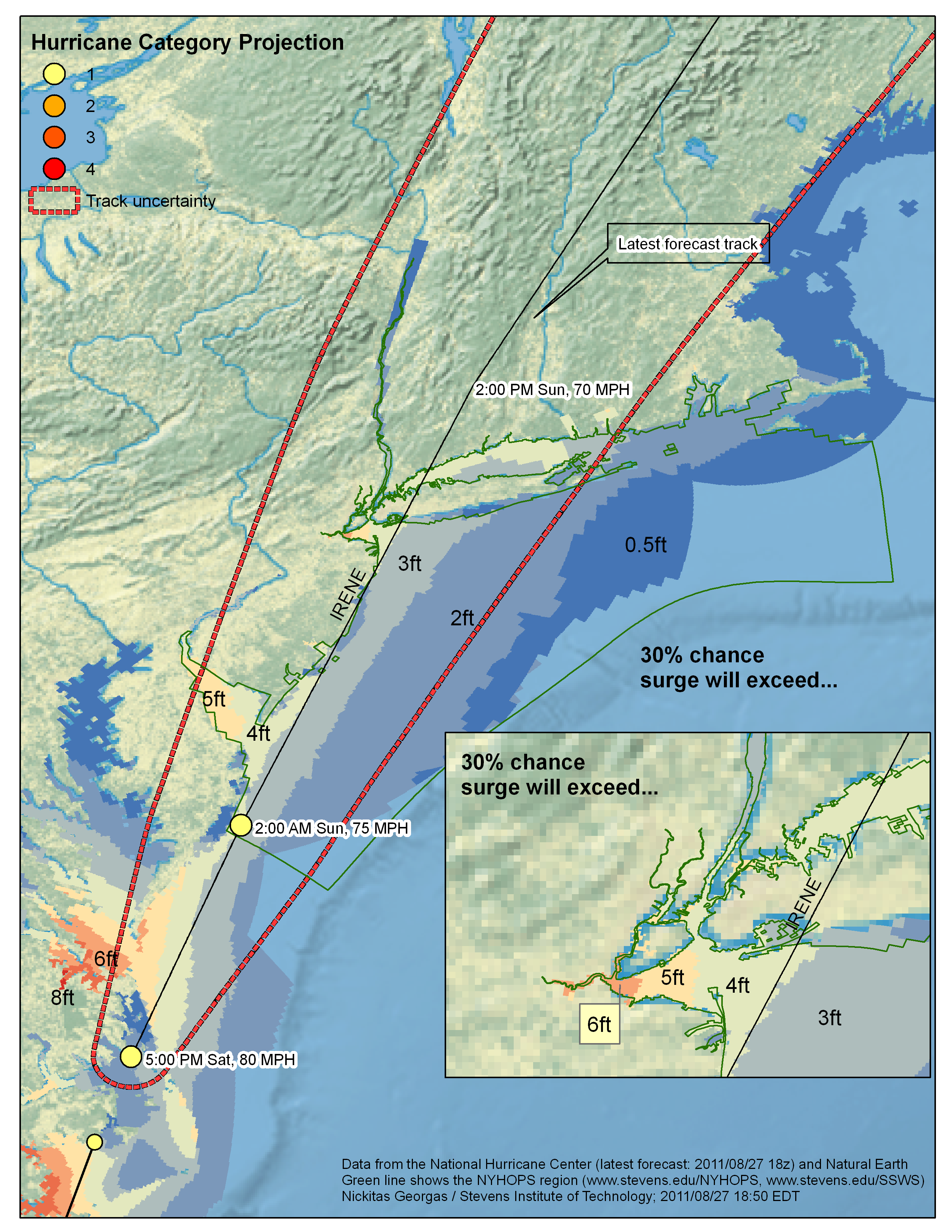
Hurricane Irene’s eye and peak intensity are now about 17 hours away, though the storm is already impacting our weather.  The latest National Hurricane Center forecast (2pm) calls for the center of Irene to pass right along the New Jersey coast as a Category 1 Hurricane (80 mph winds) and make landfall around the eastern boroughs of NYC at about 9 AM on Sunday August 28th.  The storm track and timing of arrival in our area is becoming increasingly certain.  Due to the expected time of landfall, the peak storm surge for NYC should arrive in many places with the morning high tide, which will add about 2.5 feet of water to the surge.

NHC forecast track for Hurricane Irene, including the storm surge heights that have a 33% likelihood of being exceeded (from NOAA's P-SURGE). Our Storm Surge Warning System (SSWS) domain is also superimposed with a green border. Both prediction models are discussed below. Courtesy of Dr. Nickitas Georgas.

The National Hurricane Center now maps the chances of the NYC area getting very dangerous 58+ mph steady winds at about 40%, and the chances of having extreme, hurricane force (74+ mph) winds 5-10%. Winds on high-rise structures are going to be stronger — here’s a quote from the latest NHC forecast discussion:

MORE SO THAN WITH MOST STORMS…THE WINDS WITH IRENE INCREASE SHARPLY WITH HEIGHT ABOVE THE SURFACE.  AS IRENE MOVES THROUGH AREAS WITH HIGH-RISE STRUCTURES…THESE STRUCTURES WILL EXPERIENCE WINDS SIGNIFICANTLY STRONGER THAN INDICATED BY THE ADVISORY INTENSITY.  WINDS AT THE 30-STORY LEVEL WILL LIKELY BE 20 PERCENT HIGHER THAN AT THE SURFACE…AND WINDS 80-100 STORIES UP COULD BE ABOUT 30 PERCENT HIGHER THAN AT THE SURFACE.

The storm’s winds, coupled with expected heavy rainfall and a possible high storm surge, are likely to create a very dangerous situation, so people are urged to consult the webpages of the National Weather Service and local Offices of Emergency Management (NJ, NYC, Nassau and Suffolk counties), which have begun evacuating some low lying areas and have instructions on how to make preparations for the storm.  NYC evacuation zone maps are also posted here.

NOAA’s storm surge model (P-SURGE) is a useful system for hurricanes with uncertain storm track and winds — it uses many possible weather forecasts instead of just one for the forcing of its storm surge model, so gives a broader perspective than a single forecast.  P-SURGE results suggest the probability of a 4 foot or greater storm surge for most of New York City’s inland waterways are about 50% [on the rise].  If added on top of the morning high tide, this water level could lead to overtopping of seawalls around the New York City inland waterways, and flooding of low-lying infrastructure (subways, PATH train, tunnels, FDR highway, etc.).  They list the probability of a more devastating 8+ foot surge at 5-10%.  This is in addition to expected heavy rainfall, which will merge with the storm surge some in low-lying areas.

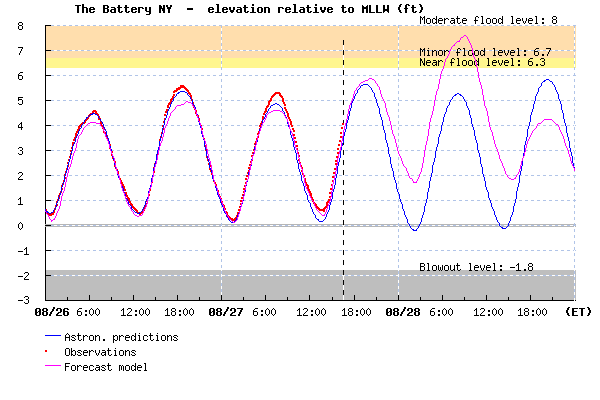
Stevens Institute’s two-day advance forecasts of storm surge, as well as waves and currents for NYC, NJ, and Long Island waterways show a small storm surge of only 2 to 4 feet, but occurring at high tide in the morning.  This is based on a single wind forecast, so it does not represent the conservative worst-case scenario for New York City area flooding — it is more of a median scenario.

Predicted Tide (blue), observations (red dots) and the SSWS water level forecast (magenta) at The Battery, New York City, for Friday through Sunday August 26-28. MLLW is the mean of typical low tide levels.

The Stevens Institute’s Storm Surge Warning System (SSWS) has been demonstrated to provide highly accurate storm surge and wave predictions throughout New York Bight and its inland waterways, with mean water level errors of ~0.10 m since June 2006, a period that includes extra-tropical storm Ernesto in early September 2006.  SSWS has not been tested under tropical storm or hurricane conditions, so I recommend focusing on the storm surge predictions of NOAA’s P-SURGE forecasting system to have a broader viewpoint.  The tides themselves are much more predictable, and a benefit below is that you can see the times of high tide and get the perspective that the tidal range (5-6 feet) is as important as the storm surge (likely between 2 and 8 ft).

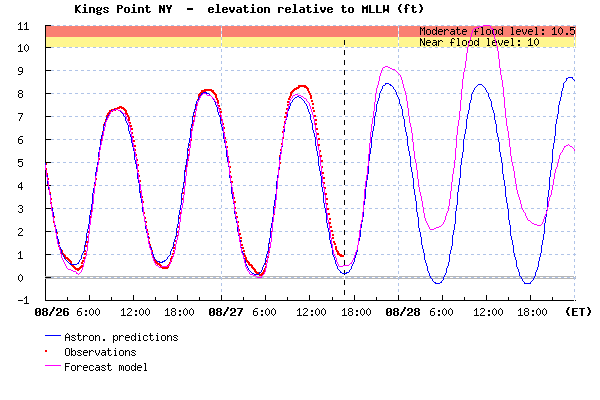
The prediction for western Long Island Sound, where water levels impact South Bronx and Queens, is for a higher storm surge of nearly 4 ft.  Note that high tide arrives about 3 hours later in western Long Island Sound, versus The Battery, the ocean beaches, and most other parts of NYC.  East River is also complicated — in spite of its extremely strong (and likely dangerous) currents, high tide progresses slowly up the East River from The Battery (8:06 AM) to Manhattan’s 90th Street (10:00 AM), and Hell Gate (Randall’s Island), which is similar to Kings Point.

Predicted Tide (blue), observations (red dots) and the SSWS water level forecast (magenta) at Kings Point, in western Long Island Sound, for Friday through Sunday August 26-28. MLLW is the mean of typical low tide levels. Consult http://stevens.edu/ssws for predictions at other locations.

Note that area beaches will have somewhat higher water levels due to the very large waves accompanying the storm, which lead to (a) periodic wave run-up and (b) piling up of average water levels due to wave breaking – called wave set-up.

Posted in water, weather | Tagged , , , , , , , , , , , , | 1 Comment

Irene Update: Friday 6pm, Glimmers of Good News

[a more recent forecast followed this one – go to the front page SeaAndSkyNY.com and scroll down to find the latest update]

There is finally a forecast with some good news to share regarding Hurricane Irene.  Today, Irene weakened a little more than was previously expected, and the latest forecast shows a storm that continues weakening.  The latest National Hurricane Center forecast (5 pm) calls for the center of Irene to pass very close to the Jersey shore as a weaker Category 1 Hurricane (75 mph winds) and make landfall around the eastern side of NYC at about 10 AM on Sunday August 28th.  The forecast at nearly two days lead time is still highly uncertain, with individual model predictions ranging from landfall at the Pennsylvania border to Cape Cod.

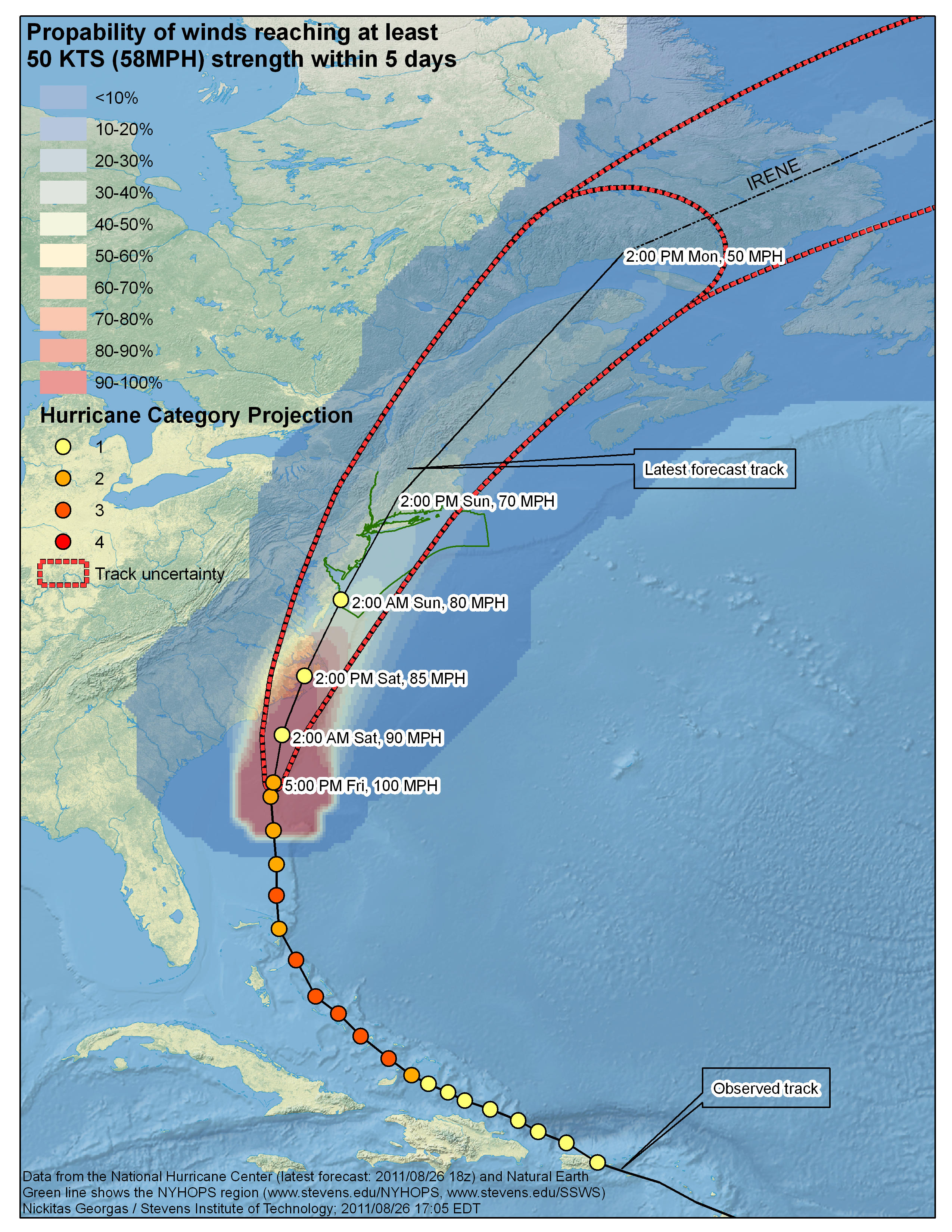
NHC forecast track for Hurricane Irene, including probabilities of dangerous 58 mph steady winds. Our NYHOPS/SSWS domain is superimposed with a green border. Courtesy of Dr. Nickitas Georgas.

We can now say almost definitively that this will not be a storm like that of 1821, as it is definitely weaker.  That storm was Cat-5 when it went over the Outer Banks, and I believe a Cat-3 at Cape May.  While it has a similar track, it is definitely going to be weaker, as significant strengthening is unlikely from here over cooler waters.

NHC now lists the chances of NYC getting very dangerous 58+ mph steady winds at about 20%, and the chances of having hurricane force (74+ mph) winds BELOW 5%.  However, the deadliest part of a hurricane is typically its storm surge, and even if the eye doesn’t hit NYC, we could still see our worst storm surge in over 100 years.

NOAA’s storm surge model (P-SURGE) is providing useful information in their 3 day forecast for our area, listing the probability of a 4 foot or greater storm surge at only about 20%.  Depending on the timing with high or low tide, this water level could lead to overtopping of seawalls around the New York City inland waterways, and flooding of low-lying infrastructure (subways, PATH train, tunnels, FDR highway, etc.).  They list the probability of a devastating 8+ foot surge at 5-10%.  Stevens Institute’s two-day advance forecasts of storm surge, as well as waves and currents for NYC, NJ, Long Island waterways, are posted at about 1:30 AM daily, so look for them Saturday morning to give highly detailed forecasts for Irene’s Sunday impacts.

The passage of Irene at 10 AM on the 28th is two hours after a moderately high tide (8:00 AM), but not the higher evening tide that was feared, so things could be worse.

Predicted Tide (blue), observations (red dots) and SSWS water elevation forecast (magenta) at The Battery, New York City, for Saturday and Sunday August 26-28. High tides along Long Island are at a similar time, and along the Jersey Shore are about one hour earlier.

The National Weather Service and local Offices of Emergency Management (NJ, NYC, Nassau and Suffolk counties) have begun evacuating some low lying areas and are urging people to begin to make preparations for the storm.  Their websites also have useful information on hurricane preparation.

Posted in water, weather | Tagged , , , , , , , , , , , , | Comments Off on Irene Update: Friday 6pm, Glimmers of Good News

Irene Forecast: 7am Friday

[a more recent forecast followed this one – go straight to SeaAndSkyNY.com and scroll down to find the latest update]

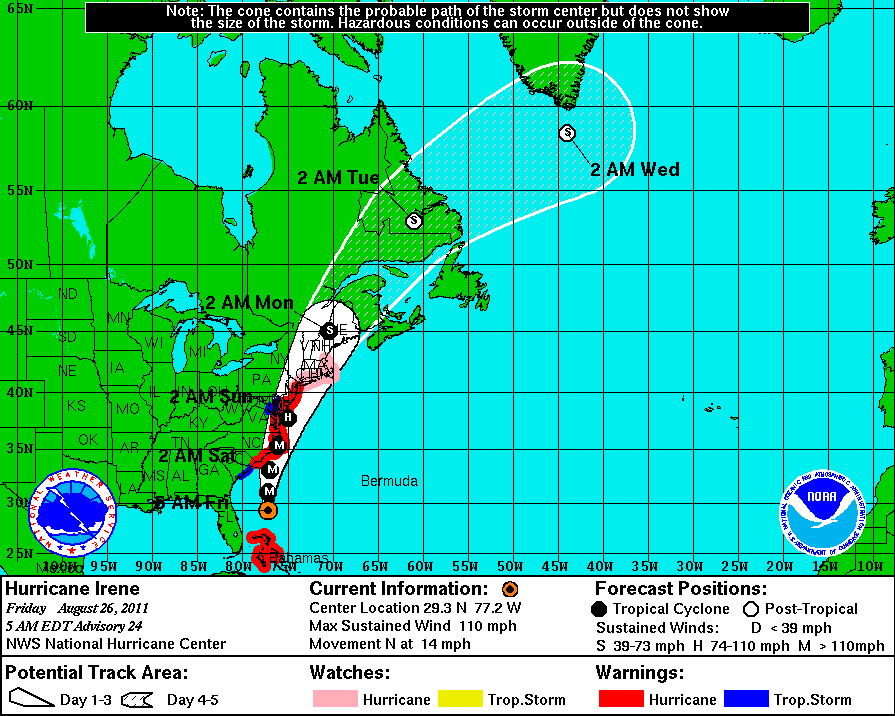
This morning, the Hurricane Irene forecast from the National Hurricane Center has held fairly steady, with little good news for New York and New Jersey interests.  Irene is currently forecast (as of 5 am) to pass just to the east of NYC as a strong Category 1 Hurricane on Sunday August 28th.  As before, the forecast at two and a half days lead time is still highly uncertain — one model still predicts it going over Washington D.C. and northward, and two models (of eight) predict it going far offshore, well to the east of Long Island.  But the worst case scenario was spelled out in a recent post, comparing the storm to a hurricane that hit NYC in 1821.

NHC now lists the chances of NYC getting very dangerous 58+ mph steady winds at about 25%, and the chances of having hurricane force (74+ mph) winds in NYC at 5-10%.  However, the deadliest part of a hurricane is typically its storm surge, and even if the eye doesn’t hit NYC, we could see our worst storm surge in over 100 years.

NOAA’s storm surge model (P-SURGE) is providing useful information in their 3 day forecast for our area, listing the probability of a 4+ foot storm surge at 10-20%.  Depending on the timing with high or low tide, this water level could lead to overtopping of seawalls around the New York City inland waterways, and flooding of low-lying infrastructure (subways, PATH train, tunnels, FDR highway, etc.).  They list the probability of a devastating 8+ foot surge below 5% (lowered, so an improvement).  Stevens Institute’s two-day advance forecasts of storm surge, as well as waves and currents for NYC, NJ, Long Island waterways, are posted at about 1:30 AM daily, so look for them Saturday morning to give highly detailed forecasts for Irene’s Sunday impacts.

The timing of the passage of Irene, during a new moon (Aug 29) at perigee (Aug 30), means that the spring tide range on Sunday will be one of the highest of the year.  Presently, the Hurricane is forecast to approach the southern NJ coast early Sunday morning, and arriving around NYC at an intermediate or high tide (5 pm or 8 pm).

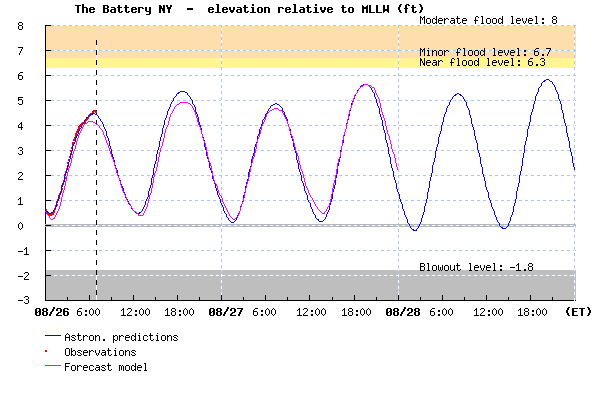
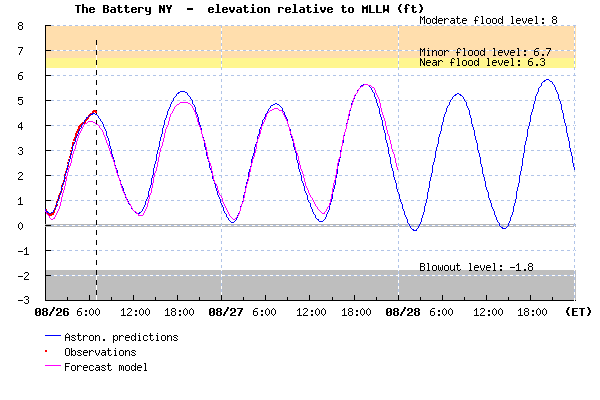
Predicted Tide (blue), observations (red dots) and storm surge forecast (magenta) at The Battery, New York City, for Saturday and Sunday August 26-28. High tides along Long Island are at a similar time, and along the Jersey Shore are about one hour earlier.

Keep your fingers crossed — the exact track of the hurricane can vary by 200 miles beyond the 24 hour forecast.  However, this is a large hurricane that will broadly impact the entire region.  The National Hurricane Center and media warnings do not always adequately warn the public about the importance of the size of such large storms.  The National Weather Service and local Offices of Emergency Management (NJ, NYC, Nassau and Suffolk counties) have begun evacuating some low lying areas and are urging people to begin to make preparations for the storm.

Tom Herrington and Nickitas Georgas also contributed to this post.

Posted in water, weather | Tagged , , , , , , , , , , , , | Comments Off on Irene Forecast: 7am Friday

NYC Storm Surge Evacuation Map PDF

The NYC Office of Emergency Management website is bogged down a bit already and warns of possible slowdowns.  Here’s a re-post of the hurricane storm surge flooding evacuation map, to help get it out there.  Mayor Bloomberg plans to make evacuation zone announcements early Saturday.  Read the map — it gives useful info about each evacuation zone.  The OEM website and the paper map version that the city sent out to people in the zones also give more details, such as whether or not people in high rises in an evacuation area are still are expected to evacuate (yes).

hurricane_map_english

[Sept 23rd, 2011: I’ve broken the link, so people go to NYC-OEM link above to get the most up-to-date maps.]

Keep tuned in for the latest storm surge and hurricane forecast updates — the last one is linked here.

Posted in security, water, weather | Tagged , , , , , , , , , , , , , , , | Comments Off on NYC Storm Surge Evacuation Map PDF

Irene forecast: 11pm Thursday

[a more recent forecast followed this one – go straight to SeaAndSkyNY.com and scroll down to find the latest update]

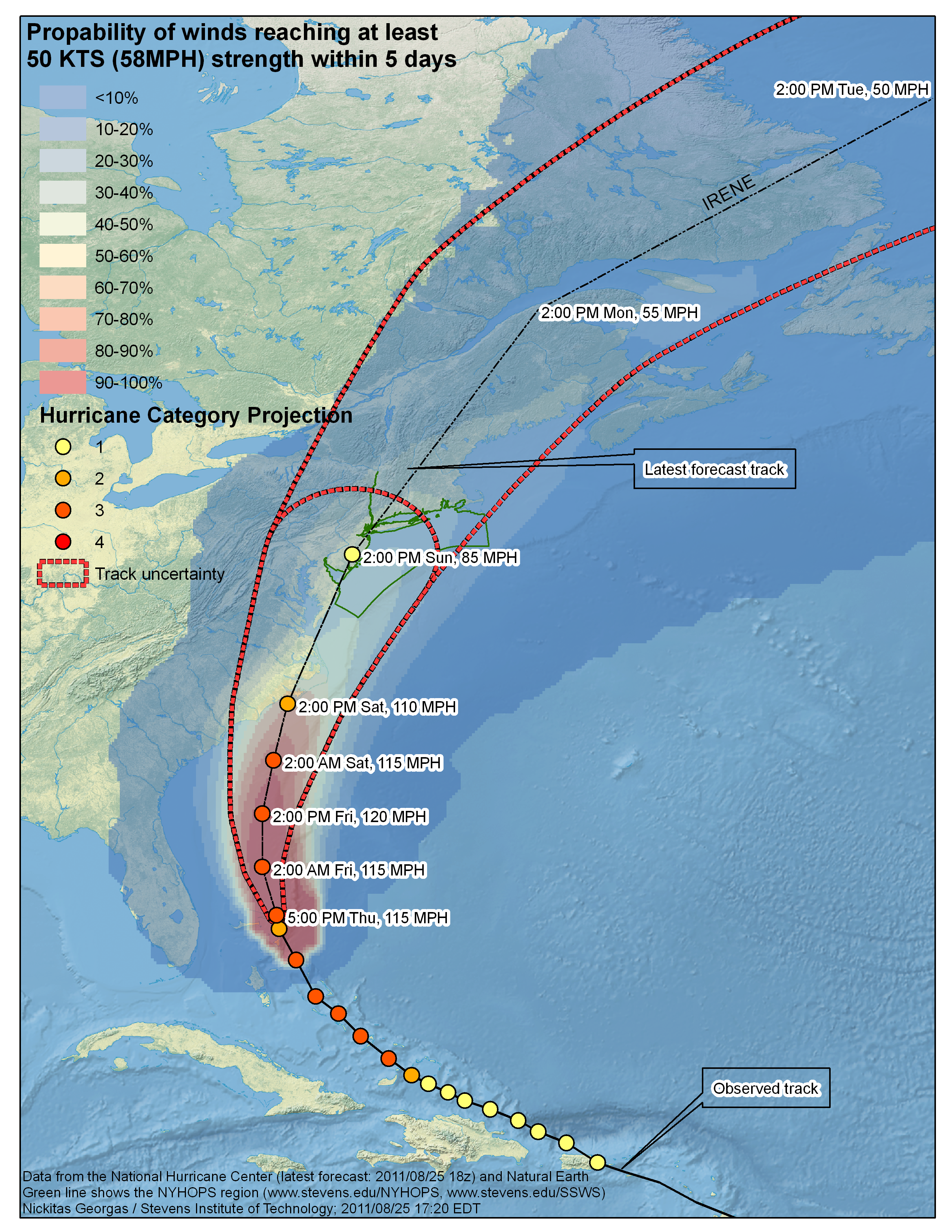
This evening, the Hurricane Irene forecast from the National Hurricane Center has held fairly steady, with little good news for New York and New Jersey interests.  Irene is currently forecast to pass right along the NJ coast and across New York City as a strong Category 1 Hurricane on Sunday August 28th.  As before, the forecast at two and a half days lead time is still highly uncertain — one model predicts it going over Washington D.C. and northward, and two models (of eight) predict it going far offshore, east of Long Island.  But the worst case scenario was spelled out in a recent post, comparing the storm to a hurricane that hit NYC in 1821.

NHC forecast track for Hurricane Irene, including probabilities of dangerous 58 mph steady winds. Our NYHOPS/SSWS domain is superimposed with a green border. Courtesy of Dr. Nickitas Georgas.

The chances of NYC getting very dangerous 58+ mph steady winds are about 25% (see above), and the chances of having hurricane force (74+ mph) winds in NYC are 5-10%.  However, the deadliest part of a hurricane is typically its storm surge, and even if the eye doesn’t hit NYC, we could see our worst storm surge in over 100 years.

NOAA’s storm surge model (P-SURGE) is providing useful information in their 3 day forecast for our area, listing the probability of a 4+ foot storm surge at 10-20%, and an 8+ foot surge at 5-10%.  Depending on the timing with high or low tide, this water level could lead to overtopping of seawalls around the New York City inland waterways, and flooding of low-lying infrastructure (subways, PATH train, tunnels, FDR highway, etc.).  Stevens Institute’s two-day advance forecasts of storm surge, as well as waves and currents for NYC, NJ, Long Island waterways, are posted at about 1:30 AM daily, so look for them Saturday morning to give highly detailed forecasts for Irene’s impacts.

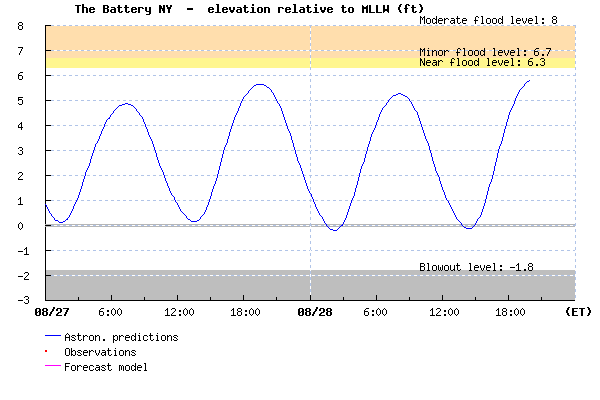
The timing of the passage of Irene, during a new moon (Aug 29) at perigee (Aug 30), means that the spring tide range on Sunday will be one of the highest of the year.  Presently, the Hurricane is forecast to approach the southern NJ coast early Sunday morning, and arriving around NYC at an intermediate tide (5 pm).

Predicted Tide (NOT including storm surge) at The Battery, New York City, for Saturday and Sunday August 27-28. High tides along Long Island are at a similar time, and along the Jersey Shore are about one hour earlier.

Keep your fingers crossed — the exact track of the hurricane can vary by 200 miles beyond the 24 hour forecast.  However, this is a large hurricane that will broadly impact the entire region.  The National Weather Service and local Offices of Emergency Management (NJ, NYC, Nassau and Suffolk counties) are now urging people to begin to make preparations for the storm.  For the most current storm guidance, watches and warnings go to the NOAA Tropical Prediction Center: http://www.nhc.noaa.gov/index.shtml

Tom Herrington and Nickitas Georgas also contributed to this post.

Posted in water, weather | Tagged , , , , , , , , , , , , | Comments Off on Irene forecast: 11pm Thursday